


Days before he was killed in an Israeli strike, senior Iranian official Ali Larijani warned the United States and Israel that targeting Iran's leadership would not weaken the country but instead strengthen its resolve.
He cautioned that Iran would retaliate forcefully, adding that any attempt to destabilise its leadership would only unify the nation and intensify its response.
A loud explosion was reported in central Beirut after Israeli forces struck a building in the Bachoura area, shortly after issuing a forced evacuation warning, according to media reports.
The attack followed earlier strikes in the city's core that killed at least six people and injured 24 in residential areas, marking a continued escalation in urban targeting.
Qatar's armed forces intercepted a missile targeting the country, its Ministry of Defence confirmed, amid a fresh wave of overnight attacks across the Gulf. Multiple countries reported missile and drone activity, underscoring the widening security threat as the conflict spills across key strategic zones.
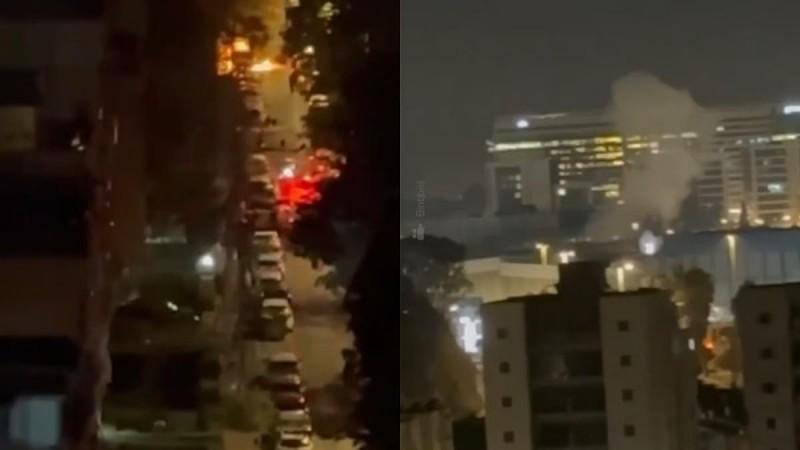
A video circulating online captured chaotic scenes in south Tel Aviv following an Iranian ballistic missile strike involving cluster munitions. Emergency vehicles were seen rushing through smoke-filled streets, with fires burning at multiple impact sites.
Israeli medics confirmed two deaths near Ramat Gan, while key infrastructure, including the Savidor Central railway station, sustained damage—marking a sharp escalation in the conflict.
Explosions were also reported across central Israel's Gush Dan region after Iran launched a fresh wave of missile attacks, according to local media. Air raid sirens were triggered, and Israeli defence systems intercepted at least one missile. However, fragments from a cluster-type warhead struck parts of the region.
In Holon, several vehicles were damaged, with some catching fire following the impact. No immediate casualties were reported.
Saudi Arabia is set to host a consultative meeting of foreign ministers from several Arab and Islamic nations in Riyadh on Wednesday evening amid rising regional tensions. According to the foreign ministry, discussions will focus on coordination efforts and measures to strengthen security and stability.
CHAOS IN SOUTH TEL AVIV — DIRECT IRANIAN MISSILE IMPACT, RESCUE TEAMS RUSH IN https://t.co/oayCfaMQiR pic.twitter.com/WwAoRXi5WO
— RT (@RT_com) March 18, 2026
At least six people were killed and 24 injured after Israeli airstrikes hit central Beirut early Wednesday, marking a sharp escalation in the widening conflict. Lebanon's health ministry said the toll is preliminary, with some victims yet to be identified due to severe damage.
The strikes targeted residential areas in the city's core—far beyond previously hit southern suburbs—raising alarm over the expanding scope of Israeli operations. The attack comes amid intensifying clashes with Iran-backed Hezbollah, as civilian casualties continue to rise across Lebanon.
The Israel–Iran conflict has now entered a dangerous new phase, expanding into a multi-front war with growing regional and humanitarian consequences. What began as coordinated strikes has escalated into sustained military exchanges involving multiple countries and armed groups, raising fears of a prolonged crisis across West Asia.
A key escalation came with Israel confirming the targeted killings of senior Iranian figures Ali Larijani and Gholam Reza Soleimani in precision overnight strikes. Both were central to Iran's security establishment, and their deaths signal a shift in Israel's strategy toward directly targeting Tehran's leadership network.
Iran responded with waves of missile and drone attacks targeting Israeli cities and critical infrastructure across the Gulf. The deployment of multi-warhead missiles suggests an attempt to overwhelm air defence systems and inflict maximum damage.
The conflict is increasingly drawing in neighbouring regions. Israeli strikes have hit central Beirut, while Hezbollah has intensified rocket attacks into northern Israel. In Baghdad, a drone strike on the US Embassy compound caused fires, highlighting risks to American assets. Saudi Arabia also intercepted a ballistic missile near a base hosting US troops, underscoring the widening geographical spread.
As hostilities deepen, the humanitarian crisis is worsening. Thousands have been killed or injured, and more than a million people—especially in Lebanon—have been displaced. Healthcare systems are under severe strain, and access to essential services is rapidly declining.
Concerns over nuclear safety have also emerged following reports of a projectile hitting Iran's Bushehr nuclear complex, though no significant damage has been confirmed so far.



![PM Modi's 2025 in frames: From Op Sindoor to Ram Mandir Dhwajarohan [Photos]](https://data1.ibtimes.co.in/en/full/826532/pm-modis-2025-frames-op-sindoor-ram-mandir-dhwajarohan-photos.jpg?w=220&h=138)



![PM Modi's 2025 in frames: From Op Sindoor to Ram Mandir Dhwajarohan [Photos]](https://data1.ibtimes.co.in/en/full/826532/pm-modis-2025-frames-op-sindoor-ram-mandir-dhwajarohan-photos.jpg?w=220&h=135)