

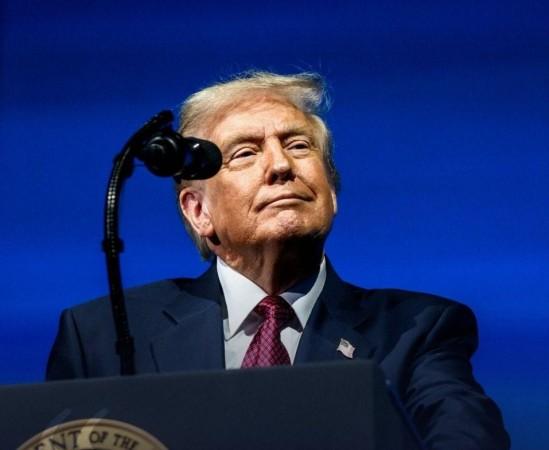
US President Donald Trump has signed the Whole Milk for Healthy Kids Act into law, reversing long-standing school nutrition rules and restoring whole milk to cafeterias across the United States. The signing, which Trump described as the first bill of the new year, marks a significant shift in federal nutrition and trade policy.
Speaking at the White House on Wednesday (local time), Trump said the law would ensure that "millions of school-aged children have access to high-quality milk" while also supporting dairy farmers who have lobbied for the change for years.
Under previous rules, schools participating in the National School Lunch Program were limited to offering low-fat or nonfat milk. "With this legislation, schools will finally be able to expand their offerings to include nutritious whole milk," Trump said.
The law also removes the requirement for parents to provide a doctor's written note to request milk substitutes for children with dairy intolerance. Calling the earlier rule "rather ridiculous," Trump said parents—not the government—should decide what is best for their children.
Agriculture Secretary Brooke Rollins said implementation would move quickly, with the US Department of Agriculture issuing guidance immediately and beginning rulemaking at once. "It should just take a few weeks, and then the milk starts moving in," she said.
Rollins noted that dairy farmers from across the country—ranging from small family farms to large operations—attended the signing. She said the law aligns with a broader push to strengthen rural America, citing higher dairy exports and expanded market access.
Health and Human Services Secretary Robert F. Kennedy Jr. said the legislation corrects years of flawed nutrition policy. "For years, Washington treated fat, especially saturated fat, as the enemy," he said. "Science has never shown that whole milk harms children."
Kennedy added that milk consumption fell sharply after whole milk was removed from schools more than a decade ago, with many children turning instead to sugary and caffeinated beverages. "Removing whole milk did not improve health; it damaged it," he said.
Housing and Urban Development Secretary Ben Carson, a former neurosurgeon, also backed the move, saying whole milk supports brain development and physical growth. "Whole milk is a wonderful beverage—especially for the brain," he said.
Democratic Senator Peter Welch of Vermont and several Republican lawmakers said the earlier policy hurt milk consumption and rural economies. Parents and farmers at the ceremony said many students rejected skim milk at school and opted for sweetened drinks instead.
Under the new law, schools will be allowed to offer whole, reduced-fat, low-fat, or fat-free milk, flavoured or unflavoured, organic or conventional. Rollins said the change aligns with updated dietary guidelines and a revised food pyramid that emphasise what officials describe as "real food."
New Trade Actions on Critical Minerals and Semiconductors
Alongside the nutrition policy shift, Trump also announced two new trade actions under Section 232, targeting critical minerals and semiconductor imports.
White House Staff Secretary Will Scharf said the first action follows a trade investigation into critical minerals and establishes a process to secure US supply chains for essential materials and related products.
The second action focuses on semiconductors and introduces a two-phase approach. In the first phase, certain imported chips will face a 25 per cent tariff. The tariff will apply to semiconductors imported into the US that are not used domestically for building artificial intelligence or computing systems, as well as chips shipped through the US to other countries.
Trump said the tariffs would generate significant revenue. "Foreign buyers want the chips, and we collect 25 per cent of their value," he said, describing the products as high-quality, though not the most advanced.
The president said tariffs have brought "hundreds of billions of dollars" into the country, strengthened national security, reduced trade imbalances, and attracted investment. He claimed the US has seen "$18 trillion" in investment commitments since his return to office.
Asked about a legal challenge to his tariff authority currently before the Supreme Court, Trump criticised the case as being driven by "very China-centric people" and warned that a ruling against his powers would be "very disappointing."
Trump also credited tariffs with lowering inflation, boosting productivity, and serving as leverage in foreign policy and trade negotiations. He pointed to recent manufacturing announcements, including expanded auto plants and new investments by major carmakers.
"We're doing great against China," Trump said, calling the United States "the hottest country anywhere in the world," in contrast to what he described as economic weakness before his return to office.
(With inputs from IANS)