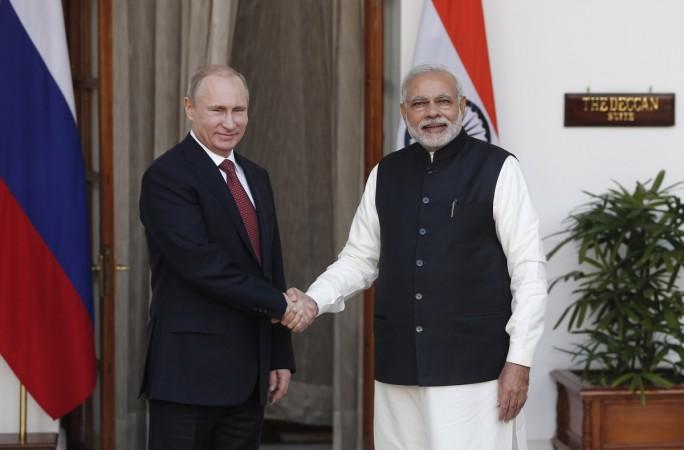
Vladimir Putin's state visit to India on December 4-5, 2025, the 23rd India-Russia Annual Summit and his first since the 2022 Ukraine conflict, crystallizes 25 years of the "Special and Privileged Strategic Partnership."
Bilateral trade has surged to $68.7 billion in FY2024-25, with India's $63.84 billion imports significantly outweighing $4.88 billion exports in a 13:1 imbalance, while targeting $100 billion by 2030 and $50 billion investments via rupee-ruble settlements, RBI-enabled Russian asset buys, and SPFS-SWIFT bypasses as sanctions-resilient bridges. Anchored by defence, where Russia holds a 36% share of India's $70+ billion arms imports per SIPRI data, discounted crude accounting for over $100 billion since 2022 and 35-43% of India's basket, and BRICS synergies, the agenda spans 10-15 MoUs on S-400 accelerations, Su-57 jets, BrahMos expansions, small modular reactors, Gaganyaan human spaceflight support, and AI investment funds. This recalibrates amid global pressures, fortifying India's strategic autonomy through principled engagement on its own terms. Day 1 features Putin's arrival, President Murmu's courtesy call and banquet, and Modi bilaterals; Day 2 delivers the summit, joint statement, Putin at the India-Russia Business Forum plenary with high-level defence-energy delegations, and potential BRICS/SCO side discussions.
Defence Backbone: From Buyer-Seller to Joint Powerhouse
Military-technical cooperation, extended to 2031 via IRIGC-M&MTC and 2+2 dialogues, evolves beyond the S-400 system valued at $5.4 billion with five squadrons under consideration following operational proofs, T-90 and AK-203 "Make in India" production, and INS Vikramaditya carrier operations. It now encompasses Su-57 fifth-generation fighters as an F-35 rival, S-500 systems, BrahMos Phase III missile advancements, and collaborative nuclear submarine R&D, all while sustaining joint exercises like INDRA and Vostok amid India's broader diversification including Rafale jets and US drones. Financially, these initiatives secure over $20 billion in pipelines, technology transfers, and spares, addressing delivery delays stemming from the Ukraine situation while integrating GLONASS with NavIC to strengthen deterrence against China-Pakistan challenges. Putin's high-level delegation signals new pacts, building on Moscow's recent treaty ratifications, embedding Russia within Viksit Bharat's $5 trillion economy alongside QUAD partnerships and iCET technology collaborations.
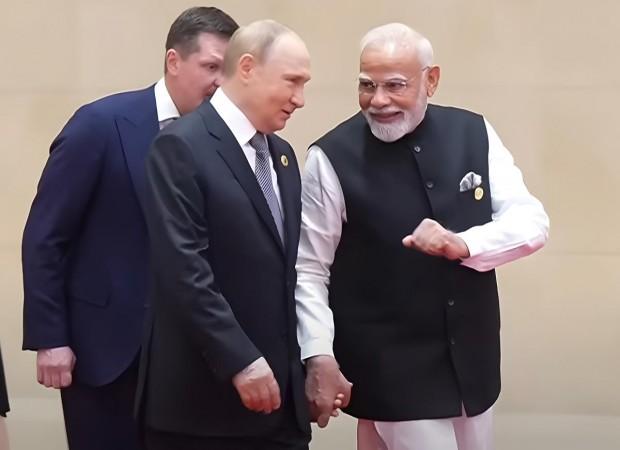
Energy Calculus: Sanction-Proof Flows and Nuclear Leap
India's Russian crude imports peaked at 43% mid-2025 before a dip due to tightened US secondary sanctions and rising US supplies, prompting discussions on pipelines, Arctic LNG projects, rupee-settled discounts that have saved billions, Kudankulam Units 3-6 expansions, and small modular reactors for civilian and naval applications, complemented by hydrogen and renewables to address 85% import dependence. Trade imbalance correction follows Putin's October 2025 Valdai directive, mandating increased Russian purchases of Indian pharmaceuticals and agriculture products worth $4.9 billion in exports, while channeling RBI rupee surpluses into infrastructure bonds and stocks toward $50 billion bilateral investments. The International North-South Transport Corridor offers 40% reductions in Suez costs and transit times, alongside the Chennai-Vladivostok Corridor and Northern Sea Route, yielding $10-15 billion in annual logistics savings and de-risking energy volatility for sustained economic momentum.
BRICS+ and Multilaterals: Advancing Global South Resilience
BRICS takes center stage, reviewing expansion to include Indonesia, Egypt, Iran, and UAE, alongside $399 billion in intra-group trade where India's $209 billion energy deficit highlights opportunities, NDB financing of $6.9 billion for Indian infrastructure and clean energy projects, and the 2030 Economic Partnership Strategy focusing on digital economy growth, AI and blockchain governance, counter-terrorism responses echoing the Pahalgam incident, and expanded use of local currencies for smoother transactions. Aligning India's 2026 chairmanship with Russia's 2024 contributions and SCO/Eurasia Economic Union initiatives, leaders advance INSTC synergies and Global South priorities, complementing G7 engagements while harmonizing with QUAD objectives. Financially, this unlocks NDB and Contingent Reserve Arrangement funding, Russian AI-technology investment funds, and six new 2025 projects in innovation to support inclusive development.
Navigating US-EU Headwinds: India's Pragmatic Multi-Alignment
The Trump administration has expressed concerns over India's Russian oil and arms purchases as potential sanction challenges alongside BRICS dynamics, while the EU has raised points on Ukraine peace processes and energy flows. India responds through Modi's consistent neutrality with multiple visits to Kyiv and Moscow, QUAD-driven Indo-Pacific security hardening, US iCET technology pacts, and diversified arms procurement, dismissing pressures as part of "time-tested" ties per MEA statements and leveraging 35% crude discounts for substantial fiscal savings exceeding $50 billion since 2022 without disrupting QUAD cooperation. This approach, including RBI adoption of SPFS and rupee recycling mechanisms, fosters 20% year-on-year growth in Russia ties while deepening over $200 billion in US trade and advancing EU free trade agreement momentum, exemplifying multipolarity in action.
In this summit, India shapes multipolar outcomes alongside partners like the US and EU. By integrating Russian defence, energy, and technology strengths into BRICS frameworks and Western partnerships, exemplified by Modi's Kyiv neutrality and iCET advancements, New Delhi secures economic multipliers: $100 billion trade targets, resilient supply chains, and edges in AI and nuclear capabilities, redefining sovereignty in a complex global landscape through strategic autonomy. The legacy offers a template for emerging powers: resilience grounded in realism.
[Major General Dr. Dilawar Singh, IAV, is a distinguished strategist having held senior positions in technology, defence, and corporate governance. He serves on global boards and advises on leadership, emerging technologies, and strategic affairs, with a focus on aligning India's interests in the evolving global technological order.]