
Notwithstanding demands from some political parties and religious groups, the Jammu and Kashmir Government on Tuesday made it clear that there is no proposal under consideration to declare the Union Territory a dry state, citing multiple socio-economic reasons.
In a written reply to a question by BJP MLA Balwant Singh Mankotia in the Legislative Assembly, the government clarified that, at present, there is no proposal to declare Jammu and Kashmir a dry Union Territory.
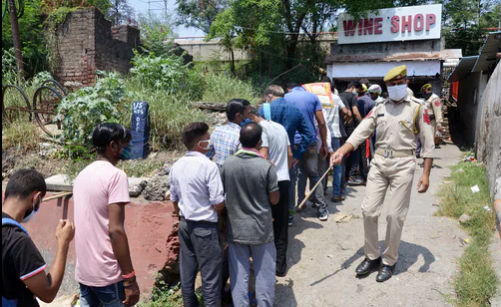
Explaining its decision, the Government said that imposing prohibition could lead to a large-scale increase in liquor smuggling from neighbouring states and Union Territories, besides encouraging the production and circulation of illicit liquor and illegal distillation, posing serious risks to public health.
The Government outlined several reasons for not imposing prohibition in J&K:
- Increase in smuggling: Prohibition could lead to large-scale smuggling of liquor from neighbouring states and Union Territories.
- Rise in illicit liquor: Illegal distillation may increase, posing grave threats to public health.
- Public health hazards: The destruction of 13.65 lakh kg of lahan and 16.3 thousand litres of illicit liquor between 2022–23 and 2025–26 (up to January 2026) highlights the dangers associated with spurious liquor.
- Strengthening of liquor mafias: Underground networks, money laundering, and hawala activities may expand, adversely affecting security and the economy.
- Employment loss: Thousands of people engaged in manufacturing, wholesale, retail, hospitality, and transport sectors—particularly youth—could lose their livelihoods.
- Impact on the transport sector: Thousands of vehicles dependent on the liquor trade would be adversely affected.
- Industrial losses: The bottle manufacturing industry would suffer due to reduced demand.
- Negative impact on tourism: Tourists expect access to alcohol; prohibition could reduce tourist inflow as visitors may prefer neighbouring states.
- Hospitality sector losses: Hotels, restaurants, and resorts rely on liquor sales to enhance customer experience and revenue.
- Online booking disadvantage: Many tourists prefer hotels with in-house bars, which could affect occupancy rates and earnings.
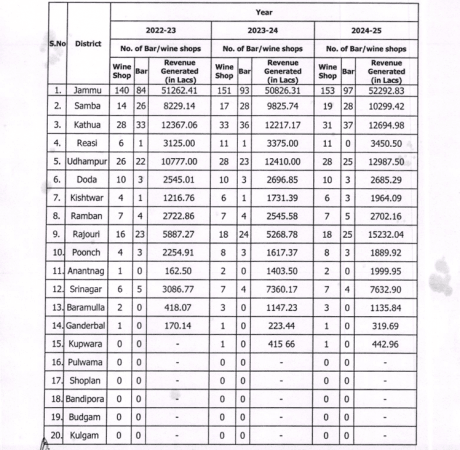
The Government further informed the House that liquor shops have been opened in 15 out of the total 20 districts of Jammu and Kashmir. Liquor shops are not operational in Pulwama, Shopian, Bandipora, Budgam, and Kulgam districts.
Jammu district has the highest number of liquor outlets, with 153 wine shops.
As reported earlier, the Jammu and Kashmir Government collected ₹1,118 crore in excise revenue during the financial year 2024–25, marking an increase of ₹79 crore compared to 2023–24.
Over the past two financial years, the Government has generated approximately ₹2,152 crore through the auction of liquor shops and has no proposal to open new wine shops during 2026–27.
The Government said ₹1,03,462.49 lakh was generated in 2023–24, while ₹1,11,816.07 lakh was earned in 2024–25. Of the total revenue over the last two years, the Jammu region contributed ₹1,96,830.06 lakh, while the Kashmir region accounted for ₹18,448.50 lakh.
The Government also clarified that no new JKEL-2 liquor licences are proposed to be issued in the next financial year.