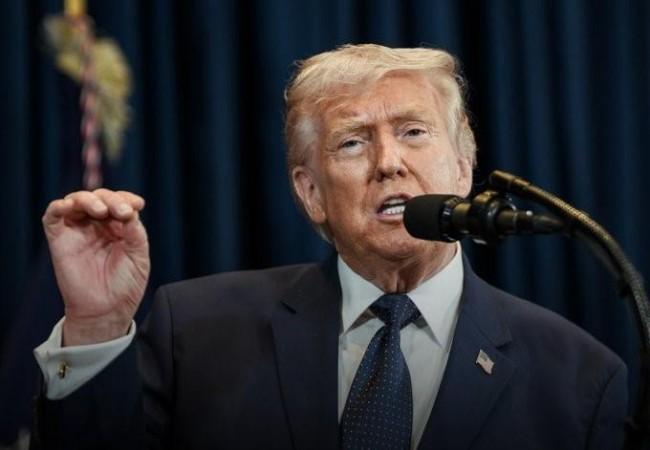
US President Donald Trump has called on several Arab and Muslim-majority countries, including Saudi Arabia, Pakistan, Turkey, Qatar, Egypt and Jordan, to join the Abraham Accords as part of a broader regional understanding involving Iran.
In a lengthy post on Truth Social, Trump said he was "mandatorily requesting" these nations to sign the accords, adding that he would also welcome Iran into the framework if Tehran agrees to a new deal with the United States. According to Trump, such an arrangement could create a "united, powerful, and economically strong" Middle East.
The Abraham Accords are a series of US-brokered agreements launched in 2020 to normalise diplomatic relations between Israel and Arab states. The first signatories were the United Arab Emirates and Bahrain, followed later by Morocco and Sudan, although Sudan has yet to formally ratify the pact. Earlier this year, Kazakhstan also formally joined the agreement, marking its expansion beyond the Arab world.
However, the accords have remained controversial across much of the Arab world because they do not directly address the Israel-Palestine conflict. Many critics view normalisation with Israel without the establishment of a Palestinian state as a betrayal of the Palestinian cause.
The issue traces back to the 2002 Arab Peace Initiative led by the Arab League, which proposed normalisation with Israel only if a Palestinian state was created and Israeli forces withdrew from occupied territories. Israel never fully accepted the framework.
Despite this, several Gulf nations moved closer to Israel during the 2010s over shared concerns about Iran's growing regional influence and nuclear ambitions. The UAE's decision to join the accords in 2020 came after Israel agreed to suspend plans to annex parts of the West Bank.
The Gaza war further complicated efforts to expand the accords, with many Arab nations condemning Israel's military actions and reiterating support for a two-state solution. In late 2025, Saudi Crown Prince Mohammed bin Salman indicated that Riyadh could consider joining the accords if there was a "clear path" toward Palestinian statehood.
However, rising tensions involving Iran and attacks linked to the presence of US military bases in Gulf countries such as Bahrain, Saudi Arabia, Oman, Kuwait and the UAE have reshaped regional calculations, potentially influencing future discussions around the Abraham Accords.