In a room charged with tension and hope, two opposing factions from the Naxal belt of Jharkhand once sat before Gurudev Sri Sri Ravi Shankar, searching for a way out of the violence that had defined their villages for years. Men and women from both sides had traveled more than 2,000 kilometers, carrying with them stories of conflict, fear, and a desperate longing for peace.
After listening patiently, Gurudev offered a solution that seemed simple yet profoundly transformative.
"Open a school there," he said. "Children from both villages will come to study. The school will be a safe zone."
That idea would grow into something far larger than anyone imagined.
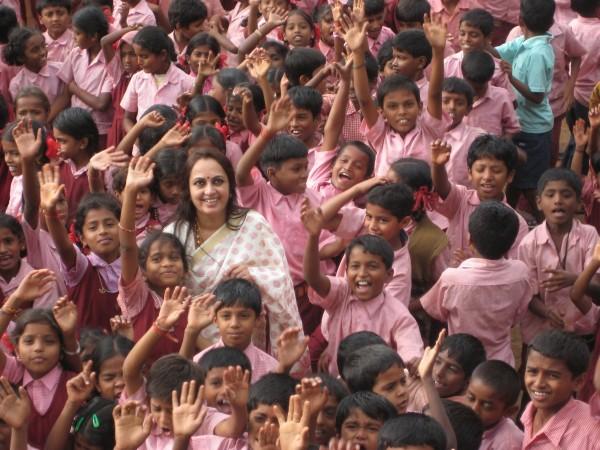
Across India today, hundreds of free schools run by The Art of Living stand in places where education once seemed impossible—deep inside Naxal-affected regions of Jharkhand, in remote villages of Arunachal Pradesh where roads disappear during harsh winters, and even in communities where former Naxals requested schools so that children orphaned by conflict could find a home, an education, and a chance at a different future.
Yet behind this vast movement transforming the lives of more than 120,000 children stands a woman whose work has largely unfolded away from the spotlight.
For more than four decades, Bhanumathi Narasimhan, Chairperson of Women's Welfare and Child Care programs for The Art of Living, has quietly carried the mission of education to the most remote corners of India—ensuring that children who once had no access to schooling receive holistic, value-based education rooted in service, peace, and inner freedom.
A Vision Marked Across the Map
Inside her meeting space, a large map of India hangs on the wall, dotted with hundreds of bindis.
"Those are all our schools," she says with a gentle smile.
Today, the Art of Living has established 1,356 free schools across 22 states, educating over 120,000 children, many of them first-generation learners.
But the origins of this movement lie in a small moment from her childhood.
Growing up in South India in a family that valued simple living and high thinking, Bhanumathi Narasimhan witnessed how deeply education—or the absence of it—could shape a child's life. The daughter of their house help in Bangalore never went to school, something that troubled her brother, Gurudev Sri Sri Ravi Shankar.
"When Bhanu can go to school, why can't she?" he would ask their parents.
That question planted a seed.
Years later, in the early 1980s, when The Art of Living's first ashram was being built, laborers' children could often be seen playing in the sand around the construction site. Instead of leaving them to their circumstances, the team began teaching them basic hygiene, reading, and writing.
What began as an informal effort slowly evolved into a full-fledged school—with uniforms, textbooks, free mid-day meals, and yellow school buses that brought children from nearby villages.
From that modest beginning, a nationwide network of schools was born.
Education Beyond the Classroom
The schools go far beyond conventional academics.
Their approach focuses on nurturing the whole personality of a child—developing calm, creativity, emotional resilience, and intuitive strength alongside academic learning.
One of the distinctive aspects of the curriculum is that students practice simple breathing techniques and meditation as part of their daily routine. These practices help children develop emotional balance, self-confidence, and mental clarity—qualities often missing in traditional education systems.
A Japanese educationist visiting a school near Bangalore once expressed surprise not at the students' academic abilities, but at something else entirely.
"These children have far fewer comforts than the average Japanese child," he remarked. "Yet they are so happy. How did you do this?"
The answer lies in an educational philosophy that nurtures both the world of information and the world within. Children spend time every day in reflection and meditation, learning to balance intellectual growth with inner well-being.
As Gurudev Sri Sri Ravi Shankar often says, "Only an education that can nourish inbuilt virtues can impart true intelligence."
Creating Changemakers
For Bhanumathi Narasimhan, the success of education is not measured only through examination results.
It is measured by the kind of human beings these children become.
Over the years, students from the Art of Living schools have gone on to break remarkable barriers. Among them are Bangalore's first female metro driver, women who became the first police officers in their villages, and village leaders who eventually rose to become Members of Legislative Assemblies (MLAs).
Many others have built careers as lawyers, teachers, accountants, Ayurvedic doctors, and social entrepreneurs.
They are not just graduates—they are citizens contributing to the social and economic fabric of the country.
Education as a Path to Peace
Many of the schools exist in some of India's most challenging environments—tribal belts, urban slums, and regions affected by militancy and Naxal influence.
Schools in states such as Chhattisgarh, Uttar Pradesh, and Andhra Pradesh operate in areas once considered too volatile for educational initiatives.
In these regions, classrooms have become more than places of learning—they have become catalysts for long-term peace.
By offering children opportunity and hope, these schools help break cycles of violence and despair that once seemed impossible to overcome.
Children from Meghalaya, Assam, and Manipur also study and live at the Art of Living Ashram in Bangalore, where they grow in a safe environment that nurtures their individuality and potential.
Empowering the Girl Child
A central focus of Bhanumathi Narasimhan's work has been ensuring that girls receive equal access to education.
For her, empowering women is not about confrontation—it is about opportunity.
"It's about bridging the gap between potential and access," she believes.
Today, 49% of students in the Art of Living free schools are girls.
In places like Parola, Rajasthan, an all-girls school was established because many families were unwilling to send their daughters to co-educational institutions. The dedicated space made education accessible for girls who otherwise would have remained outside the school system.
With education, these young girls are discovering the freedom to dream beyond the limits imposed by circumstance.
The Role of Spirituality
In a world where identities are often shaped by caste, religion, or class, Bhanumathi Narasimhan believes spirituality offers something deeper.
"Spirituality strengthens the identity as a human being and unites the hearts and minds of people," she explains.
For her, this inner foundation is essential to both personal growth and social harmony. When children develop human values along with knowledge, they gain the strength to navigate life's challenges.
Redefining the Purpose of Education
One evening, during a gathering of nearly 5,000 people under a full moon, a young boy asked Gurudev Sri Sri Ravi Shankar a question.
"What do you think should be the purpose of education?"
His answer captured the essence of the movement that Bhanumathi Narasimhan has spent decades nurturing.
"To build a robust personality," he said. "It is not about stuffing a child's mind with information. Real education has to make us flexible, not rigid; innovative, not obsessive; faithful, not fanatic; and all-inclusive."
Across India's remote villages, tribal communities, and conflict-affected regions, that vision continues to take shape.
And at the heart of it stands a woman who has spent her life working quietly, steadily, and with unwavering commitment—transforming the futures of thousands of children, one classroom at a time.
This International Women's Day, her story serves as a reminder that leadership does not always seek the spotlight.
Sometimes, it simply builds the foundation on which generations rise.