



A social media post claiming that an Indian woman accused of shoplifting during a trip to Japan was not arrested and was instead released with a warning has gone viral, sparking widespread debate online.
The post was shared on X by user Muthukrishnan Dhandapani on Saturday. Claiming to be part of the same tour group, he recounted an alleged incident involving a woman who was reportedly caught stealing items from a souvenir shop during the visit.
According to the post, other members of the group were unaware that the woman had allegedly been shoplifting since the beginning of the trip. The situation came to light when she was reportedly caught at a tourist shop and immediately offered to pay for the items.
Dhandapani claimed that the shopkeeper rejected the offer, saying Japan is a "high-trust society" where theft is uncommon. According to the account, the shop owner was particularly offended by the attempt to pay only after being caught and subsequently informed the police.
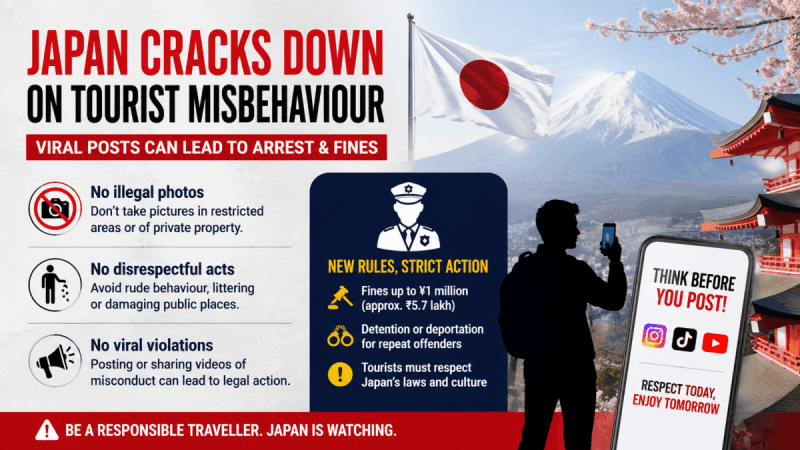
When You're in Japan, Be Japanese, Respect Japanese Way of Life
Japan is known for its discipline, courtesy, cleanliness and respect for social harmony. While Japanese people are generally welcoming towards visitors, understanding local customs can help Indians avoid unintentional cultural mistakes and enjoy a smoother experience.
Do's
- Be punctual. Arriving on time is considered a sign of respect. Whether it is a business meeting, train journey or social gathering, punctuality is highly valued.
- Queue patiently. Japanese society places great importance on orderly behaviour. Stand in designated lines at train stations, bus stops and stores.
- Speak softly in public places. Keep conversations low, especially on trains, buses and in restaurants.
- Remove your shoes when required. Many homes, temples, traditional inns (ryokan) and some restaurants require visitors to take off their shoes before entering.
- Carry a small bag for your trash. Public dustbins are limited in many cities. People often carry their waste until they find an appropriate disposal point.
- Learn basic greetings. Simple phrases such as "Arigatou gozaimasu" (thank you) and "Sumimasen" (excuse me/sorry) are appreciated.
- Respect personal space. Japanese culture values privacy and modesty. Maintain appropriate physical distance while interacting.
- Bow politely when greeting. A slight bow is a common gesture of respect. Visitors are not expected to master the practice but making an effort is appreciated.
- Use public transport etiquette. Allow passengers to exit before boarding and give priority seats to the elderly, pregnant women and people with disabilities.
- Handle money politely. In many shops, cash is placed on a tray rather than handed directly to the cashier.
- Follow local rules carefully. Whether it is sorting garbage, crossing roads or using public facilities, adherence to rules is viewed positively.
- Show respect at temples and shrines. Observe signs, remain quiet and follow local customs while visiting religious sites.
Don'ts
- Do not talk loudly on trains or buses. Loud phone conversations are considered rude and may attract disapproving looks.
- Do not eat while walking in crowded areas. While not illegal, it is generally discouraged in many parts of Japan.
- Do not litter. Cleanliness is a matter of civic pride. Even small acts of littering are frowned upon.
- Do not tip. Unlike in India, tipping is generally not expected and can sometimes create confusion.
- Do not point directly at people. Use an open hand gesture instead, as pointing may be perceived as impolite.
- Do not enter a bath without washing first. In hot springs (onsen) and public baths, washing thoroughly before entering the communal bath is mandatory.
- Do not wear shoes on tatami mats. Traditional straw mats are treated with great care and shoes are strictly prohibited.
- Do not touch merchandise unnecessarily. In stores, avoid handling products excessively unless you intend to examine them seriously.
- Do not blow your nose loudly in public. It is generally considered poor etiquette.
- Do not hug or display excessive public affection. Japanese society tends to be more reserved in public settings.
- Do not ignore queue systems. Cutting lines or rushing ahead is viewed very negatively.
- Do not photograph people without permission. Respect privacy, particularly in temples, traditional neighbourhoods and public spaces.
The most important cultural value in Japan is consideration for others. Visitors who remain courteous, patient, clean and respectful will find Japan to be one of the safest, most organised and welcoming destinations in the world.
The post further alleged that the group's tour manager accompanied the woman to a police station, where she again attempted to offer money. However, Japanese police officers were reportedly unimpressed and explained the seriousness of theft under Japanese law, including the possibility of imprisonment.
In our group, from the beginning one lady has been shoplifting. We were not aware of it. In one of the tourist souvenir shops, she was caught. She immediately offered to pay money. The Japanese shop keeper said that they are a high trust society where stealing is rare and have…
— Muthukrishnan Dhandapani (@dmuthuk) May 30, 2026
Despite this, the woman was allegedly not arrested. According to the viral post, she was released after receiving a stern warning, with authorities purportedly citing their respect for India as a factor behind the decision.
"They explained how severe the punishment is for stealing and said she needs to go to jail. But she being an Indian and they respect India a lot, she was let go with severe warning," the user wrote.
The post quickly gained traction on social media, drawing strong reactions from users. Many criticised the alleged behaviour and argued that stricter action should have been taken, while others expressed concern over the potential impact such incidents could have on India's image abroad.
One user commented, "This is the issue. I am so disappointed when I read the last line. These pests can be weeded out when they are prosecuted and made an example. Even in India people break laws because it's easy to cry, fall at someone's feet and get away with punishment."
Another wrote, "Such women should be permanently banned from getting visas anywhere in the world as they bring India's reputation down globally. No more mercy should be shown. Such a shame for the country."
However, some users urged restraint and suggested that the incident, if true, could be linked to underlying personal or psychological issues.
"She needs care and help. It's a psychological problem. You should be supportive rather than posting on social media for some likes. Indians are too judgmental very soon," another user wrote.
Notably, there has been no official confirmation from Japanese authorities regarding the alleged incident. The claims remain based solely on a viral social media post and have not been independently verified.

![Angry Jaya Bachchan pushes journalist's mic away during INDIA bloc protest [watch]](https://data1.ibtimes.co.in/en/full/839178/angry-jaya-bachchan-pushes-journalists-mic-away-during-india-bloc-protest-watch.jpg?w=220&h=135&l=50&t=40 "Angry Jaya Bachchan pushes journalist's mic away during INDIA bloc protest [watch]")








![Angry Jaya Bachchan pushes journalist's mic away during INDIA bloc protest [watch]](https://data1.ibtimes.co.in/en/full/839178/angry-jaya-bachchan-pushes-journalists-mic-away-during-india-bloc-protest-watch.jpg?w=220&h=138)



![Angry Jaya Bachchan pushes journalist's mic away during INDIA bloc protest [watch]](https://data1.ibtimes.co.in/en/full/839178/angry-jaya-bachchan-pushes-journalists-mic-away-during-india-bloc-protest-watch.jpg?w=220&h=135)