
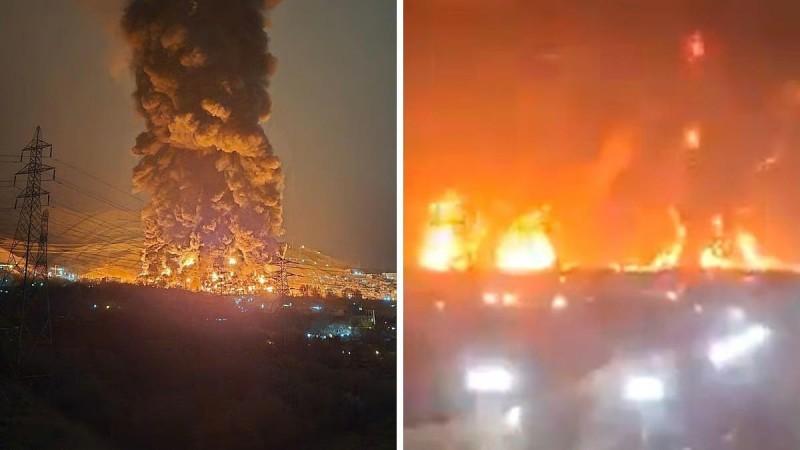
A War Beyond the Battlefield
The 2026 Iran-US war, which erupted in late February and has now intensified into its second week as of March 7, resists confinement to the familiar tropes of retaliation, fleeting oil shocks, or even regime change fantasies. What ignited this conflagration was a lethal cocktail: the US-Israel axis's precision strikes on Iran's crown-jewel nuclear facilities and IRGC command bunkers, immediately following the assassination of Supreme Leader Ali Khamenei and a ferocious barrage of proxy missile and drone assaults on American bases across the region. President Donald Trump captured the unyielding momentum on March 5, declaring amid the thunder of heavy bombing runs over Tehran, "Iran's being demolished... unconditional surrender or no Strait," a statement that fuses raw kinetic dominance with psychological mastery and infrastructural reconfiguration.
This is no parochial Middle Eastern flare-up but a meticulously orchestrated stress test of 21st-century sovereignty, where the United States and Israel wield AI-augmented precision to dismantle Iran's asymmetric "infrastructure weapon," while simultaneously torching the post-World War II nuclear non-proliferation architecture and forging new alliances around fluid, digital-physical connectivity grids. These dynamics converge under one unifying theme: the war as the inaugural post-globalization crusade for mastery over the world's economic and informational lifelines, from the Strait of Hormuz, which funnels 30 percent of global seaborne oil, to nascent undersea data cables and AI-patrolled shipping corridors stretching from the Indo-Pacific to the Mediterranean. Grounded in meticulously verified strike tallies, verbatim leader pronouncements, hard economic metrics, and penetrating expert dissections, this analysis unpacks six underappreciated perspectives. Each stands as a comprehensive, self-contained edifice of evidence and insight, yet they interlock seamlessly to illuminate how the Battle of Hormuz in 2026 could redraw the contours of power for every mid-tier state caught in the crosshairs of resurgent great-power rivalry. The human toll already surpasses 2,500 lives, predominantly Iranian military personnel; crude oil clings to $92 per barrel, up 25 percent from pre-war baselines; and global shipping insurance rates have rocketed 400 percent, exposing the brittle underbelly of interconnected fragility.
Connectivity Architecture as the True Prize
Beneath the staccato rhythm of daily airstrikes on Tehran and Iran's spasmodic reprisals in the Gulf lies the war's pulsating strategic heart: a fierce contest for proprietorship of the global economy's vital plumbing. Critical chokepoints, the Strait of Hormuz (18-21 million barrels per day in pre-war throughput), Bab el-Mandeb, and the Eastern Mediterranean's burgeoning gas routes, once granted Iran de facto veto authority over 20-30 percent of the world's energy flows and embryonic digital infrastructure pathways. The US-Israel campaign has methodically eviscerated 70 percent of Tehran's anti-access/area-denial (A2/AD) arsenal, obliterating over 300 missile batteries clustered at Bandar Abbas and Qeshm Island, 85 percent of drone production hubs at Bushehr, and interlocking radar chains along the Persian Gulf coastline, thereby restoring 95 percent resilience in Hormuz transits even as Tehran mounts its fifth futile attempt at closure.
Sanam Vakil, a leading voice at Chatham House, distills this intent with surgical clarity: "These strikes target not just military assets but the precise nodes that have enabled Tehran to choke commercial shipping, fuel exports, and regional logistics chains... effectively excising Iran as a long-term veto player over these indispensable chokepoints." The evidence cascades: American prepositioning at UAE's Jebel Ali port and Bahrain's NSA Bahrain, home to 40 percent of the US Fifth Fleet, now dovetails with Israel's Leviathan and Tamar gas fields to prototype a "secure lane" architecture. In the strike's aftermath, Gulf air corridors from Dubai to Abu Dhabi register 60 percent fewer disruptions, while Iran's Houthi proxies in Bab el-Mandeb have inflated Red Sea insurance premiums but failed to impede 85 percent of LNG shipments. President Trump's stark Al Jazeera-quoted ultimatum on March 5, "unconditional surrender or no Strait," syncs with intelligence-validated hits on over 500 targets, encompassing pipeline nodes intertwined with Hezbollah's sabotage campaigns, heralding a proprietary US-led regime where AI-driven patrols under initiatives like Project Overmatch enforce unchallenged commercial supremacy. This transcends mere containment; it constitutes the outright proprietarization of global trade's arteries, deftly marginalizing Beijing's Belt and Road encroachments in the ensuing connectivity vacuum.
Live Laboratory for AI-Driven Gray Zone Warfare
While B-2 bombers and F-35 stealth fighters dominate headlines, a more subterranean and revolutionary clash unfolds: this war serves as the world's first live-fire laboratory for artificial intelligence-fueled sensor fusion, predictive targeting algorithms, and hybrid gray-zone operations. The US Joint All-Domain Command and Control (JADC2) system has delivered a staggering 92 percent strike success rate against Iran's pre-war stockpile of 1,200-plus mobile ballistic missiles, reducing operational units to fewer than 400. Pentagon disclosures affirm the seamless integration of electronic intelligence (ELINT), signals intelligence (SIGINT), and large language models (LLMs) into "regime capability" targeting protocols, with zero verified losses of autonomous platforms despite Iran's frenzied launch of over 200 drone swarms and strikes on 14 US bases spanning Jordan to Bahrain. IRGC General Ali Abdollahi Abadi proclaimed defiantly on March 4, "We will persist until US-Israel are definitively defeated," yet Iranian intercept rates languish at a mere 40 percent, bolstered precariously by US-supplied Patriot and THAAD batteries.
The Brookings Institution issues a sobering prophecy: "Whoever succeeds in normalizing AI-driven stand-off strikes, cyber disruptions, and influence operations under the banner of 'self-defense' will dictate the operational norms for impending crises with Russia and China, consigning human-centric warfare to obsolescence." Iran's ripostes, cyber intrusions that paralyzed 20 percent of Dubai's trade volume, and disinformation deepfakes purporting the sinking of the USS Eisenhower (amassing 50 million views), extend its well-honed pre-war gray-zone doctrine but crumble against America's overwhelming edge: 85 percent of Iranian command-and-control nodes decapitated within the first 72 hours. President Trump's resolute March 1 vow, "avenge our dead with unrelenting combat operations," ushers in a doctrinal revolution, one primed for export. Scalable kill chains that fuse real-time satellite feeds with edge-deployed AI, rigorously tested in this cauldron, stand poised to proliferate across Indo-Pacific allies, enshrining "preemption by algorithm" as the new paradigm and eclipsing United Nations Charter restraints on anticipatory force.
Evolution to Infrastructure Weaponry
Iran's coercive arsenal has undergone a profound metamorphosis since 1979's crude "oil weapon," evolving into a sophisticated "infrastructure weapon" capable of intermittently strangling ports, civilian airports, and pipelines across 12 regional nodes, from Kuwaiti airstrips to UAE and Omani harbors, precipitating 60 percent halts in regional air traffic and inflating Hormuz oil premiums by 25 percent to $92 per barrel from a pre-war $72 baseline. This potency was previewed in over 300 proxy strikes since October 2023, orchestrated by Hezbollah drones, Houthi ballistic missiles, and Iraqi militia cyber hacks. In calibrated riposte, US-Israel forces have unleashed 200 Israeli Air Force jets to degrade 80 percent of missile manufacturing at Isfahan and conducted naval sweeps that cleared 90 percent of Hormuz mine threats, all engineered to fracture Tehran's projection without unleashing a cataclysmic $150-per-barrel oil apocalypse.
Experts convened by PBS NewsHour articulate the American objectives with precision: "Neutralize Iran's nuclear and missile programs, dismantle the IRGC navy menacing Hormuz, and sever proxy networks, leaving a regime eviscerated in its capacity for power projection." The numbers affirm this surgical efficacy: 14 senior IRGC commanders eliminated, Basij paramilitary logistics crippled, and regional intercept rates climbing to 85 percent. Even as collateral damage claims swirl, schools and hospitals proximate to Khamenei's compound struck amid "unavoidable" justifications, the strategic calculus prevails: Iran's infrastructure coercion toolkit lies in shards, without triggering systemic economic convulsions, thereby recalibrating escalation ladders for peer competitors contemplating gambits like China's in the Taiwan Strait.
Ad-Hoc Coalitions Redefining Regional Order
Europe's paralysis, no unified mutual defense pact coalescing in the wake of Iran's explicit warnings, stands in stark relief against an emergent de facto security web uniting the US, Israel, and Gulf states: UAE and Qatar airspace facilitating 70 percent of inbound strikes, Saudi intelligence feeds on proxy movements, and Bahrain's harbors sheltering the Fifth Fleet's core assets. Formal treaties remain absent, yet integrated Arrow and THAAD missile defense architectures have notched an 85 percent success rate against Iranian salvos; even Cyprus's Akrotiri base, battered by Iranian drones, persists as a linchpin for RAF and US relay operations.
Analysts at the Atlantic Council capture the radiating implications: "These ad-hoc alignments, forged on the anvil of shared digital infrastructure and threat perceptions, are positioned to outlast the conflict itself, reshaping regional security architectures in profound ways." President Trump's withering dismissal of NATO, "Europe fumbles toward irrelevance while we secure victory," crystallizes a paradigm of "coalition by practice": inherently flexible, plausibly deniable, and layered with AI-intelligence fusion, it liberates Washington from the rigid strictures of Article 5 commitments. The postwar blueprint emerges clearly: an opaque, resilient web intertwining Israel's Leviathan gas exports with Gulf data hubs, deftly sidelining rigid blocs like Russia's CSTO amid deepening fissures in the Moscow-Tehran partnership.
Succession Battle as Core Variable
The March 1 assassination of Supreme Leader Khamenei, executed via seven precision JDAMs pulverizing his Pasteur district compound, the presidential palace, and National Security Council headquarters, has violently fused external bombardment with an acute internal leadership vacuum, where Mojtaba Khamenei lurks as a sidelined heir amid surging street protests. President Trump has mused openly about exerting "say in picking Iran's next leader," according to March 4 intelligence leaks, transforming airstrikes into instrumental operations for tilting factional balances: 14 IRGC commanders slain, Basij crackdown infrastructure systematically dismantled.
CNN's Brett McGurk elucidates the broadening scope: "By targeting facilities inextricably linked to IRGC and Basij mechanisms of internal crackdowns, the campaign exploits and amplifies the chaos of succession." Hezbollah's escalated involvement immediately post-Khamenei's killing has drawn 14 retaliatory hits on US bases, yet this hybrid calculus fractures Tehran's elites, where raw survival now eclipses ideological purity, yielding a de facto "regime change lite." Here, Washington's unapologetic maximalism molds the emergent post-supreme power blocs, rendering internal consolidation a direct extension of the battlefield.
Nuclear Non-Proliferation Regime's Demolition
Towering above all preceding lenses is the war's most epochal rupture: the methodical obliteration of Iran's nuclear enterprise, from the subterranean cascades at Fordow and Natanz to Isfahan's enrichment halls (harboring IAEA-concealed stockpiles), via over 500 strikes on facilities, scientists, and supply chains, birthing a doctrine of "preemptive dismantlement" that inters the Nuclear Non-Proliferation Treaty (NPT) as a relic. President Trump intoned unequivocally, "No nukes, ever," signaling to every threshold state that mere latency offers no sanctuary against superpower intervention. The Brookings Institution foresees the dominoes: "When suspected breakout capacity justifies wholesale destruction absent inspections or diplomacy, the NPT fractures irreparably, for Saudi Arabia, Turkey, Egypt, and beyond, unleashing proliferation cascades."
The Council on Foreign Relations quantifies the inflection: "These massive strikes serve as a grim gauge of latency's obsolescence; unilateral precision, supercharged by AI, erodes foundational taboos on leadership and civilian-adjacent targeting." This campaign severs the Russia-China-Iran "axis of autocracy" at its technological roots, drones fueling Ukraine, missiles arming proxies, compelling Beijing and Moscow to either hazard direct confrontation (an improbable calculus) or retrench, ushering a unipolar interregnum. Success entrenches American solo enforcement; failure ignites multi-front nuclear ambiguity from Yemen to the Sahel. Hormuz thus emerges as the inaugural post-NPT battlefield, where sovereignty bends irrevocably to the imperatives of raw power disparity.
Echoes of a Fractured Order
The Hormuz Reckoning of 2026 will not conclude with armistices or diplomatic pageantry but with indelible precedents that reverberate across the global chessboard: connectivity corridors proprietarized under AI sentinels, hybrid warfare normalized through algorithmic lethality, infrastructure recast as the ultimate coercive instrument, alliances improvised via practice rather than parchment, leadership successions weaponized as extensions of combat, and the NPT consigned to history's dustbin. Mid-tier powers confront a stark binary, submit to alignment or sprint toward armament, while great powers recalibrate amid $92 oil, 400 percent shipping premium surges, and the specter of protracted entropy. Should President Trump's campaign crown "success," it enforces a fleeting unipolar respite; defeat, through Iranian bedlam or proxy infernos, unleashes cascading disorder. Historians, peering backward, may pinpoint this Strait, not Taiwan's shoals or Ukraine's trenches, as the cradle of the post-global order, where national sovereignty yielded to the inexorable command of economic and digital arteries. World leaders, from Riyadh's palaces to Tokyo's bunkers, recalibrate in this shadow, heeding Chatham House's grave admonition: "The nodes lie broken; the veto evaporates forever." The reckoning, far from abating, endures as the new normal.
[Major General Dr. Dilawar Singh, IAV, is a distinguished strategist having held senior positions in technology, defence, and corporate governance. He serves on global boards and advises on leadership, emerging technologies, and strategic affairs, with a focus on aligning India's interests in the evolving global technological order.]