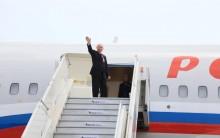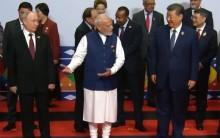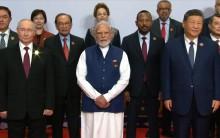
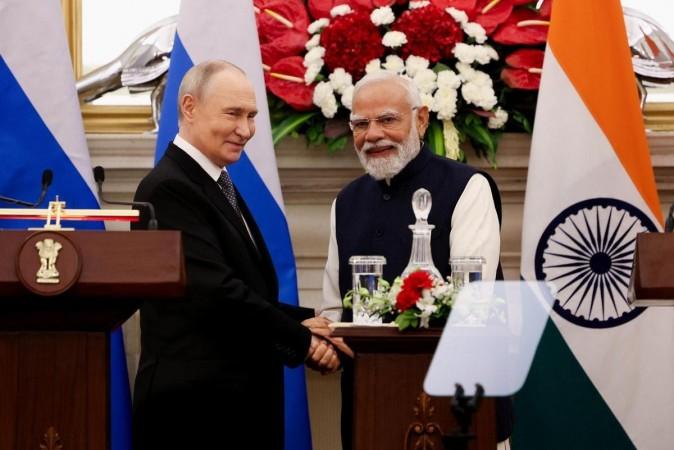
In a world where alliances fracture like brittle glass under the weight of sanctions, tariffs, and endless proxy conflicts, the opulent corridors of Hyderabad House in New Delhi became the stage for a profound geopolitical symphony on December 4 and 5, 2025. Russian President Vladimir Putin, defying the chill of Western isolation, descended upon India's capital for the 23rd India-Russia Annual Summit, welcomed by Prime Minister Narendra Modi with the embrace of enduring comradeship. This was no perfunctory diplomatic ritual; it marked the silver jubilee of their strategic partnership, forged in 2000, now tempered into a bulwark against the tempests of a multipolar order. Amid the specter of the Ukraine crisis, escalating U.S. protectionism, and China's assertive shadow across Eurasia, the two leaders orchestrated a harmony of resilience: sixteen bilateral agreements, memoranda of understanding, and protocols that transcend mere ink on paper, weaving a robust fabric of economic synergy, technological innovation, and unassailable sovereignty.
As Modi invoked the "pole star" of their friendship, steadfast and guiding, the summit illuminated India's masterful navigation: balancing Western courtship with Eastern entrenchment, all while positioning itself as the indispensable architect of a post-hegemonic global landscape. With bilateral trade already cresting at a record $68.7 billion in fiscal year 2024-25, fueled by Russian crude that now supplies over a third of India's energy needs, these pacts do not merely reaffirm old ties; they recalibrate them for an era of de-risked interdependence, where energy security meets manufacturing self-reliance and digital fortitude challenges dollar hegemony.
This encounter was a testament to strategic alchemy, transforming historical bonds into contemporary fortitude. Drawing from the Joint Statement's clarion call for "balanced, sustainable" growth, the agreements emerge from the crucible of the India-Russia Business Forum and parallel intergovernmental commissions, including the 25th and 26th Sessions on Trade, Economic, Scientific, Technical, and Cultural Cooperation, as well as the 22nd on Military and Military-Technical Cooperation held on December 4. They defy the binaries of East versus West, offering a blueprint for nations weary of unipolar dictates. Yet, as the leaders condemned terrorism in unison, referencing the April 2025 Pahalgam attack in India and the March 2024 Crocus City Hall tragedy in Moscow, the summit also revealed the undercurrents of risk: Can India harness this alliance to propel its ascent without entanglement in Moscow's geopolitical quagmires? The answers lie in the granular architecture of these agreements, their cascading implications, and the calculated gambles they entail, all underscored by a shared commitment to implementation through annual reviews and synergies with BRICS and SCO platforms.
The Sixteen Pillars of Partnership: A Precise Blueprint for Bilateral Renewal
To illuminate the summit's essence, precision demands a clear enumeration of the sixteen documents, drawn from official communiqués of the Indian Ministry of External Affairs, Press Information Bureau, and the Kremlin. These intergovernmental accords, institutional memoranda, and commercial protocols cluster across key domains, pivoting from traditional energy and defense strongholds toward a multifaceted ecosystem of collaboration. Far from ornamental, they form an interdependent lattice, with the overarching Programme for Development anchoring measurable progress toward a $100 billion trade milestone by 2030.
The joint statements highlight their collective role in diversification, elevating non-oil exports like pharmaceuticals and engineering goods, while emphasizing de-risking via national currencies and logistics upgrades.
Notably, while an exhaustive itemized list eludes public release (with some institutional or commercial sub-deals, such as university exchanges or media tie-ups with Prasar Bharati and Russian broadcasters like RT, folded into broader frameworks), the explicit ones below represent the strategic core. Each carries tailored implementation mandates, tying into working groups for milestones like Eurasian Economic Union free trade talks by 2027.
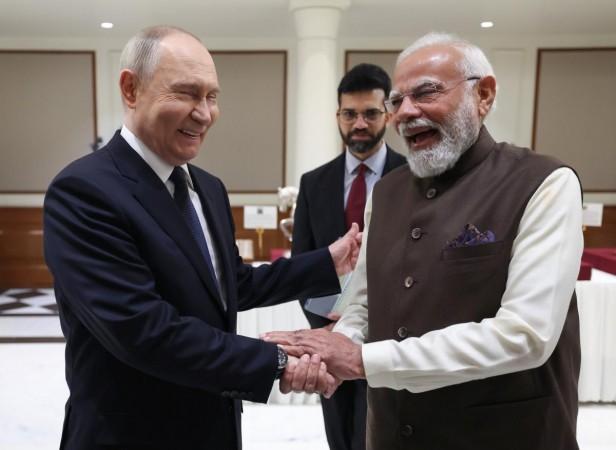
Here's the comprehensive roster, enriched with sectoral insights, commitments, and analytical weight:
1. Programme for the Development of Strategic Areas of India-Russia Economic Cooperation till 2030 (Programme 2030): This master blueprint, adopted as the summit's linchpin, charts a course for balanced trade expansion, targeting $100 billion by 2030 through heightened Indian exports in pharmaceuticals, agriculture, and engineering. It mandates forging high-tech partnerships in artificial intelligence and digital realms, while nurturing startups and small-to-medium enterprises. Critically, it prioritizes tariff eliminations, logistics enhancements, and national currency settlements, serving as the gravitational force for all subsequent pacts. Implementation hinges on the 25th and 26th Intergovernmental Commission sessions, with early wins projected in barrier removals to rebalance the current $63.8 billion import skew.
2. Protocol on Consultations for Bilateral Trade using National Currencies and Digital Platforms: A deft financial maneuver, this protocol institutionalizes rupee-ruble interoperability and central bank digital currency pilots, insulating up to 20 percent of trade from sanctions-induced disruptions. By embedding it within Programme 2030, it reduces dollar dependency, potentially slashing transaction costs by 15 percent. Working groups will operationalize seamless cross-border flows, foreshadowing BRICS-wide de-dollarization and bolstering India's forex resilience amid global volatilities.
3. MoU on Long-Term Supply and Joint Ventures in Fertilizers: Addressing India's chronic import vulnerabilities, this accord secures urea and other essentials from Russian giants like URALCHEM, partnering with Indian firms such as Rashtriya Chemicals & Fertilisers Ltd. and National Fertilizers Ltd. It paves the way for joint ventures in production, mitigating global shortages that spiked prices 30 percent in 2024. Future explorations in commission sessions could yield on-site facilities, enhancing food security and injecting $2-3 billion in agri-trade by 2028.
4. Agreement on Uninterrupted Supply of Russian Oil, Gas, and LNG: In a bold defiance of U.S. pressures, this pact guarantees stable energy inflows, encompassing petrochemicals, refining, and innovative underground coal gasification, sustaining Russia's 35 percent share of India's crude needs. It diversifies beyond spot buys, embedding long-term contracts to hedge against OPEC volatilities. Tied to energy security dialogues, it underpins India's net-zero ambitions while exposing the fragility of Western sanction regimes.
5. MoU on Expansion of Civil Nuclear Cooperation: This forward-leaning framework extends lifecycle support for Kudankulam Units 3-6, accelerates a second Indian site, and fuels research toward 100 gigawatts of nuclear capacity by 2047. Adhering to construction timelines, it promises $10 billion in investments, blending Russian expertise with Indian localization to slash import reliance on fossil fuels and position Delhi as a nuclear exporter in the Global South.
6. Agreement on Supply of Critical Minerals and Raw Materials: Unlocking Russia's vast reserves of lithium, diamonds, and precious metals, this deal fortifies India's electric vehicle and renewable supply chains, countering China's 80 percent global dominance. Integrated with the Science, Technology & Innovation Roadmap, it enables joint processing ventures, potentially adding $5 billion in value-added exports and accelerating India's $500 billion green transition by 2030.
7. Protocol from the 22nd India-Russia Intergovernmental Commission on Military-Technical Cooperation: Reviewed on December 4, this protocol catalyzes joint research and development, co-production of spares under Make in India, S-400 integrations, and amplified INDRA exercises. Shifting from imports to localization, it eyes third-country exports, enhancing India's strategic deterrence while generating 20,000 high-skill jobs and $4 billion in defense revenues by 2028.
8. MoU on Joint Manufacturing of Defense Equipment: Subsumed under the military protocol, this targets localization of Sukhoi components and BrahMos evolutions, aligning with Atmanirbhar Bharat's self-reliance ethos. Export-oriented joint ventures could capture 10 percent of the global arms market, transforming India from buyer to co-creator and mitigating U.S. technology denial risks.
9. MoU on Strengthening the International North-South Transport Corridor (INSTC): Upgrading rail, road, and sea links, this pact slashes Eurasian transit times by 40 percent, unlocking $50 billion in trade potential via the Eurasian Economic Union. Pilots slated for 2026 will test multimodal efficiencies, positioning INSTC as a Belt and Road alternative and amplifying India's role as Eurasia's logistics nexus.
10. MoU on Chennai-Vladivostok Maritime Corridor: Complementing INSTC, this harnesses the Northern Sea Route for expedited Far East connectivity, reducing Malacca Strait dependencies. Arctic integration promises seasonal shortcuts, with implementation focusing on port upgrades to boost non-oil cargo volumes by 25 percent annually.
11. Agreement on Railway Technology Exchange: Exchanging high-speed rail know-how and Arctic logistics, this builds capacity for joint infrastructure bids, from Mumbai-Ahmedabad corridors to Siberian lines. It fosters technology transfers, yielding $1-2 billion in contracts and enhancing India's high-speed ambitions amid global supply crunches.
12. MoU on Training Specialists for Ships in Polar Waters: Tailored for Russia's Far East and Arctic theaters, this equips Indian mariners for extreme operations, deepening maritime ties. Commencing in 2026, programs will train 1,000 specialists yearly, supporting energy exploration and countering climate-induced route volatilities.
13. Bilateral Agreement on Mobility of Skilled Workers: A humanitarian-economic bridge, this facilitates 50,000 annual placements for Indian IT, engineering, and healthcare talent in Russia, easing Moscow's labor gaps. Visa frameworks and joint committees ensure protections, potentially remitting $3 billion while upskilling India's workforce for global markets.
14. Protocol on Combating Illegal Migration: Bolstering the mobility pact, this deploys border management and anti-trafficking mechanisms, addressing irregular flows amid regional instabilities. Collaborative enforcement will safeguard legitimate migrations, intertwining security with economic gains.
15. MoU on Healthcare Cooperation: Spanning vaccine co-production, pharmaceuticals, and telemedicine, this leverages India's generic drug prowess, already 20 percent of Russia's imports, for joint R&D hubs. Regulatory harmonization promises $2 billion in bilateral pharma trade, fortifying post-pandemic resilience.
16. MoU on Food Safety and Standards Collaboration: Aligning FSSAI with Russian norms, this streamlines exports of marine products and agro-goods, elevating non-oil trade from $4.9 billion. It mitigates SPS barriers, injecting efficiency into supply chains and supporting rural economies.
These accords, while strategically comprehensive, reveal subtle gaps: Broader frameworks like the 2024-2029 Far East Programme (extended for mining and pharma) and the Climate Change MoU (focusing on Paris Agreement Article 6 and low-carbon finance) enrich the tapestry without standalone signatures. Absent are granular media or academic sub-MoUs, likely witnessed commercially, underscoring the summit's blend of visibility and discretion.
Ripples of Resilience: Trade, Investment, and the Rupee-Ruble Renaissance
The geoeconomic reverberations are profound and multifaceted. On trade, these pacts invigorate negotiations for a free trade agreement with the Eurasian Economic Union, dormant since 2017, now poised for culmination by 2027, potentially unlocking an additional $50 billion in tariff-free exchanges. India's exports, encompassing pharmaceuticals, electric vehicles, and agricultural products, stand to escalate to $30-35 billion by 2030, rectifying the current asymmetry in the $68.7 billion bilateral ledger and contributing 1-2 percentage points to gross domestic product growth through enhanced logistics efficiencies. Fertilizer and food safety pacts alone could stabilize rural incomes, while critical minerals secure a 20 percent cost edge in EV batteries.
Investment horizons expand ambitiously toward a $50 billion mutual target, with Russian capital eyeing $10 billion infusions into nuclear projects like Kudankulam and defense co-production ventures. Indian outflows, in turn, target Far East mining and agriculture, leveraging the extended 2024-2029 cooperation program. Strategic capabilities receive a transformative boost: Military manufacturing in India advances toward 60 percent localization of Russian-origin equipment, fostering indigenous hubs for drones, cybersecurity, and advanced weaponry, with ripple effects in 50,000 jobs across Tamil Nadu and Uttar Pradesh.
The rupee-ruble nexus emerges as a subtle yet revolutionary force, with dedicated protocols de-risking 20 percent of trade through central bank digital currencies, trimming transaction costs by 15 percent and foreshadowing broader BRICS de-dollarization efforts. This financial ingenuity, piloted via Programme 2030's digital platforms, equips India with leverage in U.S. tariff negotiations, where 50 percent duties imposed in August 2025 for perceived complicity in Russian oil trade now face a more assertive counter: Energy guarantees from Moscow provide bargaining chips for concessions in semiconductors and technology transfers, potentially averting a $5 billion export hit.
Entangled Alliances: From Brussels to Beijing, and the Neighborhood Next Door
Geopolitically, this summit articulates India's manifesto for multipolarity, a doctrine of calibrated independence. Ties with European Union nations, strained by divergent stances on Ukraine, may witness selective thawing: German and French industrial lobbies could advocate for exemptions in the International North-South Transport Corridor, catalyzing trilateral energy collaborations that blend Russian gas with EU green tech. Yet the sharper contest unfolds with China, where these accords position the corridor as a counterpoise to the Belt and Road Initiative, eroding Beijing's dominance in critical minerals like lithium via pact 6's joint processing, while Gaganyaan's space ambitions (echoed in broader roadmaps) challenge lunar hegemony, fostering a technological bipolarity in Asia.
In South Asia's intricate web, Pakistan's reliance on U.S.-backed counterterrorism frameworks diminishes as India's Russian alignment erodes Washington's coercive influence, particularly post-Pahalgam. Neighbors like Bangladesh and Nepal reap tangible benefits: Stabilized fertilizer supplies (pact 3) underpin their rice yields, while skilled worker mobility (pact 13) funnels remittances exceeding $1 billion annually; yet China's entrenched investments in Dhaka's ports and Kathmandu's hydropower could ignite proxy rivalries, compelling India to invigorate its Neighborhood First policy with targeted economic diplomacy, such as trilateral agri-tech forums. Geostrategically, access to the Northern Sea Route mitigates vulnerabilities in the Malacca Strait, shaving weeks off supply lines; geoeconomically, India solidifies its role as a sanctions-resilient conduit for the Global South, channeling diversified trade flows that enhance regional stability and amplify Delhi's voice in UN reforms.
The Gains and the Gaps: Did India Punch Above Its Weight?
The advantages for India are manifold and strategically layered: Unwavering energy sovereignty amid volatile global markets, a quantum leap in self-reliant manufacturing that elevates Atmanirbhar Bharat from aspiration to tangible prowess, localizing 60 percent of defense imports alone, and amplified influence in forums like the G20 and United Nations Security Council amid Western disarray. The mobility and healthcare pacts, for instance, not only address demographic dividends but cultivate a skilled diaspora as soft-power multipliers. In an era of U.S. introspection and European fragmentation, this partnership serves as India's lifeline, a $100 billion trade conduit sustaining trajectories of 8 percent economic growth while fortifying against hegemonic pressures, with BRICS synergies adding a multilateral sheen.
Nevertheless, introspection reveals untapped potential. India could have pressed for a firmer timeline on the Eurasian free trade pact, beyond the aspirational 2027, or explicit transfers of cutting-edge technologies such as hypersonics, which linger in military protocols without binding quotas. Equity stakes in Russian refineries, tailored for Indian crudes, or veto rights in Arctic ventures might have extracted $5-7 billion more in value. The skilled worker mobility framework, while promising, lacks robust safeguards against exploitation, echoing Gulf labor challenges, absent dedicated arbitration clauses. Modi's diplomatic acumen delivered a commendable harvest, yet in the grand theater of global strategy, settling for an 8 out of 10 risks ceding ground to more aggressive negotiators like Beijing. The summit affirms India's prowess, but mastery demands extracting every ounce of leverage, perhaps through post-summit addendums in 2026 reviews.
The Way Ahead: Navigating the Northern Star with Strategic Foresight
As the echoes of the summit fade into the exigencies of implementation, just two days hence on December 7, 2025, the path forward demands meticulous orchestration and adaptive vision, lest rhetorical flourishes ossify into unfulfilled promises. By the first quarter of 2026, bilateral working groups, as mandated in the Joint Statement, must convene to pilot high-impact initiatives: Freight trials along the International North-South Transport Corridor to validate 40 percent efficiency gains, rupee-denominated oil tenders under the energy pact to test de-dollarization at scale, and inaugural training cohorts for polar shipping specialists. These early deliverables will build momentum, with annual audits tied to the 24th Summit in Moscow ensuring accountability amid sanction flux.
Diversification emerges as a cardinal imperative, woven into Programme 2030's fabric: India should amplify synergies within BRICS, capitalizing on the October 2024 Kazan de-dollarization blueprint to embed rupee-ruble mechanisms into a multipolar payment grid, and SCO platforms for Central Asian extensions, potentially tripling non-energy trade corridors. Courting Japanese and South Korean investors for tripartite Arctic ventures, say in lithium processing under pact 6, will dilute overdependence on Moscow, injecting $3-5 billion in FDI while hedging geopolitical risks. Fostering academic and startup ecosystems through the Science Roadmap, via IIT-Roscosmos hackathons or SME incubators, can yield breakthroughs in artificial intelligence-driven recycling and sustainable materials, aligning with India's $1 trillion digital economy goal.
Geopolitically, India must weave this partnership into broader tapestries: Advocating for United Nations Security Council reforms that echo the summit's joint call, amplifying Global South voices on counter-terrorism via a proposed UN convention, and countering proxy instabilities in South Asia through enhanced economic diplomacy, such as fertilizer credit lines to Bangladesh and Nepal, bundled with anti-trafficking tech from pact 14. Domestically, leveraging the Business Forum's commercial undercurrents for public-private hybrids in pharma and EVs will democratize gains, ensuring equitable distribution across states.
Yet, vigilance remains paramount, a sentinel against complacency. Monitoring the Ukraine conflict's ripple effects on Russian commitments, through real-time commission dashboards, while navigating U.S. tariff escalations with agile trade pivots, such as selective import curbs for negotiation optics, will test Delhi's strategic depth. Contingency modeling for mineral supply disruptions, informed by pact 6's joint explorations, must anticipate Chinese countermeasures. This alliance is not an act of fealty but enlightened pragmatism, a catalyst for India's transcendence beyond Western orbits toward a sovereign multipolarity. By steering with intellectual clarity, unwavering resolve, and iterative refinement, perhaps commissioning an independent impact audit by mid-2026, India can transform the Eastern iron curtain from a mere shield into a dynamo of global influence, redefining multipolarity not as chaos, but as opportunity. In this endeavor, the summit is but the prelude; the symphony's crescendo awaits those who compose with brilliance and audacity, ensuring that today's pacts propel tomorrow's preeminence.
[Major General Dr. Dilawar Singh, IAV, is a distinguished strategist having held senior positions in technology, defence, and corporate governance. He serves on global boards and advises on leadership, emerging technologies, and strategic affairs, with a focus on aligning India's interests in the evolving global technological order.]