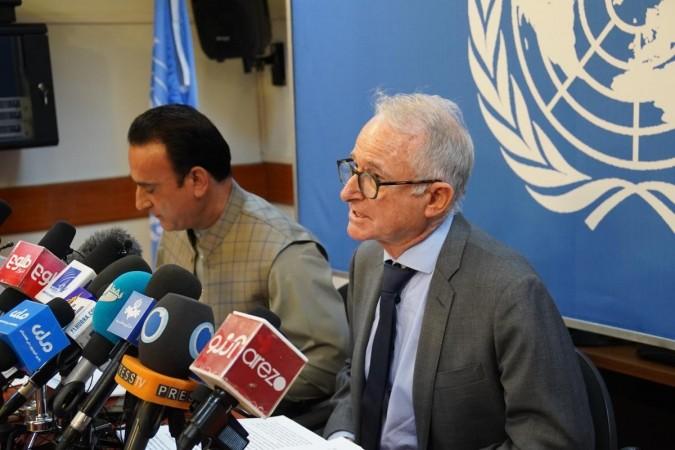
Richard Bennett, the United Nations' Special Rapporteur on the situation of human rights in Afghanistan, on Tuesday called for "prompt, independent and thorough investigations" as fresh reports cited that at least seven people have been killed and 75 injured in Pakistani strikes targeting Afghanistan's Kunar province.
"I echo UNAMA's concern and condolences. Civilians must always be protected and perpetrators held accountable. Therefore, there is a need for prompt, independent and thorough investigations of recent and earlier incidents," Bennett wrote on X while responding to a post by the United Nations Assistance Mission in Afghanistan (UNAMA).
In its post, UNAMA said that it has documented tens of civilians killed or injured yesterday afternoon in strikes on areas of Asadabad, eastern Afghanistan, including a university.
"Under international humanitarian law, civilians and civilian sites, including educational facilities, must be protected at all times. We extend our condolences to the families of those killed and wish a swift recovery to those injured," said UNAMA.
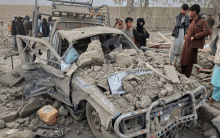
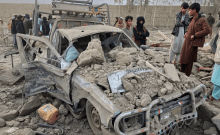
Reports indicate that at least seven people have been killed and 75 injured after Pakistani strikes hit parts of Afghanistan's Kunar province, including the provincial capital, Asadabad, and Sarkano district. The death toll continues to increase as more victims are being identified, local media reported.
According to officials at the government hospital in Asadabad, dozens of injured people, including women and children, were brought for treatment while emergency teams continue to respond to the situation, Afghanistan's leading news agency Khaama Press reported.
Local sources said that Monday's strikes hit several places, including residential areas and Sayed Jamaluddin Afghan University, where mortar rounds targeted the campus, causing damage and panic among students and employees. Heavy explosions and thick black smoke rising from the affected region were witnessed, and buildings, especially within the university compound and nearby neighbourhoods, suffered damage during the strikes.
Authorities said at least 30 students and staff were injured in the strike on the university. Local residents said the intensity of the attacks forced several people in the region to flee their homes as they feared possible use of drones, aircraft, and rocket fire, Khaama Press reported.
Last month, Bennett had expressed his dismay over Pakistani airstrikes in Afghanistan, which resulted in several civilian casualties.
Tensions between Pakistan and Afghanistan have escalated over the past few months, with repeated exchanges of fire and growing concerns over civilian casualties. The two nations have accused each other of contributing to instability, while diplomatic and local mediation efforts have remained futile in stopping further escalation.
In a statement following the attack, the Afghan ministry denounced the act as "cowardly, ruthless, and contrary to all Islamic and international principles".
Calling the strike an attack on education and the fundamental foundations of Afghanistan, the ministry urged international organisations not to remain silent in the face of the "ruthless action".
New IMF conditions bring more trouble for financially-starving Pakistan
In fresh trouble for financially-starving Pakistan, the International Monetary Fund (IMF) has added 11 new conditions to the ongoing $7 billion Extended Fund Facility (EFF) programme, according to a new report.
A report in Business Recorder says that one condition is the enactment of an amendment to the Special Economic Zones (SEZ) Act and the Special Technology Zones Authority Act to phase out existing fiscal incentives and shift from profit-based to cost-based incentives.
"What was extremely disturbing was the report that the government intends to give 6000 acres in Karachi on lease to developers of SEZs without charge," the report mentions.
However, the October 2024 IMF documents on the EFF approval observed that the tax system has been extensively used to provide non-transparent support through exemptions for privileged sectors like real estate, agriculture, manufacturing, and energy, as well as through the proliferation of Special Economic Zones (SEZs).
The condition was that existing SEZs would be phased out over a decade while no new SEZs will be set up, said the report.
Another new condition is to set up a regulatory registry to improve the business climate.
The report said that this is also a condition in the October 2024 documents wherein the government pledged to "ensure the highest level of transparency in all public procurement at the federal and provincial levels through the electronic Pakistan Acquisition and Disposal System (e-PADS), established with TA support from the World Bank".
Meanwhile, Pakistan's fragile economic footing has come into sharp focus amid shifting geopolitical and financial dynamics, even as Islamabad projects itself as a voice for peace on the global stage.
During heightened tensions linked to the US-Israel conflict with Iran, Pakistan drew international attention for its diplomatic outreach. However, behind this image of stability, a sudden financial strain exposed the country's dependence on external support, according to a Dawn report.
The United Arab Emirates withdrew $3.5 billion in deposits, creating immediate pressure on Pakistan's foreign exchange reserves, the report said.
Inflation has moderated, but high interest rates — maintained on IMF advice — have dampened investment and export competitiveness, trapping the economy in a low-growth cycle. Pakistan's external position remains particularly fragile.
(With inputs from IANS)