
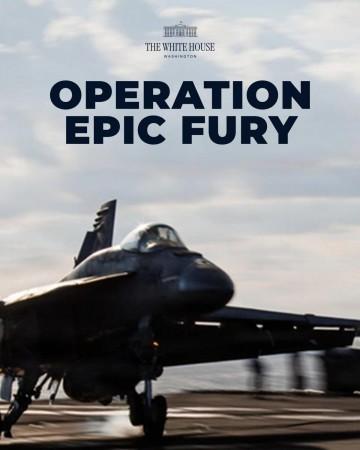
As Operation Epic Fury, the massive U.S.-led campaign against Iran's military infrastructure that erupted on February 28, 2026, at 1:15 a.m. ET, enters its eighth day, fresh reports and imagery highlight a stark tactical shift: America's two premier carrier strike groups have dramatically increased their standoff distance from Iranian coastal threats. The Abraham Lincoln-led group has maneuvered approximately 800–1,400 km farther out, while the Gerald R. Ford remains positioned far to the east in the Mediterranean, effectively placing both battle groups beyond the most immediate reach of Tehran's shorter-range anti-ship systems. This repositioning comes against a backdrop of relentless Iranian retaliation: over 500 ballistic missiles and 2,000 drones launched since the operation began, inflicting heavy damage on U.S. forward assets and forcing a protective withdrawal that has fueled speculation of vulnerability.
It is of interest to find how Iranian missile saturation, destroyed US radar, ravaged bases, embassy closures, mass evacuations, aircraft losses, and mounting casualties have forced America's two forward Carrier Strike Groups 800 km back from the Iranian frontlines in Operation Epic Fury
Herein I present an authoritative strategic assessment. In the opening days of Operation Epic Fury launched on 28 February 2026 at 1:15 a.m. ET with U.S. and partner forces striking more than 1,700 Iranian targets in the first 72 hours to dismantle IRGC command nodes, air defenses, missile production, naval assets, and other threats a dramatic shift has occurred in America's naval posture. The two most powerful U.S. carrier strike groups in the theater have executed a significant repositioning, moving back approximately 800 km from their forward operating boxes. This pullback has raised urgent questions: why have the two USN carriers in the Middle East effectively stepped out of the immediate action?
At the center of this development stand Carrier Strike Group 3 (CSG-3), led by the Nimitz-class nuclear-powered supercarrier USS Abraham Lincoln (CVN-72) with its escorts USS Spruance (DDG-111), USS Michael Murphy (DDG-112), and USS Frank E. Petersen Jr. (DDG-121), and Carrier Strike Group 12 (CSG-12), led by the world's largest and most advanced Ford-class supercarrier USS Gerald R. Ford (CVN-78), supported by destroyers including USS Winston S. Churchill. These groups were initially positioned for maximum offensive impact: the Lincoln in the Arabian Sea (routinely operating roughly 800 km off Iran's southern coast and Chabahar port) and the Ford having transited from the Caribbean into the Eastern Mediterranean. Their combined capabilities were formidable - Tomahawk cruise missile barrages from escorts, organic air wings with F-35C Lightning II fighters (VMFA-314), F/A-18E/F Super Hornet squadrons (VFA-41, VFA-151), EA-18G Growlers (VAQ-133), E-2D Hawkeyes, and MH-60R/S helicopters, plus the Ford's advanced electromagnetic catapults and dual-band radars enabling higher sortie rates. Together they represented the largest concentration of U.S. naval airpower in a generation.
Yet the Abraham Lincoln battle group after earlier routine operations and incidents such as the February shoot-down of an Iranian Shahed-139 drone increased its standoff distance to approximately 1,400 km, shifting southeast toward the Gulf of Aden, waters near Socotra Island, southern Yemen, and deeper into the Indian Ocean. This adjustment gained momentum after Iranian IRGC claims on 1 March 2026 of four anti-ship ballistic missile strikes on the Lincoln. The Gerald R. Ford group maintained its distant Mediterranean axis, thousands of kilometers from Iranian coastal threats. The overall effect has been a clear tactical withdrawal of both carrier strike groups from the hottest zones, with the Iranians noting that the carriers have not been directly attacked and appear to be lying low, hiding from the missile threats.
This repositioning cannot be separated from Iran's specialized arsenal, which lacks a direct long-range equivalent to China's DF-21D "carrier-killer" but delivers lethal effect through volume and precision in the confined Gulf theater (as detailed by The Jerusalem Post and regional analyses). The Khalij Fars (solid-fueled, maneuverable SRBM derived from Fateh-110) and its advanced Hormuz-2 variant target ships in the terminal phase. Hypersonic systems like the Mach-15 Fattah-1 (2023) and Fattah-2 (with hypersonic glide vehicle), plus the high-velocity Kheibar Shekan, are engineered to overwhelm U.S. Navy SM-6 and Aegis defenses. Medium-range ballistic missiles such as the 2,000 km Sejjil, Khorramshahr-4 (Kheibar), and precision Emad/Ghadr-1 series extend the threat envelope. Iran's doctrine relies on saturation barrages of missiles and drones rather than single precision shots exactly the tactic employed against U.S. assets.
The consequences have been severe and immediate. Iranian strikes destroyed the largest and most advanced American radar in the Gulf: the $1.1 billion AN/FPS-132 early-warning system at Al Udeid Air Base in Qatar (a 5,000 km-range ballistic-missile tracking asset installed in 2013), with satellite imagery confirming damage and contributing to nearly $2 billion in total U.S. equipment losses. Multiple bases suffered direct hits and required partial evacuation or operational pauses: Naval Support Activity Bahrain (Fifth Fleet headquarters, with warehouses and SATCOM destroyed), Camp Arifjan, Ali Al-Salem Air Base, and Camp Buehring in Kuwait; facilities in the UAE (including Jebel Ali Port), Erbil in Iraq, and sites in Jordan.
Diplomatic infrastructure collapsed under the pressure: embassies and consulates in Saudi Arabia (Riyadh struck by drones), Kuwait, Lebanon, Bahrain, and others were closed indefinitely or severely restricted, with further damage at the U.S. consulate in Dubai. The State Department issued urgent "depart now" orders for American citizens from exactly 14 Middle East countries Bahrain, Egypt, Iran, Iraq, Israel (including West Bank and Gaza), Jordan, Kuwait, Lebanon, Oman, Qatar, Saudi Arabia, Syria, the United Arab Emirates, and Yemen citing serious safety risks, while arranging charter flights and ordering out non-emergency personnel and families.
U.S. air and ground assets took direct hits. Three F-15E Strike Eagles were lost over Kuwait amid the chaos of Iranian barrages and friendly-fire complications, though crews ejected safely. Casualties mounted: at least six U.S. service members killed (including Army Reserve soldiers from the 103rd Sustainment Command in a drone strike at Port Shuaiba, Kuwait) and 18 injured, with additional shrapnel and concussion cases reported across struck facilities.
Faced with this layered Iranian arsenal terminal-phase ASBMs, hypersonic penetrators capable of piercing Aegis, and saturation tactics that have already exacted a heavy toll on forward bases, radar, diplomacy, and personnel the Abraham Lincoln group's retreat into the open Indian Ocean and the Gerald R. Ford's distant Mediterranean positioning represent a calculated response. The carriers have moved back 800 km because the combination of destroyed high-value sensors, attacked bases, closed embassies, mass civilian evacuations, lost aircraft, and fallen soldiers has compelled a protective standoff that prioritizes survivability over proximity to the fight.
In the final analysis, the two USN carriers in the Middle East are out of the immediate action now not by choice, but because Iran's missile campaign has imposed costs that no naval commander can ignore.
The two USN carriers in the Middle East have stepped back from the frontlines because Iran's missile doctrine volume over precision has imposed unacceptable risks on closer proximity, compelling a calculated retreat that preserves overwhelming firepower from safer distance. As CENTCOM asserts air superiority and strikes near 2,000 targets. The repositioning keeps the battle groups beyond the most lethal envelopes while the broader campaign continues a stark illustration of how a determined adversary's saturation strategy can force even the world's premier navy into a more cautious posture.
[Major General Dr. Dilawar Singh, IAV, is a distinguished strategist having held senior positions in technology, defence, and corporate governance. He serves on global boards and advises on leadership, emerging technologies, and strategic affairs, with a focus on aligning India's interests in the evolving global technological order.]