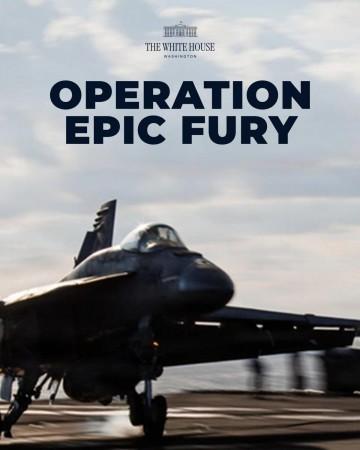
President Donald Trump has said that the United States is doing "very well" in the ongoing Operation Epic Fury against Iran, rating the war efforts as 15 on a scale of 10.
Trump's comments came amid escalating tensions following the February 28 US and Israeli strikes on Iran, which killed Supreme Leader Ayatollah Khamenei along with other key figures. He asserted that American forces had performed beyond expectations in the opening days of the conflict.
Speaking during a roundtable at the White House on Wednesday (local time), Trump said, "We're doing very well on the war front, to put it mildly. Somebody asked me, on a scale of 10, where would you rate it? I said about a 15."
He asserted that Washington was in a "very strong position" in the conflict with Iran and declared that US operations had significantly weakened Iran's military capabilities.
"We're going to continue to do well. We have the greatest military in the world by far, and that was a tremendous threat to us for many years. Forty-seven years they've been killing our people and killing people all over the world, and we have great support," he said.
Criticism of the 2015 Iran Nuclear Deal
Trump reiterated his long-standing criticism of the 2015 Iran nuclear deal negotiated during Barack Obama's administration, calling it "one of the worst deals ever made." He said that terminating it during his previous term prevented Tehran from obtaining a nuclear weapon.
"I think if we didn't do it first, they would have used it against Israel and maybe even given us a shot if that were possible. If we hadn't terminated one of the worst deals ever made—the Obama nuclear deal, where he gave everything to Iran, including a nuclear weapon—it would have led to bad outcomes four years ago," he said.
Claims of Weakening Iran's Leadership
Trump also claimed that recent US operations had rapidly degraded Iran's military capabilities and weakened its leadership.
"So, we're in a very strong position now, and their leadership is just rapidly going. Everybody who seems to want to be a leader ends up dead. It's an amazing thing happening before your eyes, because for 47 years we were pushed around, and we shouldn't have been," he added.
He argued that pre-emptive action was necessary: "I think if we didn't do it first, they would have done it to Israel and maybe even to us if possible."
Trump pointed to the destruction of Iran's missile systems and launchers, as well as attacks on neighboring countries and former allies, as evidence of the US's strategic gains. He also referenced the killing of Iranian commander Qassem Soleimani and the "complete obliteration of their nuclear potential" by US B-2 bombers.
Comments on Venezuela Relations
Turning to Venezuela, Trump described US relations with the government there as "really great," saying that Washington was "taking out hundreds of millions of barrels of oil" for mutual benefit. He asserted that Venezuelans would "be doing better than they've ever done before."
"Venezuela worked out really great. We have a wonderful relationship with the president and various representatives. We're taking out hundreds of millions of barrels of oil, which benefits both the US and Venezuela. Life will improve for the people of Venezuela, who have been very badly hit," he said.
US Military Strength Highlighted
Trump credited the rebuilding of the US military during his first term for enabling current operations, noting, "We're using it a little bit more than I thought we would have to."
Conflict Intensifies in the Middle East
The President's remarks come as the US-Israel-led conflict with Iran has escalated global tensions. The coordinated airstrikes on February 28 targeted military command centers, air-defense systems, missile sites, and key regime infrastructure, resulting in the deaths of Supreme Leader Khamenei and four senior Iranian officials. Large explosions were reported in Tehran and other major cities.
In response, Iran launched ballistic missiles and drones targeting US assets and allies across the region, including Israel, Bahrain, Kuwait, Qatar, Saudi Arabia, the United Arab Emirates, and Jordan. These retaliatory strikes have further widened the conflict in the Middle East, heightening risks for civilians and expatriates alike.

![Angry Jaya Bachchan pushes journalist's mic away during INDIA bloc protest [watch]](https://data1.ibtimes.co.in/en/full/839178/angry-jaya-bachchan-pushes-journalists-mic-away-during-india-bloc-protest-watch.jpg?w=220&h=135&l=50&t=40 "Angry Jaya Bachchan pushes journalist's mic away during INDIA bloc protest [watch]")



![Angry Jaya Bachchan pushes journalist's mic away during INDIA bloc protest [watch]](https://data1.ibtimes.co.in/en/full/839178/angry-jaya-bachchan-pushes-journalists-mic-away-during-india-bloc-protest-watch.jpg?w=220&h=138)



![Angry Jaya Bachchan pushes journalist's mic away during INDIA bloc protest [watch]](https://data1.ibtimes.co.in/en/full/839178/angry-jaya-bachchan-pushes-journalists-mic-away-during-india-bloc-protest-watch.jpg?w=220&h=135)