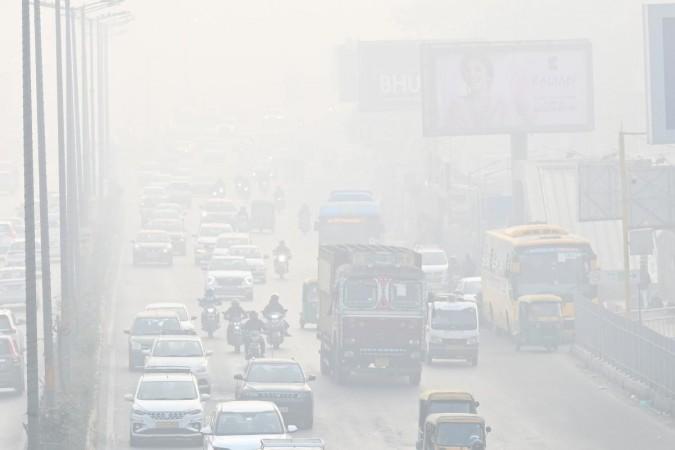
At 6:30 a.m. today as the first light struggles to pierce Delhi's impenetrable shroud, a journalist-parent's raw dispatch from the vicinity of the British School and American Embassy School shatters the complacency: "AQI 1823 Delhi Monday morning 6.30 am... Wake up Delhi. And don't look at your phone for AQI it's not showing you how bad it is!!!"
This is no mere outlier; it is the visceral truth of hyper-local toxicity, where personal sensors capture PM2.5 concentrations defying the Central Pollution Control Board's (CPCB) sanitized average of 461 for the prior day, the second-worst December reading on record. Official dashboards clock "severe" at hotspots like Anand Vihar and Akshardham (nearing 500), but ground reality, dense fog reducing visibility to 50 meters, flight disruptions, and an exodus of the vulnerable, signals a public health apocalypse.
Delhi's air is not polluted; it is weaponized, a toxic brew of anthropogenic folly trapped by winter inversions, low winds, and unrelenting emissions. This is the eighth consecutive year of such winters, yet institutional inertia persists, diverting blame while lives evaporate in the haze.
The Human Ledger: A Mounting Toll on the Frail
The abstract horror of an AQI beyond 1,800 translates to inhaling the equivalent of 50 cigarettes per day, with PM2.5 levels, fine particulates that lodge deep in lungs and bloodstreams, exceeding 1,000 μg/m³ in spikes. Infants, whose developing alveoli absorb toxins at triple the adult rate, face lifelong deficits: stunted lung growth, heightened asthma risk (up 40% in Delhi's under-fives this season), and cognitive impairments from neurotoxic black carbon. The elderly and frail, comprising 15% of the population, endure exacerbated COPD and cardiovascular crises; hospital admissions for these surged 25% in November alone, per AIIMS telemetry.
Delhi's six major central hospitals logged over 200,000 acute respiratory illness cases from 2022-2024, 67,054 in 2022, 69,293 in 2023, and 68,411 in 2024, attributable directly to pollution spikes. This December, emergency wards overflow with 12.5% of neurological admissions (dementia, Alzheimer's, Parkinson's) linked to air toxics, per recent epidemiological modeling. Low-income enclaves like Okhla and Yamuna Pushta, where 60% of cases cluster, amplify inequities: migrant laborers and slum dwellers, lacking masks or indoor filters, absorb 70% of the burden. Excess mortality? A conservative 1.5 lakh annually in the NCR, per State of Global Air 2025 projections, yet no emergency declaration, no subsidized respirators for the indigent. This is not oversight; it is abdication, prioritizing optics over oxygen.
Institutional Betrayals: A Cascade of Apathy and Evasion
Delhi's smog is a symphony of systemic failure, conducted by entities sworn to safeguard the commons yet entangled in deflection and dereliction.
The Delhi Government, under Chief Minister Rekha Gupta's BJP administration, exemplifies performative governance. GRAP Stage IV, invoked December 13, bans construction and non-essential vehicles, yet enforcement hovers at 40%, with illegal sites proliferating. Gupta's recent conflation of AQI with temperature underscores a deeper malaise: scientific illiteracy masked by denial. Allegations of data fudging, water-spraying near CPCB stations to artificially lower readings, compound the farce, as opposition voices decry a "cruel joke" in failed cloud-seeding pilots that yielded negligible PM reduction at exorbitant cost. Municipal corporations, riddled with vacancies (over 30% in enforcement wings), turn a blind eye to waste burning and biomass stoves in 40% of households.
The Union Government, via the Ministry of Environment, Forest and Climate Change, feigns coordination through the Commission for Air Quality Management (CAQM) while evading culpability. Environment Minister Bhupender Yadav deflects to "central bodies," silent on stubble-burning subsidies' 20% uptake or the ₹9,000 crore National Clean Air Programme's (NCAP) delivery of just 20% clean days since 2019. Development authorities like the Delhi Development Authority (DDA) and New Delhi Municipal Council (NDMC) accelerate unchecked megaprojects, Central Vista's dust plumes alone contribute 10-15% to seasonal PM10, defying NGT orders amid GRAP bans.
Pollution Control Boards, both central and state, are hollowed shells: CPCB's 39 stations (one per 500 sq km) under-sample spikes, with uncalibrated sensors and delayed uploads enabling tampering. Vacancies exceed 50% in enforcement cadres, per Supreme Court scrutiny, rendering source-apportionment studies, pinning 30% on stubble, 25% on vehicles, mere diagnostics without teeth.The National Green Tribunal (NGT), envisioned as environmental sentinel, has devolved into a lamentation chamber. Its 2025 directives on inter-state coordination languish unimplemented, while fines, capped at ₹10 lakh for egregious violations, evoke derision from violators. The highest judiciary, through the Supreme Court, has issued scathing rebukes, lashing the Delhi government for "hazardous" inaction in November, yet enforcement remains episodic, with contempt petitions piling up unaddressed. This triad of executive evasion, regulatory rot, and judicial fatigue perpetuates a vicious cycle: pollution as policy failure, not priority.
Global Benchmarks: Proven Pathways to Breathable Futures
Contrast this torpor with resolute models abroad, where political will harnesses technology, law, and transparency to reclaim air.China's "War on Pollution," launched in 2013, exemplifies transformation. Beijing's AQI plummeted 50% in a decade through uncapped fines (totaling US$154 million in 2017 alone, escalating since) and the 2015 Environmental Protection Law's "zero tolerance" for emitters. Winter protocols shutter 40% of factories, subsidize EVs to 50% penetration, and deploy big-data platforms integrating 10,000+ IoT sensors for hotspot detection and predictive alerts via apps, achieving 85% forecast accuracy. Penalties scale with violation severity, enforced by provincial courts with NGO standing, ensuring accountability.
South Korea's Seoul mirrors this rigor. The 2022 "Clearer Seoul 2030" plan, under the Special Act on Air Quality Improvement, mandates vehicle emission zones, fines up to KRW 100 million (US$75,000) for non-compliance, and real-time transparency via AirKorea dashboards. Regulations align with Euro-6 standards, reducing PM2.5 by 40% since 2015 through AI-optimized traffic and cloud-integrated monitoring. Public reporting, mandatory for industries, with blockchain-verified emissions, fosters trust, while 2025 policy shifts tighten standards amid transboundary haze from China.Technologically, both leverage IoT meshes (e.g., Ericsson-IIT Kanpur's 500-node networks) for 95% hyper-local accuracy, AI models forecasting spikes 72 hours ahead, and anti-smog towers filtering 10 million cubic meters hourly via electrostatic precipitators. Delhi could emulate: Scale NCAP to 10,000 sensors (₹500 crore investment), enact uncapped fines via NGT amendments, and mandate truthful reporting through a national API fusing CPCB-IQAir data.
Rekindling Resolve: From Despair to Directive
Delhi's crisis demands an existential pivot: Declare air pollution a national calamity, and the one in Delhi as an Emergency, invoking Disaster Management Act provisions for inter-state task forces. Subsidize bio-decomposers (95% efficacy in pilots), enforce construction halts with drone surveillance, and retrofit industries to renewables, creating 500,000 green jobs by 2030. Transparency via open-source dashboards, penalties escalating to 5% of turnover, and judicial fast-tracks for contempt would deter evasion.
This is no academic exercise; it is a moral imperative. As infants wheeze in unfiltered nurseries and elders ration breaths, the republic's capital, cradle of democracy, chokes on its own contradictions. Wake up, Delhi. Wake up, India. The haze lifts not with prayers, but with unyielding enforcement. Our children's tomorrow hinges on today's audacity. Let us not bequeath them a legacy of lungs scarred by neglect.
[Major General Dr. Dilawar Singh, IAV, is a distinguished strategist having held senior positions in technology, defence, and corporate governance. He serves on global boards and advises on leadership, emerging technologies, and strategic affairs, with a focus on aligning India's interests in the evolving global technological order.]