The most important achievement of the 18th BRICS Summit is easy to miss because it is buried beneath the choreography of handshakes, bilateral meetings and ceremonial photographs. India did something considerably harder than hosting a successful summit. It persuaded an expanded and increasingly heterogeneous BRICS to speak with one voice at a moment when the world itself appears to be losing the ability to do so.
The New Delhi Declaration, adopted by the leaders, contains 140 paragraphs and reaches across global governance, the UN Security Council, international finance, trade, terrorism, West Asia, energy, critical minerals, artificial intelligence, health, supply chains and development. It is not a document that eliminates differences. It is a document that demonstrates that differences need not make collective action impossible. That is the real Delhi achievement.
The difficult achievement was consensus
The diplomatic difficulty should not be understated. This is no longer the compact BRIC grouping of its early years. BRICS now spans 11 members across Asia, Africa, the Middle East and Latin America, bringing together major energy producers, manufacturing powers, financial economies and countries with competing strategic relationships. Iran and the Gulf states do not see every regional question through the same lens. China and India remain strategic competitors even as their bilateral relationship is being cautiously stabilised.
Russia remains at war with Ukraine and under extensive Western sanctions. The United States and its partners remain central to the economic calculations of many BRICS economies. Yet the leaders endorsed a common declaration built around sovereign equality, consensus, inclusiveness, international law, sustainable development and a more representative global order. India's Sherpa, Sudhakar Dalela, put the achievement in measured diplomatic language: despite leaders speaking from their respective national perspectives, there was "broad convergence" on strengthening multilateralism and making global governance institutions more representative, inclusive, effective and responsive. He described the adoption of the declaration as one of the defining outcomes of India's chairship, alongside more than 50 outcomes generated during the year.
From a pyramid of privilege to a platform of partnership
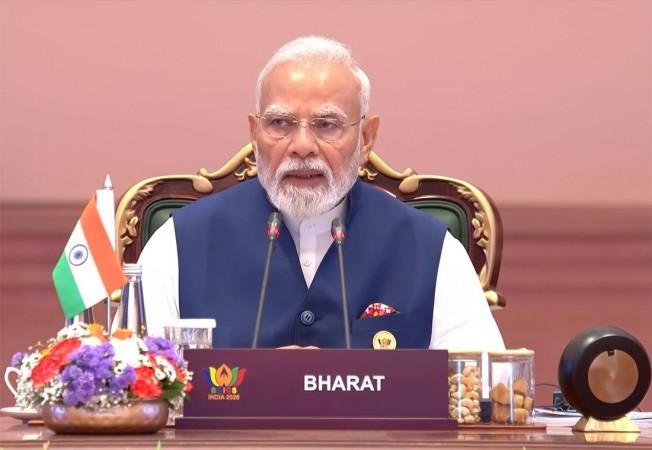
Prime Minister Narendra Modi's opening intervention provided the intellectual architecture for the summit. He described the existing global system as a "pyramid of privilege", with decision-making concentrated at the top while many countries affected by those decisions remain at the bottom. His proposed alternative was a "platform of partnership", where every country has a voice and every member has a stake. "If our future is shared, then the right to shape that future must also be shared," he declared. He proposed ten global-governance reforms to be developed into a BRICS Reform Roadmap, organised around three principles: Representation, Responsiveness and Rule-making. This is perhaps the most ambitious element of India's BRICS vision. New Delhi is not merely asking developing countries to be better represented in existing institutions. It is arguing that they must become participants in writing the rules governing artificial intelligence, cyberspace, biotechnology, outer space and other critical technologies.
That ambition is reflected directly in the declaration. BRICS calls for comprehensive reform of the UN, including the Security Council, to make it more democratic, representative, effective and efficient. Most significantly for India, China and Russia, both permanent Security Council members, explicitly reiterated support for the aspirations of India and Brazil to play a greater role in the UN, including the Security Council. The declaration also recognises the aspirations of African countries under the Ezulwini Consensus and Sirte Declaration. This is not yet a reform of the Security Council, but diplomatically it is meaningful: India has secured language placing its aspiration inside a common BRICS framework supported by the two other major Eurasian powers.
India has chosen architecture over symbolism
The economic significance of Delhi lies in another choice: India has resisted reducing BRICS to the fashionable rhetoric of a common currency or a simple anti-dollar coalition. The official Indian position is unequivocal: there is no BRICS currency proposal on the table. Instead, the agenda is more practical and potentially more achievable: national-currency settlement, payment interoperability, cheaper and faster cross-border transactions and continued work by the BRICS Payment Task Force. This distinction matters. A common currency would require extraordinary monetary and institutional convergence among countries with radically different economies and policy priorities. Interoperable payment systems require cooperation but preserve national sovereignty. In strategic terms, the second path is much more plausible.
The declaration simultaneously demands reform of the IMF and World Bank so that voting power and leadership better reflect today's economic realities, calls for meaningful quota realignment at the IMF, supports greater developing-country representation in the World Bank, and backs restoration of a fully functioning two-tier WTO dispute-settlement mechanism. It also criticises unilateral tariffs, protectionist measures and unilateral coercive sanctions not authorised by the UN Security Council. In other words, BRICS is trying to change the operating rules of globalisation without abandoning globalisation itself. That is a far more consequential proposition than the caricature of BRICS as merely an anti-Western grouping.
The declaration speaks directly to India's strategic concerns
Perhaps nowhere is India's diplomatic imprint clearer than in terrorism. The declaration condemns the 22 April 2025 terror attack in Jammu and Kashmir, which killed 26 people, and calls for zero tolerance towards terrorism in all its forms and manifestations, including cross-border movement of terrorists, terrorism financing and safe havens. It also calls for accountability for those involved in terrorism and their supporters and urges progress on the Comprehensive Convention on International Terrorism. This is stronger and more specific than a routine generic condemnation and represents a significant Indian diplomatic gain within a document requiring consensus.
West Asia presented the opposite challenge. Here India had to construct language broad enough to retain unity among countries with sharply different positions. The declaration calls for maximum restraint, protection of civilians and civilian infrastructure, respect for sovereignty and territorial integrity, and diplomatic efforts towards lasting peace. It expresses concern over attacks affecting peaceful nuclear facilities under IAEA safeguards and stresses nuclear safety and security. On Gaza, it calls for humanitarian access, implementation of relevant UN resolutions, opposition to forced displacement and support for Palestinian self-determination and full UN membership within a two-state framework. The achievement is not that BRICS has solved West Asia. It plainly has not. The achievement is that the conflict did not break BRICS consensus.
The next contest is over technology, energy and strategic resources
The declaration is also striking for what it says about the future rather than merely the present. AI is no longer treated as a peripheral technology issue. BRICS endorses cooperation on responsible, safe, secure and inclusive artificial intelligence and supports implementation of its global AI governance framework. Quantum technologies, cybersecurity, digital systems and emerging technologies are similarly moving into the core agenda. India has deliberately linked this to its own AI Impact Summit of February 2026, signalling that New Delhi wants emerging economies to participate in setting the rules of technological power rather than merely consuming technologies developed elsewhere.
The same logic applies to energy and critical minerals. BRICS recognises energy security as fundamental to economic and national security and, importantly, acknowledges that fossil fuels will continue to play an important role, particularly for emerging and developing economies, while simultaneously supporting renewable energy, nuclear power, hydrogen, storage and low-carbon technologies. It calls for resilient, diversified and fair critical-mineral supply chains, with value addition and greater benefits for resource-rich developing economies. This is the language of countries that understand that the energy transition is becoming not only an environmental project but also an industrial and geopolitical contest.
The quieter revolution: implementation
Perhaps Modi's most important institutional proposal is one that received far less attention than the headline geopolitics. He proposed a BRICS Continuity and Implementation Mechanism, operating through the BRICS Troika, with a secure digital repository recording for every decision its nodal institution, timeline and implementation status. This is precisely the kind of institutional reform that BRICS has historically lacked. Annual presidencies can produce impressive declarations and then lose momentum when the chair changes. India is attempting to create institutional memory and accountability across presidencies.
That matters because India's chairship has already produced a substantial operational base. More than 400 meetings and engagements involving ministers, parliamentarians, agencies, officials, experts, businesses and people were held across 30 Indian cities, according to the final declaration. Initiatives include cooperation on logistics and supply chains, global value chains, customs, standards, smart grids and energy storage, science and research, digital agriculture, health, startups and sports technology. The challenge now is to prevent these initiatives from becoming another collection of acronyms. India's proposed continuity mechanism could be the bridge between summit diplomacy and measurable implementation.
The Modi-Xi moment adds another layer
The summit's bilateral diplomacy was almost as important as its multilateral outcome. Modi's meeting with Chinese President Xi Jinping produced a carefully calibrated message: "Differences should not become disputes." Modi stressed mutual respect, mutual sensitivity and mutual interest, while making clear that peace and tranquillity along the border remain essential to the relationship. Both sides discussed the boundary question, trade imbalance, market access, supply chains, people-to-people exchanges and regional issues. This is not reconciliation, and it should not be described as one. It is something more useful: an attempt to prevent strategic competition from becoming permanent strategic hostility.
India's simultaneous engagement with Russia, Iran, the UAE, Ethiopia, Malaysia and other BRICS and partner countries reinforces the same strategic philosophy. With Malaysia, discussions extended from trade, defence and semiconductors to digital economy, energy and fintech, with Malaysian concurrence for an Indian Consulate General in Kota Kinabalu. With Ethiopia, Modi discussed economic cooperation, defence, capacity building and the wider Global South. These are not incidental bilateral meetings; they are the connective tissue of India's broader strategy of building relationships across competing geopolitical theatres.
The Delhi test now moves beyond Delhi
The most important question is no longer whether India has hosted a successful BRICS summit. It has. Nor is it whether India obtained a declaration. It did. The harder question is whether New Delhi has succeeded in changing what BRICS is capable of becoming.
The evidence is encouraging. A grouping representing an extraordinary share of humanity and global economic output has produced common language on reform of global institutions, terrorism, trade, development finance, AI, energy, critical minerals and conflict prevention. It has avoided the trap of becoming simply an anti-Western coalition. It has given greater institutional weight to the Global South. And India has inserted into the BRICS architecture a concept often missing from summit diplomacy: implementation.
The real achievement, therefore, is not that India made eleven countries agree on everything. That would have been impossible and undesirable. It is that India made them agree on many.
The next chapter belongs to China, which takes over the BRICS chair in 2027. Its task will be to preserve the consensus architecture created in Delhi while advancing its own priorities. India's challenge is different: to ensure that the Delhi Declaration does not become another impressive diplomatic document archived after the summit, but the beginning of a sustained programme of institutional reform, economic interoperability, technology cooperation and Global South capacity-building.
Delhi has not merely hosted BRICS. It has attempted to give the Global South a more organised political vocabulary, a more practical economic architecture and, most importantly, a greater claim to shape the rules by which the twenty-first century will be governed.
[Major General Dr. Dilawar Singh, IAV, is a distinguished strategist having held senior positions in technology, defence, and corporate governance. He serves on global boards and advises on leadership, emerging technologies, and strategic affairs, with a focus on aligning India's interests in the evolving global technological order.]