
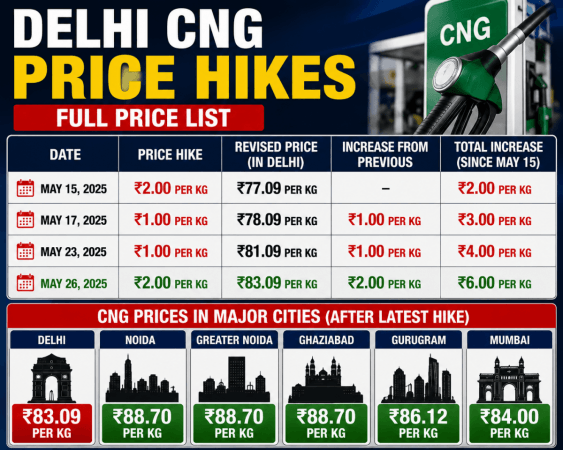
Delhi's CNG has been hiked again. Effective from 6 am on May 26, compressed natural gas in the capital now costs Rs 83.09 per kg, up Rs 2 per kg from the previous rate and the fourth increase in less than two weeks.
The cumulative rise since May 15 now stands at Rs 6 per kg, as Indraprastha Gas Limited continues to pass on the pressure of rising global energy costs to consumers. The hike on Tuesday follows a Re 1 per kg increase on Saturday (May 23), which itself came after a Re 1 per kg rise on May 17 and a Rs 2 per kg hike on May 15, three revisions in rapid succession before Tuesday's latest increase.
The trail of hikes
The pace of revision has been striking. In just 11 days:
May 15: CNG hiked by Rs 2 per kg
May 17: CNG hiked by Re 1 per kg
May 23: CNG hiked by Re 1 per kg
May 26: CNG hiked by Rs 2 per kg
The total increase across those four revisions: Rs 6 per kg in under a fortnight.

What the revised rates look like
Following the latest revision, Delhi consumers pay Rs 83.09 per kg. CNG in Noida, Greater Noida and Ghaziabad had risen to Rs 88.70 per kg after earlier revisions, while Gurugram consumers faced a revised rate of Rs 86.12 per kg. Mumbai's CNG now stands at Rs 84 per kg.
CNG is not the only fuel that has seen repeated revisions. Petrol and diesel have also been hiked multiple times over the same period. In Delhi, petrol has now crossed the Rs 100 mark after the prices were hiked again on Monday.
What is driving the hikes
Industry sources have linked the surge to fears of supply disruption in the Strait of Hormuz, the critical global oil transit route handling nearly 20% of the world's oil and gas trade, amid the ongoing US-Iran conflict. Global benchmark crude, which was trading around $70–72 per barrel before tensions escalated, surged past $120 at one point and is currently hovering between $104 and $110 per barrel. India's crude oil basket has averaged around $113–114 per barrel in recent months, compared to approximately $69 per barrel earlier this year.
India imports approximately 90% of its crude oil requirements, making it directly exposed to international price movements. Oil marketing companies have been absorbing mounting losses as global crude climbed sharply, and the successive fuel hikes represent a progressive transfer of that burden to consumers.
Who is bearing the cost?
For daily commuters, commercial vehicle operators and taxi drivers who depend on CNG for its relative affordability over petrol and diesel, the rapid succession of increases is narrowing that advantage with each revision.
Taxi unions and commercial transport bodies across Delhi-NCR have been protesting the hikes, demanding both a rollback and upward revisions in fare structures to reflect rising operational costs. Industry groups argue that mounting expenses are making it increasingly difficult for drivers and transport businesses to stay financially viable.
(With inputs from IANS)