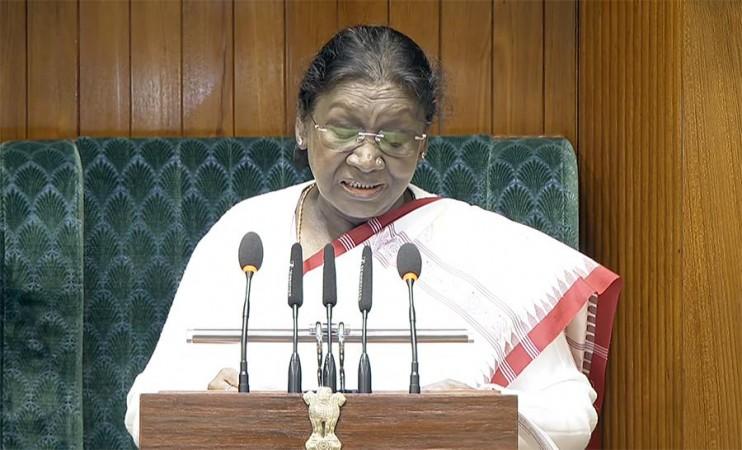
President Droupadi Murmu's address to the joint session of Parliament on Wednesday was marked by strong assertions of India's security achievements and the government's success in tackling both internal and external threats. Setting the tone for the Budget Session, she lauded the near-elimination of Maoist influence across large parts of the country and praised the Indian Armed Forces for their decisive response to terrorism through Operation Sindoor, launched after the 2025 Pahalgam terror attack.
Invoking the words of Guru Tegh Bahadur — "bhay kahun ko deit nehn nehn bhay manat aan" (we should neither scare anyone nor be scared of anyone) — the President said India's strength lies in its fearless spirit. Guided by this principle, she noted, India has safeguarded its security and demonstrated its unwavering resolve to defend sovereignty.
Operation Sindoor and counter-terror policy
Calling Operation Sindoor a turning point, President Murmu said it showcased the valour and self-reliance of the Armed Forces. "With its own resources, our country destroyed terror hotbeds," she told Parliament, underscoring that India acted independently without relying on external support to protect its citizens.
She also highlighted the government's decision to keep the Indus Water Treaty in abeyance as part of its counter-terrorism strategy, calling it a reflection of India's willingness to recalibrate long-standing agreements when national security is at stake. By linking water diplomacy to counter-terror efforts, she conveyed that India's approach is both comprehensive and uncompromising.
Maoism curtailed through security and development
Turning to internal security, President Murmu said decades of Maoist insurgency had pushed several regions into fear and distrust. "For years, there was fear in 126 districts. Maoist ideology pushed the future of several generations into darkness," she said.
She noted that Maoism has now been reduced to just eight districts, crediting sustained counter-insurgency operations, development initiatives and rehabilitation programmes. Around 2,000 individuals linked to Maoist groups surrendered in the past year, she said, calling it evidence of the government's dual approach of firmness and reconciliation.
The President emphasised that progress against extremism is not only about military success, but also about restoring trust, justice and opportunities in communities long affected by violence.
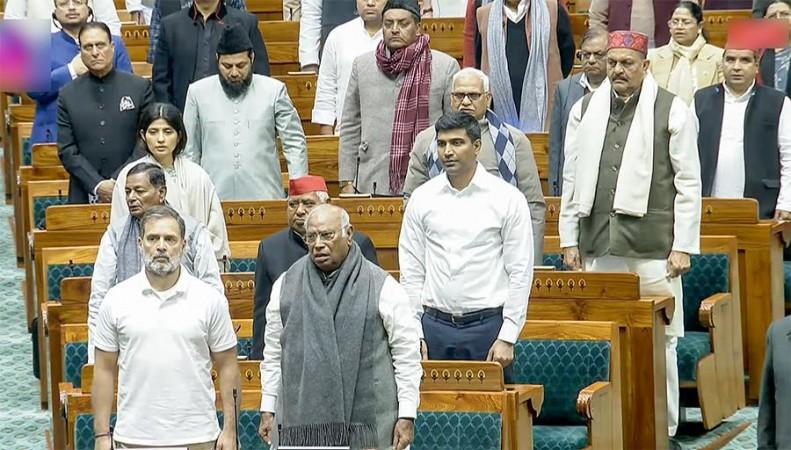
Ceremonial start to Budget Session
President Murmu was addressing a joint sitting of Parliament to mark the beginning of the Budget Session. She arrived in a ceremonial six-horse-driven buggy and was welcomed by Vice President C P Radhakrishnan, Prime Minister Narendra Modi and Lok Sabha Speaker Om Birla. She was escorted to the Lok Sabha chamber amid traditional ceremony, including a procession carrying the Sengol.
Reflecting on India's journey, she said, "The completion of the first 25 years of this century has been marked by numerous successes and extraordinary experiences," adding that over the past 10–11 years, India has strengthened its foundation across sectors.
Social justice, welfare and health
Underscoring inclusive development, Murmu said social justice meant ensuring full rights for every citizen without discrimination. She said 25 crore people have emerged from poverty in the last decade.
She highlighted construction of four crore pucca houses, provision of piped water to 12.5 crore households under Jal Jeevan Mission, over 10 crore LPG connections under Ujjwala Yojana, and ₹6.75 lakh crore transferred directly to beneficiaries in the past year.
On health, she said social security coverage had expanded from 25 crore people in 2014 to 95 crore today, with over 11 crore free treatments provided under Ayushman Bharat. She also noted that the WHO has declared India free of trachoma.
Agriculture, economy and manufacturing
Calling farmers central to Viksit Bharat, the President said India had achieved record foodgrain production of over 350 million tonnes, become the world's largest rice producer, and the second-largest fish producer.
On the economy, she said India remains the fastest-growing major economy, with smartphone exports crossing ₹1 lakh crore in the first five months of 2025–26 and electric vehicles now being exported to over 100 countries. She also welcomed the conclusion of India–EU free trade agreement negotiations.
Infrastructure, reforms and green growth
Murmu highlighted unprecedented investment in infrastructure, including 18,000 km of rural roads, expansion of Vande Bharat services, rapid railway electrification, and India becoming the world's third-largest metro network.
She said PRAGATI meetings had fast-tracked projects worth over ₹85 lakh crore, while India is on track to achieve 500 GW of renewable energy capacity by the end of the decade. Nuclear power, she added, will play a key role, supported by the SHANTI Act.
VB-G RAM G Act sparks protests
The President's reference to the VB-G RAM G Act, proposed to replace MGNREGA, triggered protests from Opposition members demanding its rollback. Murmu said the law would guarantee 125 days of work, curb leakages, and boost rural development, drawing applause from treasury benches.
Women-led development and youth
Emphasising women-led development, Murmu said over 10 crore women are connected to self-help groups, with two crore Lakhpati Didis created so far. She highlighted initiatives such as Namo Drone Didi, Swasth Nari campaign, and the graduation of the first batch of women NDA cadets.
She said India is now the world's third-largest startup ecosystem, with nearly two lakh startups and strong participation by women entrepreneurs.
Global role and cultural heritage
On foreign policy, Murmu said India is acting as a bridge amid global conflicts, amplifying the voice of the Global South and strengthening platforms like G20, BRICS, BIMSTEC and SCO. She also highlighted cultural milestones, including UNESCO recognition of Diwali and the return of Buddha relics.
Concluding her address, the President urged lawmakers to rise above differences, saying the goal of Viksit Bharat, national security and self-reliance must unite Parliament. "The goal of Viksit Bharat is not limited to one government or one generation," she said.