
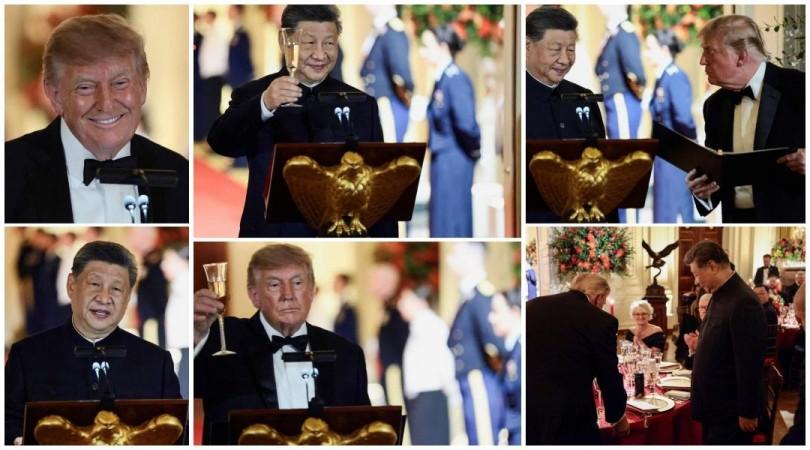
The warmth surrounding Xi Jinping's September 2026 state visit to the United States can easily obscure what was strategically more important than the ceremony itself. The Xi-Trump talks produced understandings on trade, AI, Iran, international waterways and military crisis communication, but did not resolve the fundamental China-US rivalry. Their deeper significance lies elsewhere. They offered a glimpse of how the world's two most powerful states may be preparing to coexist in an international system that is no longer comfortably unipolar, but has not yet settled into a new order.
Xi described the relationship in remarkably precise terms: "cooperation is the mainstay, competition is kept within proper limits, differences are managed and peace can be expected." China characterised the desired relationship as one of "strategic stability" based on "respect, fairness and reciprocity." The United States secured Chinese commitments on trade, agricultural purchases, precursor chemicals and other issues, while China obtained greater stability on several trade measures. Yet tariffs, technology restrictions, supply-chain dependence and Taiwan remain unresolved. The summit therefore did not produce strategic reconciliation. It established a framework within which rivalry might be contained.
That distinction is crucial because the China-US relationship is no longer simply a bilateral contest. It is increasingly a contest over the distribution of global power and the rules by which that power is exercised.
The trade understanding is consequently better understood as a truce than a transformation. Both countries have powerful incentives to prevent economic rupture. America retains extraordinary advantages in advanced semiconductors, software, finance, research and high-end technology; China possesses enormous manufacturing capacity, industrial supply chains and strength in critical minerals and processing. Neither can easily disengage from the other without imposing substantial costs upon itself. Economic interdependence has therefore become not an alternative to strategic rivalry, but one of the principal mechanisms through which rivalry is managed.
Technology exposes the same paradox even more sharply. Xi proposed continuing China-US AI dialogue, including cooperation on risks and preventing misuse, arguing that AI should remain "under human control" and serve humanity. Washington, however, continues to treat advanced AI as a strategic competition in which American technological leadership must be preserved. The two powers are thus simultaneously negotiating rules for managing technological risks and competing for technological advantage. The emerging order will be shaped not merely by who develops the most powerful technologies, but by who establishes the standards, controls critical infrastructure and influences the rules governing their use.
Iran provides an even more revealing window into the changing architecture of power. During the Washington discussions, Trump reportedly warned Xi that Chinese assistance to Iran was "totally unacceptable." China was nevertheless prepared to engage on preventing nuclear proliferation and on the security of international waterways.
Immediately after Xi's Washington visit, Chinese Vice President Han Zheng delivered a carefully calibrated message to the international community at UNGA. He said:
""Major countries should have special responsibilities for safeguarding international peace and security, and they should take the lead in complying with the rules, upholding rule of law, and doing what's right.""
He added:"China holds that the sovereignty and security of countries in the Middle East, including the Gulf, should be respected.""
China also called on the unnamed "relevant country" to stop threatening Cuba and lift the blockade and sanctions. Indian and international reporting interpreted the timing and language as an indirect pushback against Washington.
The significance lies not simply in the criticism itself, but in the separation between the two messages.
In Washington, China was negotiating with America. At the UN, China was addressing the international order.
Beijing was signalling that it was willing to stabilise relations with the United States without conceding that Washington alone should define the legitimate limits of state power or determine the security choices of other sovereign countries.
This is reinforced by China's broader Global Governance Initiative, which advocates sovereign equality, international rule of law, multilateralism, a people-centred approach and action-oriented implementation, while explicitly rejecting unilateralism, hegemony and "bullying" behaviour. Chinese Foreign Minister Wang Yi, explaining the post-summit relationship, similarly said reciprocity meant that neither side should engage in "hegemonic nor bullying behavior."
China is therefore contesting America at two interconnected levels: the distribution of power and the legitimacy of the rules governing power.
This does not mean that China is offering an uncontested alternative order, nor that other states necessarily accept Beijing's conception. It means that the legitimacy of a predominantly American-defined international system is itself becoming contested.
The United States, meanwhile, continues to emphasise national sovereignty, military capability, economic leverage, technological leadership and freedom of action. Washington also requires Chinese cooperation on trade, AI, Iran, waterways and strategic stability. This creates a structural tension at the heart of the emerging order: how can the system impose meaningful rules on powerful states when the most powerful states disagree over both the content of those rules and who has the authority to enforce them?
Taiwan remains the most dangerous expression of that unresolved contest. Xi explicitly asked Trump to oppose "Taiwan independence" and handle the issue cautiously. Nothing in the summit suggests that the underlying strategic disagreement has disappeared. It has been managed, not resolved. Taiwan therefore remains not merely a China–US dispute, but a potential test of deterrence, alliances, international law and the credibility of the emerging balance of power.
The sequence involving India adds another significant dimension. Xi met Narendra Modi in New Delhi before travelling to Washington. India and China agreed to take a "strategic and long-term perspective" of their relationship and that "differences should not become disputes," while continuing to address the border, trade imbalance, supply chains and market access. This is important because India is not simply an observer of the China–US contest. Its growing economic, technological, military and diplomatic weight gives it increasing capacity to shape the space between competing centres of power.
The same is true, in different ways, of Europe, Russia, the Gulf states, Japan, ASEAN and much of the Global South. They increasingly seek room for manoeuvre rather than permanent alignment with a single great power. Their choices may not amount to a coordinated bloc, but collectively they contribute to a world in which influence is more distributed and diplomatic agency is less concentrated.
Deeper meaning of the Xi–Trump encounter
The world is not moving neatly from American power to Chinese power. It is moving towards a more complicated environment in which American power remains formidable, Chinese power continues to expand, India and other major and middle powers seek greater strategic autonomy, Russia retains disruptive and military weight, Europe seeks greater strategic capacity, and the Global South demands greater representation in global institutions.
The emerging order is therefore likely to be neither a simple continuation of post-Cold War unipolarity nor a clean bipolar replacement. It is more likely to be contested, negotiated and increasingly multipolar, with different powers cooperating in one arena while competing in another.
The Xi-Trump summit illustrates how that system may function. China does not appear to be seeking an immediate rupture with America, nor accepting American primacy. Its approach is increasingly one of managed strategic competition: cooperate where conflict is too costly, compete where advantage matters, deter where vital interests are threatened, negotiate where interests overlap and build mechanisms that prevent crises from becoming wars.
Washington is confronting the same strategic reality from a different position: preserving technological leadership, strategic influence and freedom of action while obtaining Chinese cooperation where American interests require it.
This produces an unusual great-power relationship in which interdependence becomes a constraint on confrontation, competition becomes permanent, and diplomacy becomes the mechanism for keeping the two from colliding.
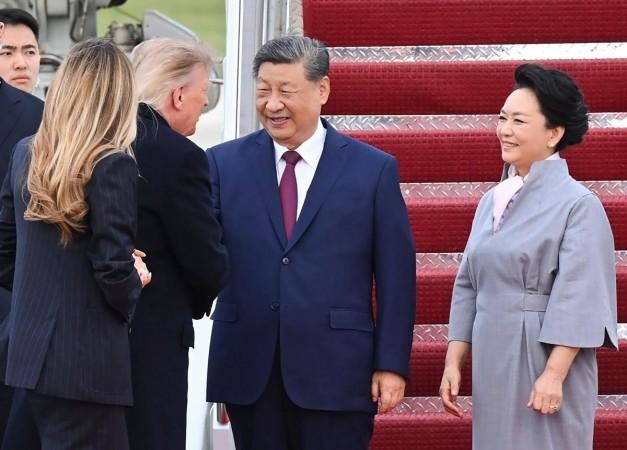
The handshake therefore matters less as a symbol of friendship than as evidence of a larger adjustment. The summit did not establish trust. It established guardrails. It did not end rivalry. It demonstrated that rivalry can coexist with selective cooperation.
And China's subsequent UNGA intervention showed that bilateral accommodation with Washington does not necessarily imply acceptance of Washington's conception of the international order.
The decisive question, therefore, is no longer simply who will be the world's most powerful country. It is becoming a more profound question: Who will define the rules by which power is exercised, constrained and legitimised? That contest will extend far beyond Washington and Beijing. It will run through the UN, international finance, trade, technology standards, AI governance, supply chains, maritime security, regional conflicts and the strategic choices of countries such as India.
The Xi–Trump encounter thus becomes significant precisely because it contains both accommodation and contestation. The handshake in Washington represented an effort to stabilise the most consequential bilateral rivalry in the world. The message from Beijing represented boundaries around what China believes that stabilisation should mean. The UNGA provided the larger stage on which the competing visions of international order were articulated. The handshake was bilateral, its meaning was global.
The immediate achievement may therefore be modest but important: the world's two most consequential powers have, for now, found sufficient common ground to compete without allowing competition to become uncontrollable.
But the larger story has only begun. The central struggle of the coming decade may not be about replacing one hegemon with another. It may be about whether the next international order will be defined by the dominance of a single power, by bipolar rivalry, or by a more distributed system in which several centres of power have both the capacity and the legitimacy to shape the rules. That is the real significance of Xi and Trump meeting in Washington: not the handshake itself, but the emerging contest over what comes after it.
[Major General Dr. Dilawar Singh, IAV, is a distinguished strategist having held senior positions in technology, defence, and corporate governance. He serves on global boards and advises on leadership, emerging technologies, and strategic affairs, with a focus on aligning India's interests in the evolving global technological order.]