
The geopolitics of the Arctic has entered a decisive and far more consequential phase. What appears outwardly as a technical arrangement between Canada and Greenland on critical minerals and energy cooperation in fact represents a subtle but profound strategic shift in the High North. Beneath the diplomatic language lies a struggle over one of the most decisive resources of the twenty-first century: the minerals that power the digital economy, the clean energy transition, and the next generation of military technology. Rare earth elements, lithium, cobalt, molybdenum, and other strategic minerals have become the new foundations of power in a world defined increasingly by artificial intelligence, electrification, precision weaponry, and advanced electronics. As oil shaped geopolitics throughout the twentieth century, critical minerals are now shaping the economic and strategic architecture of the present century. The influential strategist Daniel Yergin once observed that "energy transitions reshape the entire map of power," and the same logic increasingly applies to mineral supply chains that feed modern technology. Likewise, Ursula von der Leyen has warned that "the raw materials of the future are as important to our economies as oil was in the last century." The emerging Canada–Greenland partnership therefore reflects far more than a mining initiative. It signals the beginning of a new geopolitical contest over Arctic resources, supply chains, and influence in a region that is rapidly moving from peripheral geography to a central strategic theater.
Greenland: The Strategic Island at the Center of the Arctic
Few territories on Earth combine geography, resources, and strategic location in the way Greenland does. With a population of roughly fifty-six thousand people but a landmass larger than Mexico, the island sits at the critical juncture between North America and Eurasia. For military planners, Greenland occupies a unique position along the shortest missile trajectories between Russia and the United States, making the American installation at Pituffik Space Base one of the most critical nodes in the global missile early-warning architecture. The renowned geopolitical thinker Halford Mackinder famously wrote that "who controls the strategic heartlands shapes the destinies of continents," and in the modern Arctic equation Greenland increasingly resembles such a strategic pivot. Former NATO Secretary General Jens Stoltenberg has warned that "the High North is becoming more important for NATO because we see a significant Russian military buildup and increasing Chinese interest." Yet the island's geopolitical significance extends far beyond military geography. Greenland possesses substantial deposits of rare earth elements, zinc, nickel, uranium, molybdenum, and other minerals essential to modern industry. As Fatih Birol has cautioned, "critical minerals are fast becoming the cornerstone of the global energy system." These materials are indispensable components of electric vehicles, wind turbines, satellites, missile guidance systems, advanced radar arrays, and artificial intelligence hardware.
Canada's Arctic Strategy and the Emerging Mineral Corridor
Canada has moved deliberately to position itself at the center of this emerging Arctic mineral ecosystem. Ottawa's critical minerals strategy seeks to build secure supply chains across North America and allied economies. Canadian policymakers increasingly see Arctic mineral cooperation as both an economic opportunity and a strategic imperative. Former Canadian prime minister Justin Trudeau once remarked that "Canada is an Arctic nation, and the future of the Arctic is deeply tied to our economic and environmental destiny." The growing cooperation between Canada and Greenland reflects both geographic logic and shared Arctic interests. Canadian mining companies possess decades of operational experience in harsh northern environments, and their expertise in infrastructure development, indigenous engagement, and environmental stewardship makes them natural partners for Greenland's emerging mining sector. Arctic policy scholar Heather Exner-Pirot has observed that "Canada's credibility in the Arctic comes from decades of practical governance and partnership with northern communities." Canada has reinforced this approach by opening a consulate in Nuuk and expanding diplomatic engagement with Greenlandic institutions. As Canadian officials frequently emphasize, cooperation in the Arctic must be grounded in sustainability, respect for indigenous communities, and long-term regional development.
Greenland's Quest for Economic and Strategic Autonomy
Greenland occupies a unique constitutional position within the Kingdom of Denmark, controlling domestic affairs while Copenhagen retains authority over defense and foreign policy. Yet the island's long-term political ambition increasingly centers on greater economic independence and eventually full sovereignty. Mineral development is central to that vision. Greenland's prime minister Múte Bourup Egede has repeatedly emphasized that "Greenland's resources belong to Greenland and must benefit the people who live here." Danish political leaders have also acknowledged the island's evolving aspirations. Danish prime minister Mette Frederiksen has stated that "the future of Greenland will always be decided by the Greenlandic people themselves." Economic realities, however, make the transition toward greater autonomy complex. Greenland's economy remains heavily dependent on fishing exports and financial transfers from Denmark. Mining offers a pathway toward diversification and long-term sustainability. Political economist Joseph Stiglitz has argued that "resource wealth, if governed wisely, can transform small economies into engines of prosperity." Greenland's leaders therefore face the delicate task of attracting investment while maintaining control over their national development trajectory.
The United States and the Strategic Sensitivity of Greenland
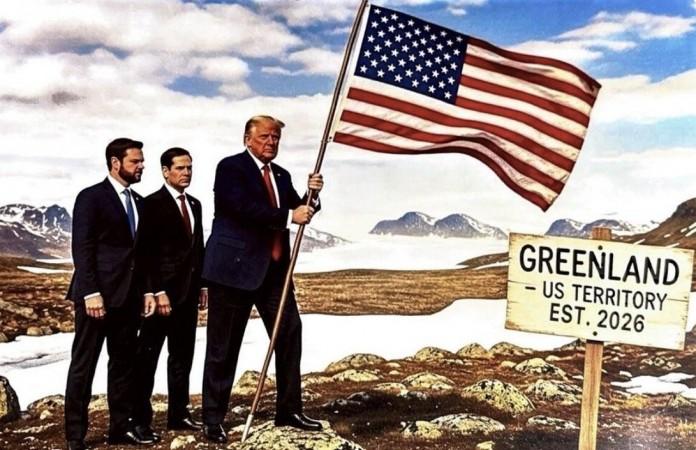
For Washington, Greenland has long been a territory of extraordinary strategic sensitivity. American forces first established a presence there during the Second World War, recognizing its value for monitoring the North Atlantic and Arctic approaches. During the Cold War the island became a cornerstone of North American missile defense architecture. The strategic significance of Greenland was dramatically illustrated in 2019 when Donald Trump publicly suggested that the United States might purchase the island from Denmark. While the proposal was rejected, it revealed the enduring importance Washington attaches to Greenland's geographic and economic potential. Trump defended the idea by arguing that "strategically it's interesting and we'd be interested in it," highlighting how deeply the island features in American strategic thinking. Former U.S. Secretary of State Mike Pompeo similarly warned that "the Arctic has become an arena of power and competition." American defense planners view Greenland not only as a military outpost but also as a potential source of critical minerals that could reduce dependence on Chinese supply chains.
The Arctic Resource Race
The transformation of the Arctic is driven by climate change, technological transformation, and intensifying geopolitical competition. Rising temperatures are gradually opening new maritime routes across the polar region, while advances in exploration technology are making mineral extraction increasingly feasible. Russian President Vladimir Putin has declared that "the Arctic will provide Russia with a strategic resource base for the twenty-first century," reflecting Moscow's massive investments in northern infrastructure and icebreaker fleets. China has also expanded its Arctic ambitions. Chinese President Xi Jinping has described polar development as part of a "Polar Silk Road" linking Asia with Europe through emerging Arctic shipping routes. Western policymakers increasingly recognize the strategic implications of these developments. Former U.S. Defense Secretary James Mattis once cautioned that "nations with Arctic access will shape the future of the region." The Arctic is therefore rapidly evolving into one of the most strategically contested regions on the planet.
The Industrial Realities of Arctic Mining
Despite the geopolitical excitement surrounding Greenland's resources, the industrial challenges of Arctic mining remain formidable. Extreme temperatures, months of darkness, fragile ecosystems, and limited infrastructure significantly increase operational costs. Mining companies must invest billions of dollars in ports, power generation, and transportation networks before extraction becomes viable. Environmental considerations are equally important. Former UN Secretary-General Ban Ki‑moon warned that "the Arctic is a barometer of climate change for the entire planet." Arctic researchers emphasize that development must proceed carefully to avoid irreversible ecological damage. Environmental advocate Greta Thunberg has repeatedly argued that "economic growth cannot come at the expense of planetary stability." Another crucial challenge lies in processing capacity. Mining rare earth elements is only the first step in a long industrial chain that requires advanced refining technology. Economist Jeffrey Sachs has noted that "control over supply chains often matters more than control over raw resources." This insight highlights why Western governments are investing not only in mining but also in downstream processing infrastructure.
The Rise of Arctic Middle Powers
One of the most striking features of the emerging Arctic order is the growing influence of middle powers. Countries such as Canada, Norway, and Denmark possess deep expertise in Arctic governance, environmental stewardship, and indigenous partnerships. Their geographic proximity and operational experience give them advantages that larger powers often lack. Norwegian prime minister Jonas Gahr Støre has emphasized that "the Arctic must remain a region of cooperation even in times of geopolitical tension." Scholars of international relations often highlight the importance of middle powers in stabilizing contested regions. Diplomatic strategist Joseph Nye famously argued that "soft power rests on the ability to shape the preferences of others through attraction rather than coercion." Canada's partnership with Greenland reflects precisely this approach. Instead of pursuing dominance, Ottawa has framed its engagement around cooperation, sustainability, and long-term regional development.
The Strategic Economy of the Twenty-First Century
The minerals beneath Greenland's ice represent far more than industrial commodities. They are inputs into the technological architecture that will define the twenty-first century. Rare earth magnets power electric motors and wind turbines. Lithium and cobalt drive advanced battery systems. Nickel and molybdenum strengthen aerospace alloys. Gallium and germanium enable high-performance semiconductors. Economist Klaus Schwab has described the present moment as the "Fourth Industrial Revolution," where digital, biological, and physical technologies are converging. In such a world, control over mineral supply chains becomes a strategic imperative. U.S. national security advisor Jake Sullivan has stressed that "economic security is national security." The race for critical minerals is therefore not simply about mining. It is about technological sovereignty, industrial resilience, and strategic autonomy.
The Quiet Transformation of the Arctic
The expanding cooperation between Canada and Greenland may appear incremental, yet history often turns on developments that initially seem modest. Infrastructure agreements attract investment. Investment reshapes supply chains. Supply chains redefine alliances and geopolitical influence. The Arctic is undergoing precisely such a transformation. As polar ice retreats and technological capabilities advance, the region is evolving from a frozen frontier into a central arena of global economic competition. Former U.S. President Barack Obama once observed that "the Arctic is the leading edge of climate change and a test of international cooperation." Strategic thinkers increasingly recognize that it is also becoming a test of geopolitical adaptation. Once dismissed as an isolated territory on the margins of world affairs, Greenland now stands at the center of a rapidly unfolding contest over resources, technology, and influence. The minerals buried beneath its glaciers may ultimately prove as geopolitically consequential as the oil fields of the Middle East were in the last century.
[Major General Dr. Dilawar Singh, IAV, is a distinguished strategist having held senior positions in technology, defence, and corporate governance. He serves on global boards and advises on leadership, emerging technologies, and strategic affairs, with a focus on aligning India's interests in the evolving global technological order.]