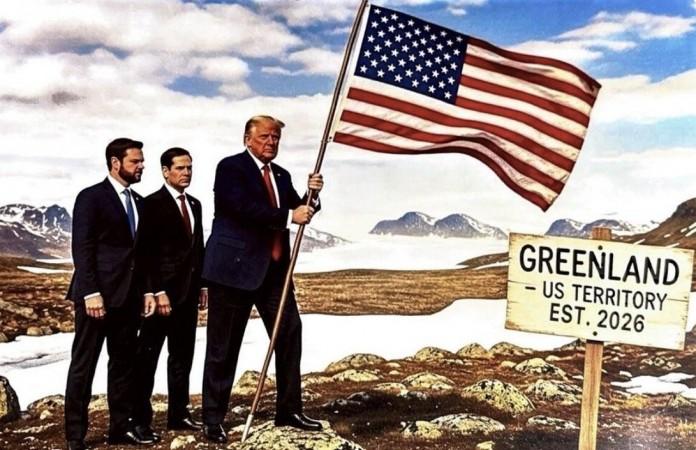
Greenland did not change overnight; the rules governing power did. What began as a distant Arctic question has rapidly evolved into a test of international relationships and institutional restraint. In geopolitics, it is often the periphery that reveals the centre, and Greenland long frozen at the margins of strategic consciousness has suddenly exposed a fault line running through alliances, sovereignty, and the very notion of restrained power. The significance of Greenland lies not in its ice, minerals, or geography, but in what the contest around it reveals: a dispute over an Arctic island has become a referendum on how power will be exercised and constrained in the coming era.
Greenland, remote, sparsely populated, and long assumed to be geopolitically dormant, has emerged in early 2026 as precisely such a theatre. What is unfolding around this Arctic island is not a bilateral dispute, nor a curious revival of an old American idea. It is a stress test of the post-war international order itself.
When President Donald Trump publicly reiterated that Greenland was a "strategic necessity" for the United States and warned that countries obstructing American objectives would face "serious economic consequences," he was not merely posturing. His subsequent remarks that tariffs would be imposed on European states opposing U.S. moves, beginning at a baseline rate and escalating sharply converted what had once been dismissed as rhetorical eccentricity into an explicit doctrine of leverage. Sovereignty, in this framing, is no longer inviolable; it is negotiable. Alliance solidarity, long treated as a constraint on behaviour, becomes conditional.
This moment did not arise in a vacuum. The United States has viewed Greenland through a strategic lens since the early twentieth century. The 1941 defence agreement with Denmark effectively placed Greenland under American military protection; during the Cold War, Thule Air Base became indispensable to U.S. ballistic missile early-warning architecture. What distinguished earlier eras, however, was restraint. Strategic necessity was pursued through consent, basing agreements, and alliance management not through public coercion.
That restraint is now receding. Greenland is not the object of this crisis; it is the instrument. The real issue is whether power in the twenty-first century will once again operate without self-imposed limits.
Tariffs Reimagined: From Trade Policy to Economic Siegecraft
The most consequential innovation in the Greenland episode is not territorial ambition but method. Tariffs historically justified as tools to correct trade imbalances or protect domestic industry have been openly repurposed as instruments of political compulsion. President Trump's language has been unusually direct: countries that "stand in the way" of U.S. strategic imperatives should expect punitive economic measures. Whether framed initially at 10 percent or hinted to rise far higher, the intent is unmistakable.
This is not trade policy. It is economic siegecraft.
The significance of this shift cannot be overstated. For decades, Western economic power rested on the separation of commerce from coercion among allies. Trade disputes occurred, but they were insulated from questions of territory and sovereignty. Greenland collapses that firewall. Economic pressure is now explicitly linked to territorial outcomes a practice previously associated with revisionist powers, not the architects of the liberal order.
European leaders immediately recognised the precedent at stake. European Commission President Ursula von der Leyen warned that using tariffs as political weapons against allies risked triggering a "dangerous downward spiral" that would undermine both economic stability and strategic trust. The EU's discussion of counter-coercion instruments is not retaliation for its own sake; it is a defensive response to the normalisation of economic force as a geopolitical lever.
Europe's Response: Sovereignty as Systemic Defence
What is striking about Europe's reaction is not merely its speed, but its coherence. France, Germany, the Nordic states, and EU institutions closed ranks with unusual clarity. Danish Prime Minister Mette Frederiksen's blunt assertion that "Greenland is not for sale" was echoed across European capitals, transforming what could have been framed as a bilateral U.S.–Denmark issue into a systemic European concern.
French President Emmanuel Macron elevated the debate further. In public remarks, he framed the Greenland episode as part of a broader erosion of norms governing sovereignty and alliance behaviour, cautioning that Europe could not accept a world in which power alone determined outcomes especially within the Western alliance itself. This was not anti-Americanism; it was a defence of the rules that allowed American power to be legitimised for decades.
The European Union's parallel move to strengthen Arctic security cooperation and investment in Greenland underscores a critical point: Europe is no longer content to be a passive stakeholder in Arctic geopolitics. It is positioning itself as a strategic actor, not merely a regulatory one.
The Unspoken American Calculus
Beneath the rhetoric lies a hard strategic logic that deserves acknowledgment. Greenland sits astride emerging Arctic sea lanes accelerated by climate change. It offers access to rare earths and critical minerals at a time when supply chains are weaponised. Its geography is central to missile detection, space surveillance, and hypersonic defence architectures domains that will define future warfare.
From Washington's perspective, delay carries risk. China has declared itself a "near-Arctic state" and invested steadily in polar research, infrastructure, and diplomatic presence. Russia has militarised its Arctic frontier extensively, reopening bases and integrating the region into its nuclear deterrence posture. In this context, Greenland appears not as an optional acquisition but as strategic insurance.
Yet this logic carries a fatal contradiction. By pursuing strategic dominance through coercion rather than alliance consensus, the United States risks dismantling the very architecture that multiplies its power. As Henry Kissinger warned repeatedly, legitimacy is not a moral luxury; it is a strategic asset. Once power is perceived as transactional and unilateral, resistance becomes structural.
NATO's Missing Doctrine: When Coercion Comes From Within
Nowhere is the strategic vacuum more exposed than within NATO. The alliance was designed to deter external aggression and prevent conflict among its members through institutional restraint. It was never designed to manage coercion exercised by its most powerful member against others.
This is NATO's missing doctrine.
The deployment of additional Danish and allied forces to Greenland defensive in intent and limited in scope has nonetheless been interpreted through an adversarial lens because NATO lacks an agreed framework for addressing internal coercion. There is no mechanism to adjudicate disputes where economic pressure, political intimidation, and strategic leverage intersect inside the alliance.
George Kennan's insight is instructive here. Power, he argued, is most stable when it is restrained by structure, not goodwill. NATO's structure restrains tanks and missiles, but not tariffs and threats. Until this gap is addressed, the alliance remains vulnerable not to external attack, but to internal erosion.
Russia has been quick to exploit this narrative, with senior officials openly describing the Greenland dispute as evidence of NATO fragmentation. Moscow's intent is not subtle: to present Western unity as performative and Western norms as conditional. China, more quietly, is observing and learning.
China, Russia, and the Strategic Classroom
China's response has been notable for its restraint. Official statements have been minimal, yet Beijing's strategic community is undoubtedly drawing conclusions. If economic coercion over territory becomes acceptable within the Western alliance, similar logic can be applied elsewhere. The Greenland episode thus becomes a case study not in Arctic governance alone, but in how norms decay.
Russia, by contrast, has been explicit. It has questioned Denmark's historical claims, criticised NATO's Arctic posture, and portrayed the crisis as proof that Western rules are selectively applied. This narrative reinforces Moscow's long-standing argument that power, not principle, governs international outcomes.
India and the Global South: The Quiet Recalibration
For India and much of the Global South, Greenland is not a regional curiosity. It is a precedent. India has consistently emphasised sovereignty, territorial integrity, and multilateral governance principles central to its own strategic environment. Watching these principles become negotiable among Western allies introduces discomfort and caution.
Joseph Nye's warning about soft power resonates here. When coercion replaces consent, influence erodes even where capability remains. States recalibrate not because they oppose power, but because they distrust its unpredictability.
Greenland Itself: Agency in an Age of Power Politics
Amid grand strategy, Greenland's own voice matters profoundly. Greenlandic leaders have reiterated that decisions about their future rest with their people. Treating the island as strategic terrain rather than a political community risks reviving colonial patterns under the guise of security necessity.
Arctic Council reports have repeatedly warned that climate change is transforming the region into a zone of intensified competition, precisely when governance mechanisms are weakest. Ignoring local agency in such an environment is not merely unjust it is destabilising.
India's Strategic Reckoning.
For India, the Greenland episode carries a quiet but profound lesson. As a civilisational state that has consistently anchored its foreign policy in sovereignty, strategic autonomy, and multilateral restraint, India cannot afford to view this crisis as a distant transatlantic anomaly. The normalisation of economic coercion to advance territorial or strategic objectives even among democratic allies erodes the very norms India relies upon in managing its own contested geographies and partnerships. New Delhi's growing engagement in Arctic forums, its emphasis on rule-based order, and its careful balancing of relations with the United States, Europe, and Russia will now unfold in a world where power is increasingly transactional and precedents travel fast.
What Is Likely in the Coming Days and Weeks
In the immediate weeks ahead, India should expect the Greenland episode to remain volatile rather than settle quickly. Public positions are likely to harden, with the United States continuing to frame the issue in strategic-security terms, while Europe institutionalises its response through EU mechanisms and NATO consultations. Even if tariff threats are modulated or tactically paused, the underlying coercive logic is unlikely to disappear; it will instead be embedded into negotiations, trade signalling, and alliance diplomacy. Simultaneously, Russia will amplify narratives of Western fragmentation, while China will maintain studied restraint, quietly absorbing lessons about how economic and strategic pressure can be normalised even among democracies. For India, the coming phase will be characterised less by dramatic announcements and more by precedent-setting behaviour how disputes are handled, which instruments are legitimised, and whether institutional pushback meaningfully constrains unilateral power.
Implications for India's Strategic Environment
The deeper implication for India is that the boundary between alliance politics and power politics is blurring globally. If economic coercion tied to strategic geography becomes an accepted tool within the Western alliance, its use elsewhere becomes easier to justify. This directly affects India's interests in a rules-based order that protects sovereignty without forcing binary alignment. It complicates India's partnerships with the United States and Europe, not because of divergence in values, but because of uncertainty in methods. At the same time, it reinforces India's long-standing caution against over-dependence on any single power or bloc. The Greenland episode also intersects with India's growing Arctic engagement scientific, environmental, and strategic underscoring that polar regions are no longer insulated from great-power competition, and that governance norms in emerging domains are fragile and contested.
Imperatives for India: Strategy, Autonomy, and Norms
For India, the imperative is threefold. First, New Delhi must double down on principled consistency, reinforcing sovereignty, consent, and multilateral governance in every relevant forum, from the Arctic Council to the UN and G20, without being drawn into performative alignment. Second, India must treat economic statecraft tariffs, supply chains, market access not as neutral instruments, but as potential tools of coercion in a more transactional world, and insulate itself accordingly through diversification and resilience. Third, India must preserve and sharpen its strategic autonomy, not as equidistance, but as strategic credibility the ability to work closely with major powers while remaining normatively anchored and politically uncoerced. In an era where even alliances are testing the limits of restraint, India's long-term influence will rest less on choosing sides, and more on defending the idea that power, to remain stable, must still accept limits.
For India, the imperative is not alignment with any one camp, but the reinforcement of principles: that sovereignty is not tradable, that partnerships must be consensual, and that strategic autonomy remains the only durable insurance in an era where even alliances are no longer immune to coercion.
A Generational Warning
The Greenland crisis is not an episode to be managed and forgotten. It is an inflection point. If coercive leverage over allies succeeds, the precedent will ripple far beyond the Arctic. If it fails, the cost will be borne in fractured trust and diminished legitimacy.
Either outcome signals the end of an era in which power willingly accepted restraint.
Henry Kissinger once observed that world orders collapse not from defeat, but from the loss of shared belief in their rules. Greenland suggests that belief is fraying. The question now is whether it can be repaired or whether unconstrained power has already returned as the organising principle of international life.
Greenland, frozen and distant, has become the mirror in which the future of global order is visible. The reflection is not comforting. But it is clarifying. And it demands choices whose consequences will outlast this crisis and perhaps this generation.
[Major General Dr. Dilawar Singh, IAV, is a distinguished strategist having held senior positions in technology, defence, and corporate governance. He serves on global boards and advises on leadership, emerging technologies, and strategic affairs, with a focus on aligning India's interests in the evolving global technological order.]