The Lok Sabha on Friday witnessed a dramatic defeat of the Constitution (131st Amendment) Bill, which had sought to expand the number of seats in the House and implement one-third reservation for women in legislatures beginning in 2029.
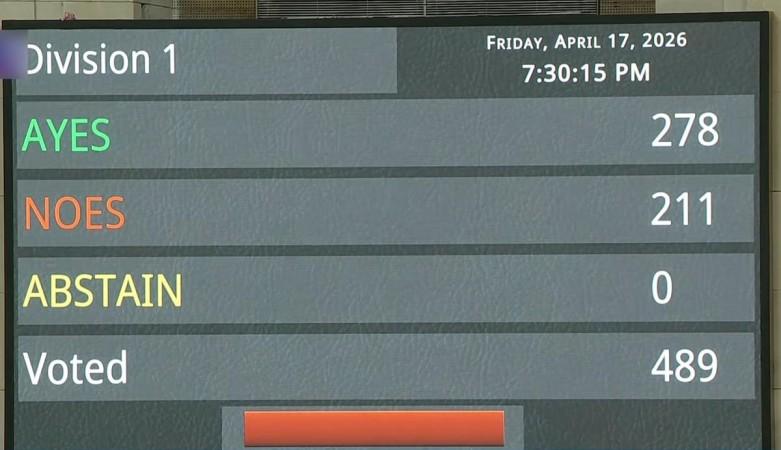
After two days of heated debate, the Bill secured 298 votes in favour and 230 against, but still failed to cross the two-thirds majority threshold required for constitutional amendments.
The Bill was ambitious in scope. It proposed increasing the Lok Sabha's strength from 543 to 850 seats, a move tied to the long-delayed delimitation exercise that would redraw electoral boundaries based on population changes.
Alongside this, it aimed to operationalise the 33 per cent quota for women in the Lok Sabha and State Assemblies, a reform that had been promised but deferred until after the next delimitation.
The government argued that the expansion and redistribution of seats were necessary to correct the imbalance between voters and representatives, a gap that has widened since the last delimitation froze boundaries based on the 1971 Census.
Prime Minister Narendra Modi and Home Minister Amit Shah both pressed the case for the Bill, warning that women across the country would closely watch the Opposition's stance. Shah accused the Congress of historically blocking delimitation and claimed that the party was once again depriving citizens of fair representation. He insisted that linking women's reservation to delimitation was the only way to ensure equity in representation.
However, Opposition parties countered that the government was using the promise of women's empowerment as a cover for a political manoeuvre that would benefit northern states with higher population growth, at the expense of southern states, which have managed to stabilise their demographics.
The defeat of the Bill also meant that two other related proposals—the Delimitation Bill and the amendment to extend women's quota to Union Territories—would not be taken up.
Parliamentary Affairs Minister Kiren Rijiju confirmed that the government would not move forward with them after the setback.
For many observers, the rejection underscored deep political fault lines over how India should balance representation between regions while advancing gender equality in politics. The outcome leaves the future of women's reservation uncertain. While the constitutional framework for the quota was laid down in 2023, its implementation was tied to delimitation—and with this defeat, the timeline has been pushed further into uncertainty.
The episode highlights the difficulty of building consensus on reforms that touch both the structure of representation and the promise of gender justice. For the Modi government, the loss is a rare legislative setback; for the Opposition, it is a moment of triumph in resisting what they see as a politically loaded exercise. Yet for women aspiring to enter legislatures, the wait for guaranteed representation has once again been extended, leaving one of the most significant reforms of recent years in limbo.
Opposition blocks Constitution Bills but loses narrative
The Opposition may be celebrating its perceived success in preventing the Union government from passing three key Constitution Amendment Bills in the Lok Sabha on Friday after two days of intense debate, but it lost the narrative.
Its claim to champion social justice, caste enumeration, and reservation policies will need a rethink and retune, rendering it a political blow even amid a "victory." By framing the Opposition as anti-women and anti-OBC, the government effectively shifted the narrative, portraying critics as obstructive elites.
With 528 members present and voting, the Constitution (131st Amendment) Bill, 2026 received 298 votes in favour and 230 against, with the ruling National Democratic Alliance (NDA) falling short by about 54 votes.
Also introduced on Thursday in the Lok Sabha were the Union Territories Laws (Amendment) Bill, 2026, and the Delimitation Bill, 2026. These Bills proposed increasing the size of the House of the People, enabling delimitation based on the 2011 Census, and facilitating reservation for women based on this exercise.
The Jammu & Kashmir, Puducherry, and Delhi Laws Bill was intended to give effect to similar provisions in those Union Territories. The Opposition opposed linking delimitation with the implementation of women's reservation.
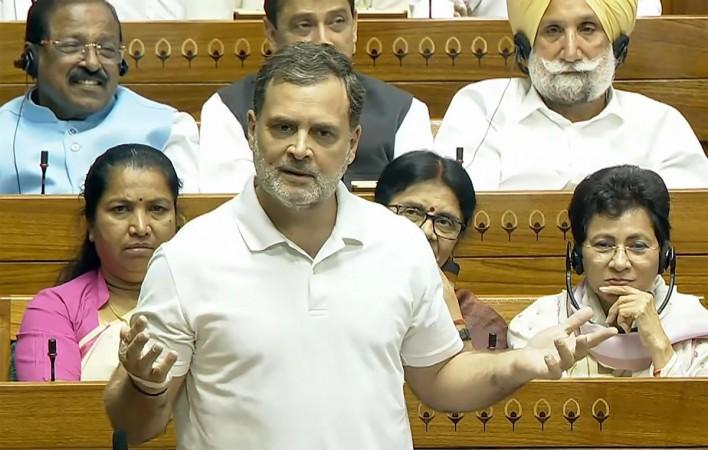
In his statement during the debate, Leader of Opposition Rahul Gandhi announced that under no condition would the bloc support the Bills. Following the result, Parliamentary Affairs Minister Kiren Rijiju requested Speaker Om Birla not to put the other two Bills to a vote, as the three were intrinsically interrelated.
On Thursday, Prime Minister Narendra Modi urged the House to support the Bill aimed at women's empowerment, while Home Minister Amit Shah repeatedly underscored, citing data, that southern states need not worry about losing representation compared to their current strengths. However, the Opposition remained unmoved.
Even as the numbers were displayed, Rijiju reiterated the Modi government's pledge to work for women's empowerment. "It's regrettable that you lost a chance to empower women with this historic Bill," he told the Opposition benches, who were cheering the final outcome.
Meanwhile, citing specific instances from Congress rule to substantiate his claims, the Home Minister criticised the party for consistently opposing caste-based census and reservations for Other Backward Classes (OBCs) during its decades in power. He countered the "false narrative" that the Bills harm southern states, presenting data showing that they would gain seats post-delimitation.
He accused the Opposition of "opposing everything," from women's quota to fair representation, and clarified that procedural rules barred content debates at the introduction stage. Prime Minister Modi also asked critics to support the "landmark" reforms, framing the Bills as fulfilling long-delayed women's empowerment without constitutional overreach.
Treasury benches emphasised equity rather than punishment for the South's success in family planning. Shah also countered the Congress' claim of being the primary force behind women's empowerment, citing examples such as the BJP supporting the first woman Chief Minister of Delhi and a tribal woman becoming President of India.
With crucial state elections approaching—including those in Tamil Nadu and West Bengal later this month, followed by Uttar Pradesh and Punjab—the Opposition may need to recalibrate its messaging once the political impact becomes clearer.
Regarding its demand for caste enumeration, the Home Minister clarified that the Census of India, currently underway, includes it. The last Census was conducted in 2011, with the next scheduled for 2021 but postponed due to the COVID-19 pandemic.
Meanwhile, the 2023 Women's Reservation Act, providing 33 per cent reservation for women in the Lok Sabha and State Legislative Assemblies, was notified on Thursday by the Union Law Ministry.
'Deeply disturbing and disgraceful': Piyush Goyal on Opposition's conduct in LS over women's quota
Union Minister Piyush Goyal on Friday criticised the Opposition, alleging that it blocked the passage of a Constitution Amendment Bill linked to the Nari Shakti Vandan Adhiniyam and "celebrated" its stalling in the Lok Sabha.
Describing the developments in the House, Goyal said they were "deeply disturbing and disgraceful," alleging that the Opposition not only opposed the Bill but also raised slogans after stalling it.
In a post on social media platform X, Goyal said the Congress, Trinamool Congress, DMK, Samajwadi Party, and other INDIA bloc allies came together not to debate, but to block the Bill.
"Today, a deeply disturbing and disgraceful scene unfolded in the Lok Sabha. The Congress, TMC, DMK, Samajwadi Party, and the INDIA alliance came together not to debate, but to block the passage of a crucial Constitution Amendment Bill for the Nari Shakti Vandan Adhiniyam. A Bill that sought to guarantee 33 per cent reservation for women was not just rejected, but shockingly celebrated with victory slogans," he wrote.
"This is not opposition politics, but a calculated betrayal of India's women," he added.
Questioning the Opposition's conduct, Goyal said it was unclear what exactly was being celebrated, adding that such actions amounted to supporting patriarchy and suppressing women's rights.
He alleged that by stalling the Bill, the Opposition had denied women their rightful representation in legislative bodies.
Goyal said the developments reflected a broader pattern, accusing Opposition parties of resisting women's empowerment and placing political considerations above national progress.
"This is not an isolated act. It is a pattern," he said.
He further said that the Opposition's stance was neither aligned with the interests of women nor with the aspirations of the country.
Goyal added that the issue would have political repercussions, asserting that women voters would remember the developments.
"Their mindset stands exposed, neither aligned with the interests of women nor with the aspirations of a rising India. This insult to our Nari Shakti will neither be forgotten nor forgiven. It will travel far and wide, echoing across every constituency, every state, and every election. The women of India will remember who stood with them and who stood against them," he wrote.
He also said that the "political cost" of the Opposition's actions would be reflected not only in the 2029 Lok Sabha elections but also in other electoral contests.
"The political cost of this betrayal will be paid, not just in the 2029 Lok Sabha elections, but at every ballot across Bharat," he said.
Rahul Gandhi hails Constitution as women's quota amendment Bill falters
Leader of Opposition Rahul Gandhi on Friday credited the INDIA bloc's unity for the defeat of the Amendment Bill related to women's reservation in the Lok Sabha.
"The Amendment Bill has fallen. They used an unconstitutional trick in the name of women to break the Constitution. India has seen it. INDIA has stopped it. Hail the Constitution," he said on social media platform X.
Earlier, Gandhi's "magician" barb—purportedly aimed at Prime Minister Narendra Modi—while opposing the Constitution (131st Amendment) Bill and two related Bills created a furore in the Lower House.
The House witnessed noisy scenes, angry exchanges, and demands for an apology as Gandhi's remark drew sharp reactions from Treasury bench members, who called it a "blatant mockery" of Parliament and 1.4 billion people.
He said there is a "central confusion" in the minds of the Bharatiya Janata Party—that it represents the entirety of India and its armed forces—which, he argued, is not the case, and asked them to "stop hiding behind the armed forces as cowards."
Opposing the proposed delimitation, Gandhi said that former Prime Ministers Indira Gandhi and Atal Bihari Vajpayee had both chosen not to proceed with the exercise during their tenures, understanding the potential risks involved.
Earlier, after two days of heated debate, the Bill secured 298 votes in favour and 230 against, but still failed to cross the required two-thirds majority.
The Bill proposed increasing the Lok Sabha's strength from 543 to 850 seats, tied to a delimitation exercise that would redraw electoral boundaries based on population changes.
It also aimed to operationalise the 33 per cent quota for women in the Lok Sabha and State Assemblies, a reform long promised but deferred until after delimitation.
The Union government maintained that the expansion and redistribution of seats were necessary to correct the imbalance between voters and representatives, a gap that has widened since the last delimitation froze boundaries based on the 1971 Census.
Prime Minister Narendra Modi and Home Minister Amit Shah had both pressed for the Bill, warning that women across the country would closely watch the Opposition's stance.
Shah accused the Congress of historically blocking delimitation and claimed that the party was once again depriving citizens of fair representation. He reiterated that linking women's reservation to delimitation was essential to ensure equity in representation.
(With inputs from IANS)