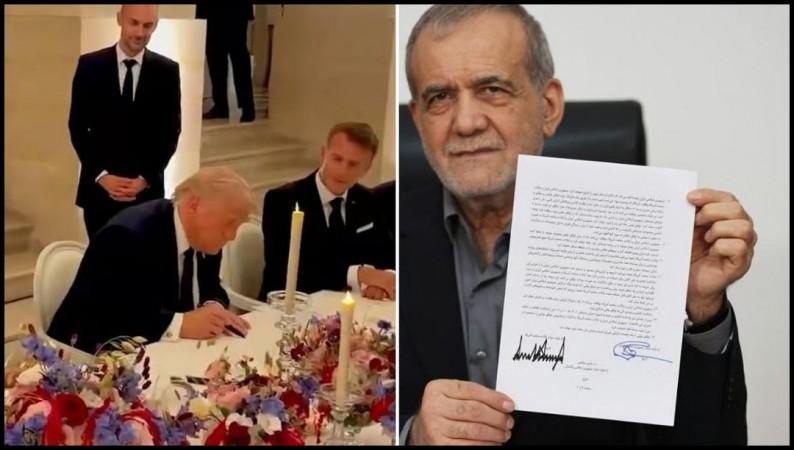
The United States and Iran have signed a formal memorandum of understanding on Wednesday, June 17, as the first step toward ending the war that began when the U.S. and Israel launched a massive military campaign against Iran in late February.
The conflict, which initially appeared likely to produce a swift strategic victory for the U.S. and Israel, instead evolved into a prolonged and costly confrontation that reshaped the Middle East and rattled the global economy.
The details of the interim agreement, reportedly lasting 60 days, have not been made public – although news outlets such as Bloomberg and the Wall Street Journal have recently published a draft memorandum. The proposed framework would extend a ceasefire that was first announced on April 8 and subsequently renewed multiple times.
Pakistan played a key role in the initial mediation efforts, while Qatar later emerged as a principal intermediary. Negotiations proved difficult, with Iran insisting that any broader understanding include an end to Israeli military operations in Lebanon.
Regardless of the final details, one thing is clear: President Donald Trump wanted a deal badly.
Not because the United States achieved its strategic objectives, but because it did not.
The war fundamentally altered the regional balance of power, but not in ways that advanced Washington's goals. The United States failed to achieve its two principal objectives: regime change in Tehran and the dismantling of Iran's nuclear program.
Instead, the conflict strengthened Iran's leverage in several critical areas. Most significantly, Tehran emerged with effective control over the Strait of Hormuz, a waterway through which roughly one-fifth of the world's oil supply passes.
The disruption of shipping through the strait sent shockwaves through energy markets and underscored how vulnerable the global economy remains to instability in the Gulf. Oil and gas prices rose sharply, reigniting inflationary pressures not only in the United States but across Europe and Asia.
Those economic consequences quickly became political consequences.
From the outset, the war lacked broad public support. Many influential voices within Trump's own MAGA coalition criticized the intervention as a betrayal of one of his central campaign promises in 2024: keeping America out of new Middle Eastern wars.
During the 2024 presidential campaign, Trump repeatedly argued that he would focus on domestic priorities, lower inflation, and avoid foreign entanglements. The Iran war undermined him on both fronts.
As fuel prices climbed, Americans once again felt the impact at the gas pump. Higher transportation and energy costs threatened to ripple through the broader economy, raising fears that inflation, which had been easing but went up in May, could become a political issue once again.
At the same time, the conflict exposed the vulnerability of America's regional partners. While Iran entered the war with a relatively weak conventional air force and navy, the Gulf states possessed extensive energy infrastructure and densely concentrated economic assets that were highly vulnerable to missile and drone attacks. As the war dragged on, concerns grew that a broader regional conflict could inflict severe damage on economies throughout the Gulf.
The outlines of the proposed agreement appear designed to address these immediate concerns. Under the reported framework, the ceasefire would be extended for another 60 days. Iran would reopen the Strait of Hormuz and begin de-mining operations, while negotiations over sanctions relief and Tehran's nuclear program would continue during the interim period.
For Trump, the alternatives were becoming increasingly unattractive.
Once the conflict began, it became evident that Iran was unlikely to capitulate short of catastrophic military defeat. Because of this the U.S. pursuing a military victory strategy carried enormous risks. Iran possesses the ability to inflict substantial damage across the Gulf, potentially drawing neighboring states deeper into the conflict and triggering a prolonged economic crisis.
The humanitarian consequences would have been equally daunting.
The collapse of relatively small states such as Libya and Syria, with populations of 7 million and 23 million, respectively, produced refugee crises that reverberated throughout Europe for years. Iran, with a population of more than 90 million people, is significantly larger and more complex than either country.
State failure in Iran would likely generate a refugee flow on a scale unseen in recent decades, placing extraordinary pressure on neighboring countries and European governments alike.
The country's ethnic diversity would further complicate any post-conflict scenario. Persians constitute the majority population, but large Azerbaijani, Kurdish, Arab, and Baluchi communities also play important roles in Iranian society. The sudden collapse of the state could have unleashed instability extending far beyond Iran's borders.
Domestic politics weighed heavily on the White House as well.
Unlike many previous American military interventions, the conflict failed to generate a sustained "rally around the flag" effect. Instead, opposition remained strong throughout the war. With the midterm elections less than five months away, Trump faced increasing pressure to show progress on the very issues that helped return him to the White House.
The political stakes are enormous. Republicans currently hold only a narrow majority in the House of Representatives. If Democrats regain control, the final two years of Trump's presidency could become consumed by investigations, hearings, and legislative gridlock. In that sense, the Iran war threatened not only America's strategic interests abroad but also Trump's political agenda at home.
Even if a peace agreement succeeds in lowering energy prices, some analysts believe the economic damage has already been done and may continue shaping voter perceptions heading into the election season.
America's allies were hardly enthusiastic about prolonging the conflict either.
The Gulf states had suffered significant economic losses and infrastructure damage. Their governments had little appetite for an open-ended war whose costs were mounting with every passing week.
Nor was Washington able to build the kind of broad international coalition that characterized earlier military campaigns in the Middle East. Unlike the Gulf War of 1991, Afghanistan and Iraq wars of the 2000s, when the United States assembled a multinational alliance, this conflict found few enthusiastic partners beyond Israel.
Even after the closure of the Strait of Hormuz, Washington struggled to persuade Europe, China, Russia, and other major powers to align fully with its approach.
That diplomatic isolation further increased the incentive to seek a negotiated settlement.
Yet a peace agreement, even if signed, is unlikely to produce immediate stability. The greatest uncertainty remains Israel.

As a principal participant in the conflict, Israel's willingness to support a negotiated settlement will be critical to the success of any agreement. Continued military operations in Lebanon or elsewhere could quickly derail the diplomatic process and provoke renewed escalation.
Israeli Prime Minister Benjamin Netanyahu faces political pressures of his own. With elections approaching, he has powerful incentives to demonstrate strength and resolve. Whether those domestic considerations can be reconciled with the requirements of a lasting peace remains an open question.
There are also questions about Trump's ability to maintain support for a compromise within his own coalition. Critics who supported the war are likely to argue that any agreement falling short of Iranian denuclearization or regime change represents a strategic retreat. Others will view the deal as a necessary recognition of reality.
If Israel resumes military operations or if hardliners on either side gain the upper hand, Tehran may conclude that the agreement no longer serves its interests. The ceasefire could collapse as quickly as it emerged.
Nevertheless, the memorandum of understanding represents an important first step.
It may not resolve the underlying disputes between Washington and Tehran. It does not erase decades of mistrust. Nor does it guarantee a lasting peace. But after months of conflict, economic disruption, and mounting regional instability, diplomacy offers a far more promising path than continued escalation.
Ultimately, the war demonstrated the limits of military power in achieving political objectives. The United States entered the conflict seeking to reshape Iran and the Middle East. Instead, it discovered once again that wars often produce consequences that cannot be controlled or predicted.
Trump's desire for a deal was not driven by the fact that the U.S. was winning or had won the war with Iran. It was driven instead by the recognition that the costs of continuing the war, economic, political, diplomatic, and humanitarian, were becoming greater than the costs of compromise.
The challenge now is whether the parties can transform a temporary pause in fighting into a sustainable framework for peace. The alternative, a return to war, would be far costlier for the region, the global economy, and the political leaders on all sides who would have to defend the choices they have made.
(Frank F. Islam is an entrepreneur, civic leader and thought leader based in Washington, DC. The views expressed here are personal.)