India's constitutional democracy depends upon a simple institutional faith: that the body conducting elections will not become a participant in them. The Election Commission of India is not an ordinary government department. Under Article 324, it controls the preparation of electoral rolls and the conduct of elections. Under Article 326, elections are founded on adult suffrage. Under Article 325, citizens cannot be excluded from electoral rolls on grounds only of religion, race, caste or sex.
These provisions impose more than administrative responsibility. They impose a constitutional duty of neutrality, fairness, transparency and institutional accountability. That duty is now under unprecedented strain.
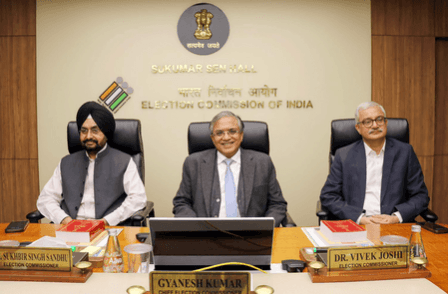
An investigation has reported that Election Commissioners Sukhbir Singh Sandhu and Vivek Joshi recorded at least 14 objections over ten months to decisions concerning voter registration, deletions, restorations, Form 6, ERONet and ECINet. They reportedly described some actions as "unauthorised" and "illegal", and alleged that important decisions were taken without their knowledge. The Commission has denied any institutional rupture and maintains that all final decisions were unanimous.
The contradiction cannot be resolved through press statements. It requires the publication of the relevant records: agenda notes, minutes, approvals, dissenting memoranda, software authorisations and statutory reasons.
The issue is not whether Commissioners may disagree. They must be able to disagree. The issue is whether a constitutional multi-member body was reduced, in practice, to a single centre of decision-making.
Section 18 of the Chief Election Commissioner and Other Election Commissioners Act, 2023, permits decision-making by majority where the Commissioners differ. But that provision presupposes that the matter is placed before the Commission and that the majority is legally ascertainable. A decision issued in the name of the "Full Commission", without the knowledge of two Commissioners, would raise questions of jurisdiction, institutional misrepresentation and non-application of mind.
The crisis is most visible in electoral rolls
The Special Intensive Revision began as an exercise in purification. No democracy can tolerate dead, fictitious, duplicate or unlawfully registered voters. But purification cannot become a synonym for deletion. A data mismatch may justify verification; it cannot itself become a finding of ineligibility.
Bihar exposed the danger. Approximately 65 lakh names were initially omitted from the draft roll. The Supreme Court directed the Election Commission to publish the names and reasons for exclusion and permitted Aadhaar as one basis for filing claims. The Court later upheld the Commission's power to conduct the SIR, but that judgment did not validate every individual deletion or every procedure used in implementing the exercise.
The formal availability of a process does not establish its practical fairness. The Bihar exercise was conducted amid the monsoon, flooding, agricultural work, seasonal migration, poor connectivity and substantial documentary disadvantage. A short deadline may exist on paper while remaining inaccessible to citizens who cannot travel to a BLO, obtain records from another district or navigate an online system.
The law demands a genuine opportunity to respond, not merely a deadline announced by government.
West Bengal has revealed the deeper institutional failure. Reports placed before the Supreme Court indicated that more than 38 lakh appeals had been filed against exclusions and inclusions, with more than 37 lakh pending. The Commission reportedly acknowledged that, at the existing rate, disposal could take approximately 12 years.
An appeal decided 12 years later is not an effective remedy for a voter whose election takes place next month.
Even more troubling, reports stated that approximately 93 per cent of decided appeals by excluded electors resulted in restoration. This does not prove that every original deletion was unlawful. It does, however, suggest a severe false-positive problem in the initial screening process. When the overwhelming majority of decided appeals succeed, the Commission must explain whether the defect lay in its data, its notices, its field verification or its decision-making.
The constitutional logic is stark:
VOTER DELETED
│
▼
APPEAL FILED
│
▼
DISPOSAL IN 12 YEARS
│
▼
ELECTION TAKES PLACE
│
▼
LATER RESTORATION CANNOT
RESTORE THE MISSED VOTE
Maharashtra and Haryana have generated another category of concern: the alleged persistence of large numbers of duplicate voters, bulk entries at tiny addresses, zero-address records, repeated photographs, invalid addresses and voters appearing in more than one State. The Commission has rejected several allegations and correctly pointed out that a duplicate EPIC number or a common name does not automatically prove double voting. But neither does that response resolve the matter.
A zero house number may represent a genuine resident of an informal settlement. Hundreds of voters at one address may live in a hostel, tenement or labour colony. Yet these explanations require physical verification. They cannot be used either to retain suspicious entries or to delete vulnerable citizens mechanically.
The correct procedure is not political assertion but transparent audit:
SUSPICIOUS ENTRY
│
├─ Physical verification
├─ Identity and residence check
├─ Duplicate matching
├─ Notice to affected voter
├─ Reasoned ERO order
└─ Timely appeal and restoration
Assam adds a further constitutional danger. In a State shaped by migration and citizenship disputes, electoral-roll revision must not quietly become a citizenship tribunal. The Election Commission may determine eligibility for electoral registration, but it cannot replace the authorities legally empowered to decide citizenship or foreigner status. A database mismatch is not proof of foreign nationality. A voter must be told the precise legal ground for exclusion and the authority competent to decide it.
The same questions extend to campaign finance and the Model Code of Conduct.
The 2024 election witnessed enormous seizures of cash, liquor, drugs, precious metals and other inducements. The existence of a seizure does not itself prove bribery. But the seizure must lead to investigation: who owned the money, whether it was connected to a candidate or party, whether it was reflected in expenditure accounts and whether Section 123(1) of the Representation of the People Act, 1951 was attracted.
The Model Code prohibits the announcement of new financial grants after the election schedule and bars the use of official machinery for partisan advantage. Government schemes announced or accelerated immediately before an election may not automatically be illegal, but the timing, publicity, political messaging and method of distribution require scrutiny. A cash transfer to more than one crore women in Bihar shortly before polling raised precisely these questions. Complaints deserved a reasoned public determination, not silence.
Selective enforcement is equally damaging. During the 2024 election, opposition parties alleged that communal appeals, inflammatory speeches and campaign violations by ruling-party leaders received delayed or inadequate treatment. Media analyses also questioned the imbalance in notices issued to different parties. The Commission may reject those allegations, but it must publish a comparable case-by-case record. Equality before law cannot be demonstrated by assertion.
Nor can transparency stop at polling day. Form 17C, turnout data, VVPAT records and polling-station video form part of the evidentiary architecture of an election. CCTV footage reportedly remains available only for a limited period unless an election petition or preservation request intervenes. Voter privacy must be protected, but privacy cannot become a justification for destroying evidence before allegations can be investigated.
Finally, the ECI's decisions concerning splits in political parties and the allocation of symbols have generated a separate crisis of electoral jurisprudence. Paragraph 15 of the Symbols Order requires the Commission to determine which faction represents the recognised party. Legislative headcount may be relevant, but it cannot automatically replace the party constitution, organisational membership, internal elections and legitimate institutional control. A symbol order cannot retrospectively legalise defection or convert legislative capture into organisational legitimacy.
India does not need an Election Commission that is merely powerful. It needs one that is demonstrably impartial.
The Commission should publish all material decisions affecting electoral rolls, record dissent, preserve software audit trails, protect ERO independence, disclose deletion reasons, provide appeals before polling, preserve CCTV upon complaint, publish a complaint-wise MCC action register and apply a consistent organisational test in party disputes.
The central question is no longer whether the ECI possesses the power to revise rolls or conduct elections. It does. The question is whether that power is being exercised lawfully, accessibly, transparently and equally.
A constitutional referee cannot ask citizens to trust what it refuses to disclose. And an appeal that arrives after the election is not justice delayed. It is democracy denied.
[Major General Dr. Dilawar Singh, IAV, is a distinguished strategist having held senior positions in technology, defence, and corporate governance. He serves on global boards and advises on leadership, emerging technologies, and strategic affairs, with a focus on aligning India's interests in the evolving global technological order.]