
By Shubhangi Chowdhury
Indian American entrepreneur Robert J. Makheja reflects on the defining moments, hard choices, and values that helped him build a business empire spanning technology, cybersecurity, venture capital, and real estate.
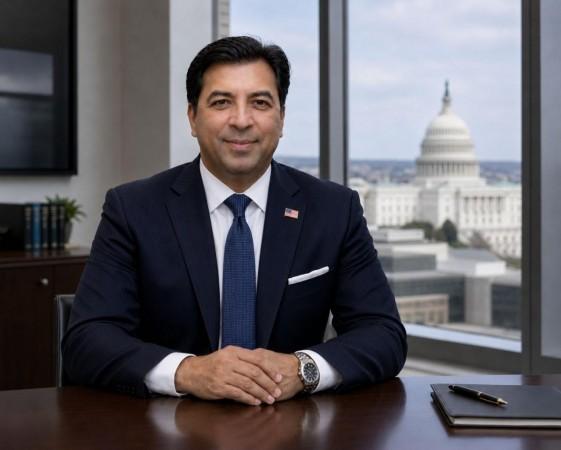
Robert J. Makheja, known to friends and colleagues simply as "Bobby," is the Founder, President, and CEO of MFGS, Inc., one of the largest private suppliers of cybersecurity and artificial intelligence software solutions to the U.S. government, with more than $1.6 billion in cumulative sales. He is also the Founder and Chairman of The RJM Companies, a diversified enterprise with interests in venture capital and private equity, commercial real estate, and RJM & Associates, PC, a legal advisory services firm.
A self-made billionaire with a net worth exceeding $1 billion, Makheja has built businesses across enterprise technology, cybersecurity, artificial intelligence, venture capital, private equity, and commercial real estate. Over the course of three decades, he created his success without inheritance or outside capital, relying instead on discipline, entrepreneurial vision, and a steadfast commitment to service.
Makheja holds a Bachelor of Engineering degree from The George Washington University, an MBA from the Sykes College of Business at the University of Tampa, and a Juris Doctor from the Antonin Scalia Law School at George Mason University. He has also completed executive management programs at Harvard Business School. Alongside his wife, Sonia, he has served on the Board of Visitors of George Mason University and the Dean's Council of the Costello College of Business, among other civic and educational organizations.
Through the Makheja Family NEXTGEN Charitable Organization, the family supports initiatives focused on education, leadership development, and community empowerment in both the United States and India.
In a recent interview with Shubhangi Chowdhury, Makheja reflected on entrepreneurship, leadership, philanthropy, and the principles that have guided his success. Edited excerpts from the conversation follow:
Shubhangi Chowdhury: You have spent more than three decades building a remarkable business empire, one that spans enterprise technology, venture capital, private equity, and commercial real estate, with an estimated value exceeding a billion dollars. Yet, despite the scale of your success, you have largely remained out of the public spotlight. Was that a deliberate choice?
Robert J. Makheja: I think it comes down to who you were raised to be. My parents did not come to this country dreaming of wealth. They came dreaming of contribution, of raising children who would give more than they took. That stayed with me. I have spent my career trying to be useful: to the country that gave my family a home, to the people who trusted me with their careers, to the institutions that depend on us getting it right. Whatever has been built along the way is genuinely secondary to that purpose. I hold it with open hands. But it was never the scoreboard I was watching.
Q: MFGS crossed $1.6 billion in total sales in eight short years. The RJM Companies, spanning venture capital, private equity, and a commanding real estate portfolio. Three decades of building. We want to understand the man behind it.
[The] man behind it is simply someone who never stopped believing that if you do the right thing, for long enough, with enough care for the people around you, the rest has a way of following. I did not engineer a fortune. I tried to earn trust, one relationship at a time, one decision at a time. The fact that it has compounded into something significant, yes, a net worth that has crossed a significant dollar mark, built without inheritance or safety net, is, I think, less a product of strategy than of the grace of this country and the goodness of the people who chose to walk alongside me. What I care about is what it makes possible for others.
Q: You became one of the youngest Vice Presidents in Oracle's history. Then you discovered the company was billing federal agencies for training that had not yet been delivered. You confronted it. You were fired. The Department of Justice joined your complaint. Oracle settled and returned the funds to the government. Take us back to the moment you decided to walk in and say something.
There was no dramatic moment. There was a quiet one. I was sitting at my desk one evening and I realized that if I said nothing, I would spend the rest of my life pretending I had not seen what I had seen. That seemed like an exhausting way to live. I had a young family. I had an enormous amount to lose. But the alternative was to lose myself, and that was not a trade I was willing to make. People remember the lawsuit. I remember the months before it, the months spent trying to correct things inside the company first, through the proper channels, the way it is meant to be done. That is the part that never makes the headline. You always go through the front door first. The courtroom is the last door, not the first.
It was a large False Claims Act actions against a major technology company. Did it change you?
It clarified me. It confirmed what I had already suspected about myself, that I would rather be right and unemployed than wealthy and quiet. As it turned out, the universe was generous enough to allow me to be neither for very long. I will always be grateful for that. But I would have done it again with nothing waiting on the other side.

You spent nearly thirteen years at Hewlett-Packard and played a central role in the $8.8 billion merger of HPE Software with Micro Focus International. What is the part of that transaction that nobody ever asks about?
The people. Everyone asks about the multiples, the integration timeline, the regulatory complexity, and all of it mattered. But what held my attention for the better part of a year was the thousands of careers on both sides of that transaction. A deal is a piece of paper. The lives behind it are not. The most consequential meetings in a merger of that magnitude are never with the investment bankers. They are with the men and women who do not yet know whether the company to which they have given fifteen years of their lives will need them tomorrow. You are asking them to trust you with something no severance package can address, their professional identity, their sense of purpose. That is the weight no press release captures, and it was the one I felt most acutely.
When the deal closed, you were appointed founding CEO of Micro Focus Government Solutions. And then within a year, after that you walked away from a Fortune 50 position to build MFGS from a blank page. Why?
Because the work was not finished. The United States Government has the most complex enterprise technology requirements on the planet. You cannot serve those requirements as a secondary concern of a multinational with seventeen other priorities. The mission deserved a company built around it, not adjacent to it. So we built that company. It was the most expensive entrepreneurial decision of my life, and one of the easiest I have ever made.
MFGS has crossed $1.6 billion in total sales in under eight years. How do you see artificial intelligence reshaping industry and government over the next five years?
Artificial intelligence is not arriving from outside. It is already restructuring how decisions are made, how threats are detected, how capital is allocated, and how governments serve their citizens. The organizations that grasp this now and build for it rather than react to it will define the next era of institutional relevance. Those that treat it as a feature rather than a foundation will find themselves where the companies were that dismissed the internet as optional in 1998. What I am focused on, specifically, is the intersection of AI and national security. Our adversaries are not waiting for any five-year horizon. They are operating on timelines measured in milliseconds. The imperative is to close that gap permanently, and to do it with systems that carry genuine trust. Trust, in that context, is not a sentiment. It is an engineering requirement.
You were trained as an engineer at George Washington, then earned an MBA, a law degree, and Harvard Business School's executive programs. Why so much schooling?
Because I never quite trusted that I had learned enough. My parents came to this country holding the conviction that an education could not be taken away from you, and I absorbed that very literally. The engineering taught me how systems break. The MBA taught me how companies break. The law degree taught me how people break, and how to rebuild what is worth saving when the institutions around them fail. The Harvard programs, candidly, taught me how to listen to people who are smarter than I am. That last lesson has probably been worth more than the other three combined.
How have your backgrounds in engineering, law and business shaped your approach to leadership?
They operate on me simultaneously, and often in productive tension. The engineer wants to build the most elegant system and resist the impulse to over-engineer it. The lawyer insists on examining every assumption as though it were a clause that will one day be tested in court. And the business mind wants to know, relentlessly, whether the system is creating genuine value and whether that value will endure. The combination produces a leadership style that is, I am told, occasionally exhausting to be around, but very difficult to catch off guard. At its root, the discipline of each field is the same discipline expressed in a different language: precision, intellectual honesty, and the willingness to follow an argument wherever it leads, even when the destination is uncomfortable.
What is the single turning point in your life, the moment that, in retrospect, reset the entire trajectory?
The Oracle decision, without question. Not because of the legal outcome, though that mattered deeply, but because of what it revealed about my own character when the stakes were as high as they had ever been. I was a young Vice President at one of the most powerful technology companies in the world. I had everything to lose. I chose to address what I had found, knowing it would cost me that position, possibly my career, and certainly my comfort. What I discovered on the other side of that choice was that I was standing alone, and that I could live with myself completely having done the right thing no matter what it could cost. That is not a small thing. Many people never reach that particular clarity. I reached it early, and it has been the foundation of every significant decision I have made since. If you know what you will not do for money, you have done more than most people ever will to define who you are.
Are governments and enterprises genuinely prepared for the cybersecurity threats already present?
The candid answer: Not yet — and the gap is considerably more dangerous than most senior leaders are willing to acknowledge publicly. The threat landscape has shifted from individual bad actors to nation-state adversaries running sophisticated, AI-augmented campaigns at industrial scale. What concerns me is not the adversaries themselves; they have always been resourceful and inventive. What concerns me is institutional complacency dressed carefully as preparedness. The organizations that are genuinely ready share three qualities: they treat cybersecurity as a leadership responsibility rather than an IT function; they invest in integrated platforms rather than collections of point solutions; and they exercise their defenses as rigorously as they protect them. That is the standard we hold ourselves and our government partners to, without exception.

What trends will define enterprise software and digital transformation in the years immediately ahead?
Three convergences are already underway. The first is the consolidation of enterprise software around a small number of deeply integrated platforms, the era of assembling dozens of best-of-breed point solutions is ending, and the complexity overhead has itself become a security liability. The second is the regulatory maturation of AI in government and critical infrastructure; the rules governing what autonomous systems may do on behalf of the state are being written right now, and the companies shaping those frameworks will define compliance for a generation. The third is the return of data sovereignty as a primary institutional value. Governments and serious enterprises are demanding to know precisely where their data resides, who may access it, and under which law it is governed. That is a structural transformation, and it permanently advantages organizations that were built around compliance from their first day, as ours was.
How does MFGS balance innovation with security, compliance, and the operational trust that government customers require?
We do not balance them. We treat them as the same thing and that is the fundamental difference between a company built for this market and one that has adapted itself to it. In our context, innovation means finding better ways to protect mission-critical systems. Security is not a constraint upon the mission; it is the mission. Compliance is not a cost of doing business; it is the evidence that we have earned the trust placed in us. Operational trust is not a brand attribute; it is built contract by contract, agency by agency, over years of showing up correctly on the days when it matters most. When those principles are held as a unified purpose rather than competing priorities, the decisions become far clearer.
What do you look for in entrepreneurs and businesses before committing capital?
I look for the same things I looked for in myself thirty years ago, including the things I found deficient and had to build. I look for founders who understand the distinction between confidence and certainty and do not confuse them. I look for people who have already been seriously wrong about something important and can tell me precisely what they learned. I look for businesses that exist because a real problem demanded them, not because a market opportunity attracted them, those are not the same origin story, and they produce very different cultures under pressure. Beyond that, I look for what I call character capital: the reputation a founder carries before they have a reputation worth carrying. How do their earliest employees speak of them? What choices do they make when no one is watching? That is the entrepreneur I want on the cap table. The returns follow, and they almost always do.
You command an enterprise spanning cybersecurity, AI, venture capital, private equity and commercial real estate. From the outside, it appears effortless. What does it feel like from the inside?
It feels like the same thing it has always felt like: that there is considerably more work to do tomorrow than there was today. I do not look at a balance sheet and feel finished. I see the people whose livelihoods depend on our getting the next year right. The empire, if that is the word, is really a long sequence of small decisions made carefully over many years. Effortless is the kindest possible description. It is not the accurate one.
Through The RJM Companies you have assembled a commercial real estate portfolio across the eastern United States. What drew you to the built environment after a career forged in software?
Software is extraordinary, but software is invisible. There is something deeply satisfying about driving past a building you helped bring into existence, knowing that people will work and live there long after you are gone. Real estate also imposes a discipline that software does not. A building cannot be patched at two in the morning. You must think clearly the first time.
You and your wife have several philanthropic initiatives in the greater Washington region. What does giving look like in the Makheja household?
Mostly, it looks like dinner conversations. We have tried to raise our children with the understanding that wealth, if it is a privilege, is also a debt, owed to every person who helped lift us to where we stand. My wife is the moral architect of our family. Anything generous that the world observes in us is, at its foundation, a reflection of her conviction and not mine.
Your three children are Ivy League graduates and lawyers. Did you guide them toward the law?
I guided them toward nothing. We tried, above all else, to raise people who would be useful to others. The law was the door each of them chose on their own, and I am proud of that, but I would be equally proud had any of them entered teaching, medicine, or the arts. The honor lies in the character, not the credential.
You have served on the Board of Trustees of George Mason University and on the Dean's Council of the Costello College of Business. What do you see when you look at the next generation of Indian American leaders?
I see a generation more globally fluent than any that came before. They have grown up between two civilizations and they take both seriously. My counsel, when they ask for it, is simply this: the country that received you deserves your fidelity, and the country your parents came from deserves your honor. Those obligations are not in tension. They are the same duty, written in two languages.
(By arrangement with American Bazaar. Shubhangi Chowdhury is an editor at The American Bazaar, based in Washington, DC.)