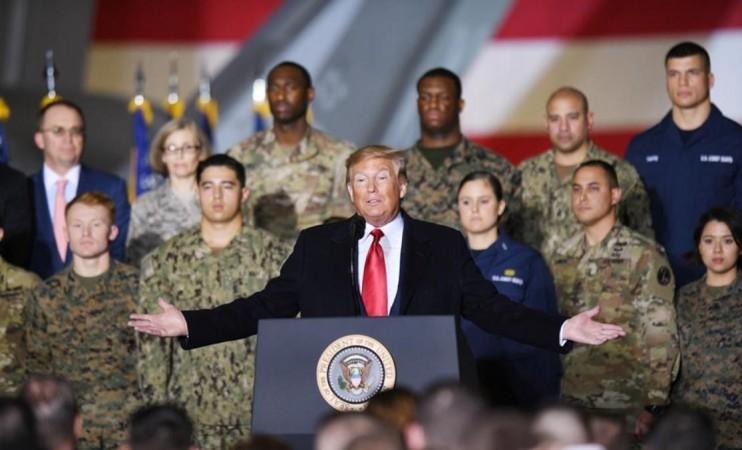
"We'll bomb again if we have to."
With that stark declaration, President Donald J. Trump did not merely issue a warning to Tehran; he compressed time. The statement landed at a moment when Iran's internal order is under its most sustained and multifaceted strain in decades transforming a domestic legitimacy crisis into a situation with unmistakable international gravity.
Iran today is not simply protesting.
It is unravelling under cumulative pressure economic, social, generational, and ideological while its leadership doubles down on coercion as both instrument and doctrine. The convergence of these forces has brought the Islamic Republic to one of the most dangerous thresholds in its modern history.
From Grievance to Defiance: A System Losing Fear
What began as economic anger has now crossed a critical line. Inflation has hollowed out livelihoods, the currency has steadily weakened, and opportunity has narrowed for a young population that no longer believes patience will be rewarded. But economic distress alone does not destabilise states. What destabilises them is the collapse of fear.
Across Tehran and major provincial cities, protests have continued despite internet blackouts, mass arrests, and lethal force. Slogans have evolved from demands for relief to outright rejection of authority. This shift matters profoundly. When citizens no longer ask for reform but instead question legitimacy, repression becomes exponentially harder to sustain.
Iran's leadership understands this and that understanding explains the response. Communications have been cut, security forces surged, and dissent framed not as civil unrest but as treachery. The state's message is unambiguous: obedience or punishment.
Yet the persistence of protest under these conditions reveals a deeper truth: coercion is no longer restoring control; it is advertising fragility.
When the Centre Heats Up: Symbolism Turns Strategic
Unrest touching the religious and ideological heartland including areas central to the Supreme Leader's own legitimacy — carries implications far beyond street violence. These are not marginal zones historically inclined toward dissent. They are pillars of the Islamic Republic's moral architecture.
When agitation spreads into symbolic cores, regimes face a grim calculus. Compromise risks appearing weak; restraint risks momentum; escalation risks rupture. History suggests that systems under ideological siege often choose escalation not because it resolves unrest, but because it postpones reckoning.
Iran now appears firmly on that path.
Women Without Hijab: The Quiet Revolution Inside the Revolt
No element of the current unrest is more destabilising than the normalisation of open hijab defiance.
This is not symbolism; it is structural challenge.
Compulsory hijab is the most visible daily assertion of clerical authority. When women remove it publicly and persistently, they are not negotiating policy they are withdrawing consent. The act has moved from exceptional bravery to routine behaviour, signalling that the regime's ideological enforcement mechanisms are losing social traction.
This transformation matters because legitimacy cannot be rebuilt through arrests alone. To reimpose compliance at scale would require repression so pervasive that it risks accelerating, rather than suppressing, backlash. The state thus confronts a dilemma for which there is no clean solution.
As one lesson from history endures: When fear evaporates faster than legitimacy can be restored, coercion becomes an accelerant, not a solution.
Khamenei's Language Signals a Closing Window
Recent rhetoric from the Supreme Leader and aligned institutions has hardened decisively. The framing is no longer corrective; it is existential. Protest is cast as sabotage. Dissent is equated with enemy action. Loyalty is presented as the sole alternative to chaos.
Such absolutist language is revealing. It signals that the leadership believes time is not on its side and that political space must be closed before it widens beyond control. This posture reduces flexibility, raises stakes, and sharply narrows the margin for error.
Once leaders define unrest in civilisational terms, compromise becomes indistinguishable from surrender.
Trump's Ultimatum: Deterrence at the Edge of Escalation
President Trump's warning must be read not as impulsive rhetoric, but as coercive signalling designed to deter mass repression, constrain regional escalation, and reinforce American credibility.
Yet deterrence theory rests on rational calculation and stable command. Iran today is under internal siege, its leadership psychologically cornered, and its narrative dependent on externalising blame. In such conditions, even calibrated threats risk unintended effects.
The danger is not immediate war.
The danger is feedback.
Internal repression invites external pressure. External pressure validates internal repression. Each side tightens its posture until miscalculation, misinterpretation, or a single violent incident forces escalation neither side initially sought.
This is how internal revolts metastasise into international crises.
Iran Is Not on the Brink of Reform It Is in a Phase of Transformation
This moment does not resemble previous protest cycles. Iran faces a structural legitimacy challenge, not a transient disturbance. A generation has disengaged emotionally from the system. Women have openly contested its moral authority. Economic hardship has eroded patience. Ideology no longer compensates for deprivation.
At the same time, the state retains formidable coercive capacity and has shown willingness to deploy it without restraint. That combination, deep alienation paired with hardened repression — is the most volatile configuration a regime can possess.
Iran may endure. It may fragment. It may transform.
What it cannot do is return to the status quo ante.
A Shrinking Corridor Between Control and Catastrophe
Iran stands in a narrowing corridor between internal breakdown and external confrontation. Every decision now carries outsized consequence. Every misstep compounds risk.
For Tehran, the danger lies in believing force alone can restore legitimacy.
For Washington, the danger lies in believing pressure alone can shape internal outcomes.
History is unforgiving to both illusions.
This crisis will not be resolved by slogans, threats, or brute force. It will be shaped by judgment or the lack of it in the coming weeks. When internal revolt meets external ultimatum, the line between deterrence and disaster is perilously thin.
The clock is no longer strategic.
It is operational.
[Major General Dr. Dilawar Singh, IAV, is a distinguished strategist having held senior positions in technology, defence, and corporate governance. He serves on global boards and advises on leadership, emerging technologies, and strategic affairs, with a focus on aligning India's interests in the evolving global technological order.]