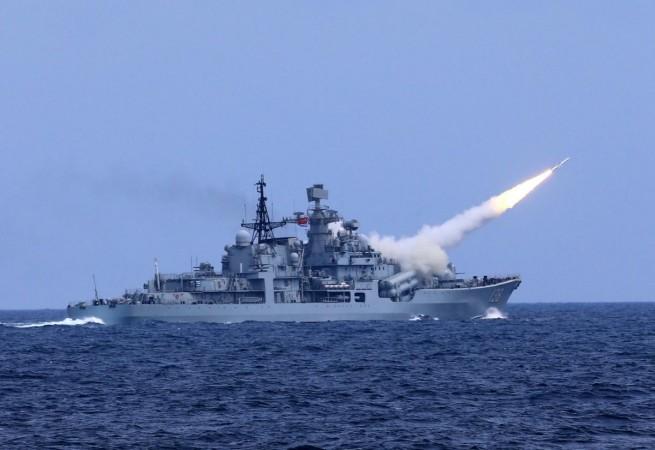
The United States on Monday expressed concern over China's expanding nuclear programme after Beijing test-fired a long-range ballistic missile carrying a dummy warhead into the Pacific Ocean, in a rare launch that analysts said showcased China's growing sea-based nuclear reach while signalling its military posture toward regional rivals, including Japan and Taiwan.
While India has also conducted submarine-launched ballistic missile (SLBM) tests in recent years, those launches have largely been confined to designated test areas in the Bay of Bengal and Indian Ocean as part of validating its second-strike nuclear deterrent.
The launch, conducted from a nuclear-powered submarine, marked China's second known intercontinental-range missile test over international waters in less than two years, following a similar launch in September 2024.
Unlike India's recent K-4 SLBM trials from the indigenous INS Arighaat, which were carried out within notified test corridors after standard navigation warnings, China's latest launch into the South Pacific drew diplomatic responses from Japan, Taiwan, Australia, New Zealand and the United States. Chinese authorities described the exercise as routine annual military training and said relevant countries had been notified in advance.
US State Department spokesman Tommy Pigott criticised Beijing's rapid expansion of its nuclear arsenal.
"At a time when the United States is working harder than ever to prevent nuclear proliferation, China is doing the opposite," Pigott said. "Beijing's rapid and opaque nuclear weapons buildup is of great concern to the region and the world."
Washington also urged China to engage in meaningful arms-control talks and establish a regular notification mechanism for intercontinental-range ballistic missile and space launches.
Regional Signal Beyond The US
While the missile demonstrated China's ability to threaten the US mainland from sea-based platforms, defence analysts said the launch also carried a broader strategic message for the Indo-Pacific, where tensions remain high over Taiwan and the East China Sea.
Analysts said the test reinforced China's expanding deterrence capabilities against US allies, particularly Japan, while highlighting Beijing's growing military pressure on Taiwan, which China claims as its own territory.
Lyle Morris, a senior fellow at the Asia Society Policy Institute, said the test showed China was moving toward a more survivable sea-based nuclear deterrent capable of reaching the continental United States from waters closer to its own coastline.
Regional Powers Express Concern
Japan, which said it had been informed before the launch, voiced "serious concerns" over China's expanding military activities and urged Beijing to exercise greater restraint. Taiwan condemned the missile test as an act of intimidation, while Australia and New Zealand described the launch as destabilising and criticised the limited advance notice provided by Beijing.
The missile landed in the South Pacific after travelling thousands of kilometres. The launch coincided with the signing of a new defence pact between Australia and Fiji, although analysts said such missile tests are planned well in advance and cautioned against linking the timing directly to the agreement.
Russia defended China's actions, saying the missile test was Beijing's sovereign right and insisting that China was not threatening other countries.
How China's Missile Test Differs From India's Sea-Based Missile Tests
China's latest missile launch differs from India's recent submarine-launched ballistic missile (SLBM) tests in terms of range, location, operational objective and regional impact.
The People's Liberation Army Navy (PLAN) launched a long-range SLBM carrying a dummy warhead from a Type 094 Jin-class nuclear-powered ballistic missile submarine into the South Pacific. The missile reportedly flew several thousand kilometres before landing in international waters. The launch prompted diplomatic responses from Japan, Taiwan, Australia, New Zealand and the United States.

India's most recent SLBM tests involved the K-4 missile, which has an estimated range of about 3,500 km, fired from the indigenous INS Arighaat, an Arihant-class nuclear-powered ballistic missile submarine. The tests were conducted in the Bay of Bengal within designated warning zones after India issued NOTAMs (Notice to Air Missions) and NAVAREA navigational warnings, in line with international practice.
China's launch demonstrated an operational sea-based deterrent capable of striking targets far beyond the western Pacific. Defence analysts said it highlighted Beijing's ability to deploy nuclear missiles from waters close to its coastline while maintaining the range to reach distant targets, including the continental United States.
India's K-4 programme is intended to complete the country's nuclear triad, the ability to launch nuclear weapons from land, air and sea, and strengthen its second-strike capability under its declared No First Use (NFU) nuclear doctrine.
China is estimated to operate six Type 094 (Jin-class) SSBNs, each capable of carrying 12 JL-2 or JL-3 submarine-launched ballistic missiles, while India currently operates INS Arihant and INS Arighaat, with additional Arihant-class submarines under construction as New Delhi expands its sea-based nuclear deterrent.


![Apple Watch Series 12, Ultra 4 launched in India: Price starts at Rs 56,900 [Details]](https://data1.ibtimes.co.in/en/full/837338/apple-watch-series-12-ultra-4-launched-india-price-starts-rs-56900-details.jpg?w=220&h=138)