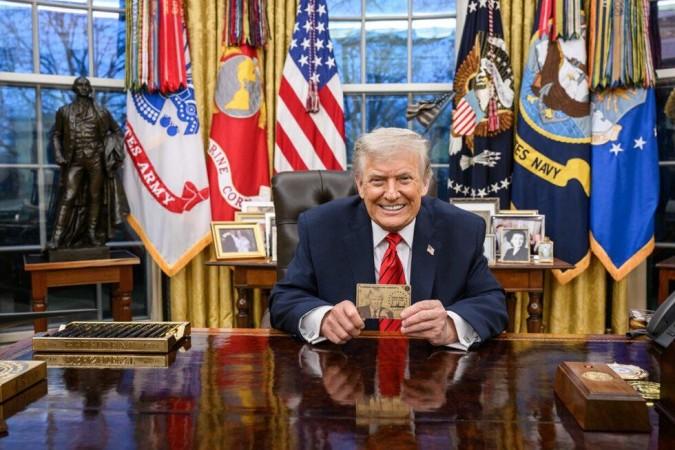
US President Donald Trump announced a new "Trump Gold Card" programme that he said would allow companies to retain top graduates from American universities -- including thousands from India -- ending what he described as a "ridiculous" system that forces skilled talent to leave after completing their studies.
Speaking at a White House roundtable with leading technology CEOs on Wednesday (local time), Trump said the initiative would give firms "certainty" in hiring highly trained international students, many of whom face years-long immigration hurdles despite graduating at the top of their class.
"You graduate, number one from your college, and there's no way of guaranteeing... there's no way of guaranteeing that they're able to stay in the country," he said. "They have to go back to India, they have to go back to China, they have to go back to France."
Calling the existing system "a shame," Trump said the Gold Card would remove a long-standing barrier for American companies competing globally for scientific and engineering talent. "It's a ridiculous thing that we're taking care of," he noted, adding that CEO complaints -- particularly from Apple's Tim Cook -- had motivated the change. "Nobody talked to me more about it than Tim Cook. He said it's a real -- it's a real problem."
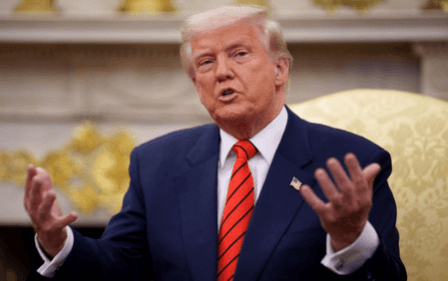
Howard Lutnick, introduced by Trump to outline the programme, said individuals could obtain the Gold Card for $1 million, while corporations could purchase one for $2 million. For companies, the card would allow them to retain an employee who undergoes "full vetting, the best vetting the government has ever done."
He said the vetting process would cost $15,000 and ensure the candidate "absolutely qualify to be an American, absolutely qualify."
Once approved, the employee would have a path to citizenship after five years, Lutnick said. A company could then "put someone else on the card," enabling firms to rotate foreign employees through long-term, employment-linked residency. "It's a gift to the United States of America... to help America be great again under Donald Trump," he added.
Trump said the programme would also generate substantial revenue for the US Treasury. "We think probably billions of dollars... many billions of dollars even," he said, noting that firms had previously shifted personnel to Canada and other countries because of US visa uncertainty. "The companies are going to be very happy," he said. "As you know, they used to send people up to Canada... So we solved that."
The roundtable brought together a group of influential technology chiefs -- including Michael Dell of Dell Technologies, Arvind Krishna of IBM, Cristiano Amon of Qualcomm, and leaders from HP and Hewlett Packard Enterprise -- as the administration sought to highlight the intersection of immigration reform, workforce competitiveness, and a broader push for US technology "dominance."
Trump repeatedly praised the executives for their investments in manufacturing and AI capacity in the United States. He said the country was "leading artificial intelligence by a lot" and emphasised his administration's efforts to centralise regulatory oversight and cut red tape. "Our administration is committed to total dominance in technology," he said. "We want to stay number one by a lot."
While the CEOs did not directly address immigration policy, they underscored the need for a stable workforce and low-cost energy to support massive semiconductor and AI investments. Dell saidAI and chip manufacturing "consume a great deal of power" and praised the administration's focus on lowering energy costs.
Krishna called for strengthening the full AI "stack," saying it included "semiconductors... software... systems... and the software applications on top."
The announcement of the Trump Gold Card marks one of the most significant immigration policy shifts affecting Indian students and skilled workers in more than a decade. India accounts for the second-largest contingent of foreign students in the United States and the vast majority of H-1B high-skilled visas, making the new programme especially consequential for the Indian tech workforce.
Previous administrations, including both Republican and Democratic ones, struggled to reform employment-based immigration pathways amid congressional gridlock.
Large US technology companies have long argued that unpredictable visa lotteries and numerical caps undermine American competitiveness, particularly against Trump's Gold Card to retain top foreign talent in the US.
(With inputs from IANS)