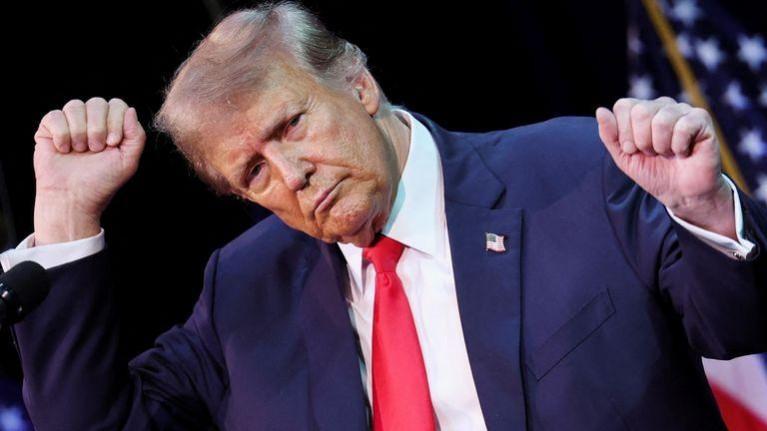
US President Donald Trump has vowed to continue what he called a "righteous mission" against Iran until "all objectives are achieved," warning that more American troops could die in the process.
In a video posted on Truth Social on Sunday, Trump once again portrayed the war as a response to an existential threat, stating that "an Iranian regime armed with long-range missiles and nuclear weapons would be a dire threat to every American."
Trump and senior officials had made similar assertions before Saturday's strikes, which killed Iran's Supreme Leader Ayatollah Ali Khamenei and several top figures in the country's leadership. However, the administration has not presented evidence that Iran was developing a long-range missile capable of reaching the United States or that it was close to building a nuclear weapon.
— Donald J. Trump (@realDonaldTrump) February 28, 2026
Tehran has consistently denied pursuing nuclear arms, and many experts believe that even if it chose to do so, such a programme would take several years to complete. The US launched the attacks alongside Israel while nuclear talks between Washington and Tehran were still ongoing.
Trump also referred to the three US service members confirmed killed during Iran's retaliatory actions in the region.
"As one nation, we grieve for the true American patriots who made the ultimate sacrifice, even as we continue the righteous mission for which they gave their lives," he said, adding that "there will likely be more before it ends."
"America will avenge their deaths and deliver the most punishing blow to the terrorists who have waged war against civilisation," he said.
No reference to diplomacy in address
The remarks stood in contrast to interviews Trump gave earlier in the day, in which he suggested the possibility of renewed talks.
"They want to talk, and I have agreed to talk," he told The Atlantic, referring to Iran's "new leadership." He added that Tehran had delayed agreeing to terms that were "practical and easy."
Iran earlier announced a three-member interim council following Khamenei's death. The body includes President Masoud Pezeshkian, Chief Justice Gholam-Hossein Mohseni-Ejei, and Guardian Council member Ayatollah Alireza Arafi.
Trump acknowledged that some Iranian officials involved in negotiations had been killed in the recent strikes.
Analysts suggest Iran's new leadership may be cautious about engaging with Washington, particularly after previous US-Israel military actions coincided with diplomatic efforts. Some experts argue Tehran could instead opt for a prolonged conflict that might carry political risks for Trump.
"Most of those people are gone," Trump said, referring to Iranian negotiators. "Some of the people we were dealing with are gone, because that was a big hit."
In his Sunday address, Trump did not mention diplomatic initiatives and instead reiterated calls for regime change in Iran.
He offered amnesty to members of the Islamic Revolutionary Guard Corps (IRGC), as well as Iranian military and police personnel, if they "lay down" their arms, warning of "certain death" if they do not.
He also urged "Iranian patriots who yearn for freedom" to "be brave, be bold, be heroic, and take back your country," suggesting the US would support such efforts.
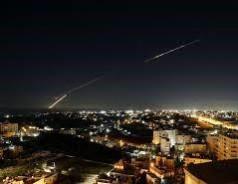
Trump spoke as hostilities continued across the region. US Central Command (CENTCOM), which oversees operations in the Middle East, confirmed the deaths of three American service members and said five others were seriously wounded, without providing further details.