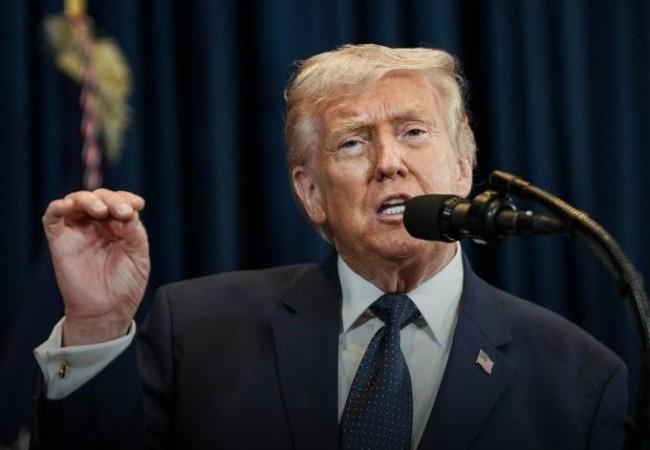
Donald Trump has said that the ongoing conflict with Iran is "close to being over," while asserting that the American economy has remained resilient despite escalating tensions.
In an interview with Fox News at the White House, Trump said Iran has been "hit very hard" and claimed that a US-led blockade of Iranian ports is now fully in place. "It only matters what the end result is... and maybe it'll happen fairly soon," he said.
Reiterating Washington's stance, Trump stressed that Iran must not acquire nuclear weapons. He added that while the US has the capability to escalate further, restraint has been exercised. "We could take out every one of their bridges... every one of their power plants... but we don't want to do that," he said.
Despite the geopolitical tensions, Trump expressed confidence in the US economy. He pointed to relatively stable oil prices, noting that crude remains around $92 per barrel—far lower than earlier predictions of a spike to $200.
"Gasoline's coming down very soon and very big," he said, adding that energy costs would ease significantly once the conflict ends.
Trump acknowledged there could be short-term economic disruption but dismissed long-term concerns. "There's gonna be a hit, but it's gonna recover," he said, predicting that financial markets would rebound strongly. "When this is over, I think the stock market is gonna boom."
He also highlighted the relative stability of US stock markets during the crisis, saying they have held up better than expected despite earlier volatility.
On domestic policy, Trump credited tax changes for cushioning households, claiming that refunds ranging from $5,000 to $11,000 are reaching Americans. He also reiterated proposals such as no tax on tips, overtime, and Social Security.
The remarks come as global markets remain sensitive to developments in the Strait of Hormuz, a key route for global oil supplies. Any disruption in the region has immediate implications for energy prices and inflation worldwide.
Trump maintained that military action was necessary to prevent a larger crisis, warning that allowing Iran to develop nuclear weapons would have far more severe economic consequences.