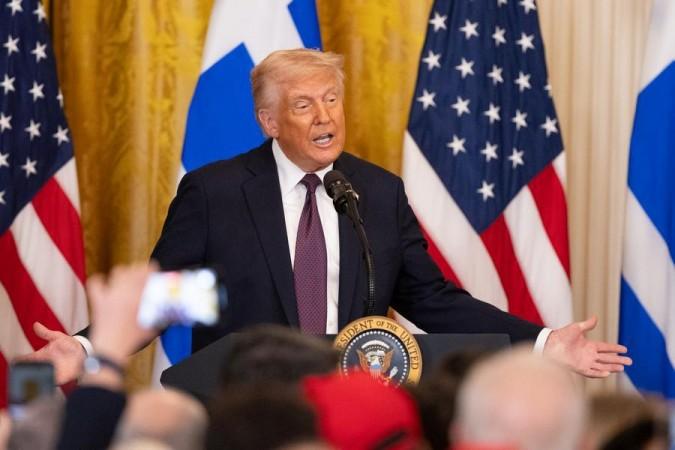
US President Donald Trump announced that the United States will permit NVIDIA to ship its advanced H200 artificial intelligence chips to approved customers in China under what he described as strict national security conditions, drawing an immediate and sharp warning from Senator Elizabeth Warren, who said the move could "risk turbocharging China's bid for technological and military dominance."
In a post on Truth Social, Trump said he had "informed President Xi, of China, that the United States will allow NVIDIA to ship its H200 products to approved customers in China, and other Countries, under conditions that allow for continued strong National Security." He added that "President Xi responded positively!"
Trump cast the decision as a financial and industrial gain for the United States. "$25% will be paid to the United States of America. This policy will support American Jobs, strengthen U.S. Manufacturing, and benefit American Taxpayers," he wrote.
He sharply criticized the previous Biden administration, claiming it forced US companies to "spend BILLIONS OF DOLLARS building 'degraded' products that nobody wanted, a terrible idea that slowed Innovation, and hurt the American Worker."
"That Era is OVER!" Trump declared. "We will protect National Security, create American Jobs, and keep America's lead in AI."

Trump noted that NVIDIA's domestic customers were already moving ahead with next-generation chips. "NVIDIA's US Customers are already moving forward with their incredible, highly advanced Blackwell chips, and soon, Rubin, neither of which are part of this deal." He added that his administration "will always put America FIRST."
He also signaled the policy would apply more broadly. "The Department of Commerce is finalizing the details, and the same approach will apply to AMD, Intel, and other GREAT American Companies. MAKE AMERICA GREAT AGAIN!"
Senator Elizabeth Warren, the Ranking Member of the Senate Banking, Housing, and Urban Affairs Committee, issued a strongly worded statement rejecting the decision and tying it to corporate access.
"After his backroom meeting with Donald Trump and his company's donation to the Trump ballroom, CEO Jensen Huang got his wish to sell the most powerful AI chip we've ever sold to China," she said. "This risks turbocharging China's bid for technological and military dominance and undermining US economic and national security."
She urged Congress to respond quickly. "Congress must act swiftly. It should pass bipartisan legislation that reins in this Administration, and it should require Mr. Huang to testify publicly and under oath."
Warren and Senator Andy Kim, Ranking Member of the BHUA Subcommittee on National Security and International Trade and Finance, had previously urged Commerce Secretary Howard Lutnick not to greenlight the export of H200 chips to China. A bipartisan group of lawmakers had earlier objected to Commerce resuming shipments of NVIDIA's less powerful H20 chips.
The exchange underscores the sharpening debate in Washington over whether the United States should permit exports of frontier AI technology to China as competition over semiconductors, high-performance computing, and defense-related innovation intensifies. The H200 is among NVIDIA's most powerful AI accelerators and is widely used for training and deploying advanced artificial intelligence models.
Beginning in 2022, the Biden administration imposed strict export controls designed to curb China's access to cutting-edge chips, while simultaneously encouraging the expansion of US-based semiconductor manufacturing through the CHIPS and Science Act. Those rules reshaped global supply chains and sparked a new phase of geopolitical tension over access to advanced computing hardware.
The Trump administration has taken a different approach, allowing certain exports under financial and security conditions while promoting the rapid expansion of AI manufacturing in the United States.
The policy debate comes as China continues to pour resources into its domestic AI, semiconductor, and military modernization programs—developments closely watched by US policymakers and allies across the Indo-Pacific who view advanced computing as a critical frontier in strategic competition.
(With inputs from IANS)