
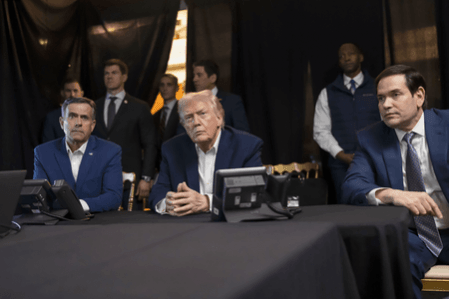
As the United States deepens its military involvement in Iran, President Donald Trump has been publicly acting as if the conflict is already behind him. Even as thousands of additional troops are being sent to the Middle East and tensions remain high, Trump has repeatedly signalled that he sees the war as effectively over — a posture that has unsettled some senior White House aides and outside allies, according to three people who spoke to MS NOW.
They described Trump's public messaging as confusing, internally inconsistent and increasingly detached from battlefield reality. A second White House official, also speaking anonymously, said Trump has already begun shifting his focus away from the conflict and toward the economy, domestic issues and the upcoming midterm elections.
But for many inside and outside the administration, the war is far from over. According to a previously unreported intelligence assessment cited by Reuters, the United States has destroyed roughly a third of Iran's missile arsenal, offering the clearest picture yet of the impact of nearly a month of sustained US-Israeli strikes.
At the same time, tensions remain high. The United States and Iran are continuing to exchange proposals through intermediaries, but the situation on the ground — and at the Strait of Hormuz — continues to deteriorate.
On Thursday, Trump posted on Truth Social that the "Iranian negotiators are very different and strange." He also wrote that they are "begging us to make a deal." Iranian officials have repeatedly denied that claim.
Some current and former Trump officials say his messaging has not kept pace with the reality of the conflict. Trump prematurely claiming victory despite the evidence is not new. He used a similar approach after the 2020 election, when he made unsubstantiated claims of massive voter fraud to explain his loss to Joe Biden. But allies say that approach lands differently in wartime.
"He has learned he can tell the American people his feeling, and, with enough time, they will accept it," a former Trump White House official said. "Just telling us the war is won isn't good enough. We need to see it; we need to feel it."
That disconnect has also become visible in the White House's communications strategy, which some officials say has made the conflict look less like a war and more like online content. In recent weeks, official White House social media accounts have used internet memes to promote the conflict, including clips from movies like Iron Man and Top Gun, cartoon characters such as SpongeBob SquarePants, and rap music placed over unclassified footage of bombs striking Iranian targets.
For some inside the White House, that approach has become a major, though mostly quiet, source of tension. "The war videos are cringe and disrespectful and gross," a senior White House official told MS NOW. "It makes me feel embarrassed."
Others also questioned the value of the administration's online messaging. "The social media posts of bombs being dropped — okay, cool — but what do we get out of this?" one official said.
A second White House official defended the administration's broader communications approach, saying there is a distinction between the White House's two main messaging channels. According to the official, the administration's accounts have leaned more into viral content, while Trump's Truth Social account serves as the more substantive platform for policy and communication.
The same official added that there is a clear divide among White House officials over how to handle messaging as the war drags on. All the current and former officials who spoke to MS NOW anonymously said they do not share these opinions openly inside the White House because they fear consequences.
"So many people are afraid of being on the outs that they are just drinking the Kool-Aid and going along with it," the former official said.