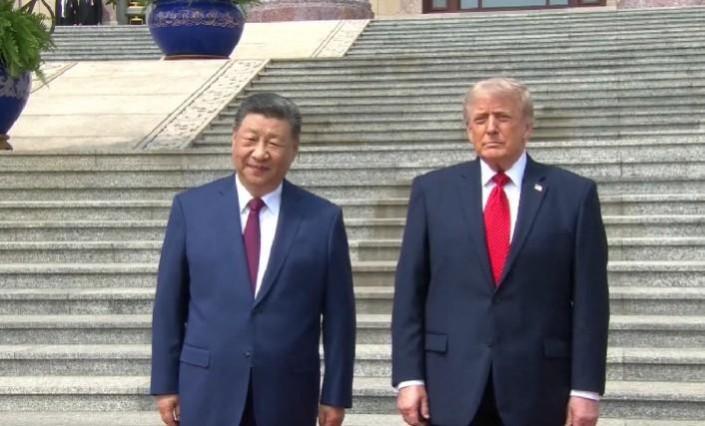
President Donald Trump left Beijing after a tightly scripted 43-hour visit marked by ceremonial splendor: a lavish state banquet in the Great Hall of the People, symbolic photographs at the ancient Temple of Heaven, and warm personal exchanges with Chinese President Xi Jinping. The optics were flawless. The substance proved far more restrained.
Trump emerged bullish, telling reporters aboard Air Force One and in interviews that the trip delivered "fantastic trade deals" and that "a lot of good has come of it." He described the meetings as an "incredible visit" during which the two sides "settled a lot of different problems." Yet one straightforward question hung over the outcome: Where was the comprehensive signed agreement? There was none.
Washington and Beijing released separate statements that overlapped in broad aspirations but diverged in specifics, a familiar diplomatic pattern that lets each leader project success to domestic audiences while preserving flexibility.
The Tangible Deliverable and Market Reaction
The clearest outcome was China's commitment to an initial purchase of 200 Boeing aircraft, the first major order in nearly a decade. Boeing confirmed an "initial commitment" and expressed optimism about reopening the Chinese market. Trump went further, noting the potential for expansion toward 750 planes "if they do a good job" and referencing related deals for roughly 400 to 450 GE jet engines.
"This has been an incredible visit," Trump said. "We've made some fantastic trade deals, great for both countries." In one interview he added pointedly, "One thing he agreed to today: he's going to order 200 jets. That's a big thing. Boeing 200 big ones. That's a lot of jobs."
Markets were less enthusiastic. Boeing shares fell nearly 4 percent on the announcement, reflecting disappointment that the figure landed well below the 300 to 500 planes many analysts had anticipated.
Other elements highlighted in U.S. readouts, including expanded agricultural purchases, energy and oil deals, and the creation of bilateral trade and investment councils, received limited or no detailed confirmation from the Chinese side. No broad tariff resolution or structural trade framework was jointly formalized.
Divergent Priorities and Readouts
Xi characterized the summit as "historic and landmark," declaring that the two countries had established "a constructive strategic stable relationship" that would guide ties for the next three years and beyond. "We have achieved many cooperative outcomes," he said, emphasizing long-term stability over immediate transactional wins.
On Iran, the sides found some common language but offered differing levels of detail. Trump stated that he and Xi "feel very similar on Iran. We want that to end. We don't want them to have a nuclear weapon. We want the Strait of Hormuz opened." He added that Xi expressed interest in helping broker peace and pledged that China would not supply military equipment to Iran. Chinese statements were more circumspect, focusing on general calls for de-escalation and a permanent ceasefire without firm enforcement commitments.
On Taiwan, Xi delivered a clear warning early in the talks: mishandling the issue would put the entire bilateral relationship "in great jeopardy." Trump urged cooling tensions and described the island as "a very small target" near China, while maintaining U.S. support.
Two Powers Buying Time
Beneath the pageantry lies a sobering reality. Both nations are navigating significant internal pressures that limit their appetite for grand bargains.
The United States confronts a national debt approaching 39 trillion dollars, with debt held by the public exceeding 100 percent of GDP. Interest payments now rival major federal spending categories, and the trajectory continues upward.
China grapples with the prolonged aftermath of its property-led growth model. Real estate investment has declined sharply for multiple consecutive years, with reports indicating drops exceeding 15 percent in key recent periods. Private investment has also weakened, and analysts routinely question the gap between official growth figures and underlying momentum amid demographic challenges and subdued consumption.
As one analyst framed the encounter, two large economies under strain met not as ascendant hegemons but as pragmatic negotiators seeking breathing room. The summit reinforced an existing trade truce, established dialogue mechanisms, and produced warm personal rapport Trump repeatedly called Xi a "great leader" and invited him to the White House in September yet delivered no transformative reset.
Beyond Bipolar Theater
This outcome challenges the tidy media narrative of a fully formed bipolar world order. Interdependence persists alongside rivalry. Third countries resist being forced into exclusive alignment. Domestic constraints on both sides debt and deficits in the United States, property deleveraging and confidence issues in China shape a contest defined as much by endurance as by headline diplomacy.
Trump returns home able to tout commercial wins and personal chemistry. Xi demonstrated control and hospitality while making minimal visible concessions. Both secured time. Whether that time produces deeper adjustments in debt management, innovation, demographics, or strategic restraint will determine the longer arc.
The Temple of Heaven photographs endure as striking images of ceremony. The comprehensive signed agreement that would redefine the relationship, however, remains absent. For now, the theater continues, and the deeper test of resilience lies ahead.
[Major General Dr. Dilawar Singh, IAV, is a distinguished strategist having held senior positions in technology, defence, and corporate governance. He serves on global boards and advises on leadership, emerging technologies, and strategic affairs, with a focus on aligning India's interests in the evolving global technological order.]