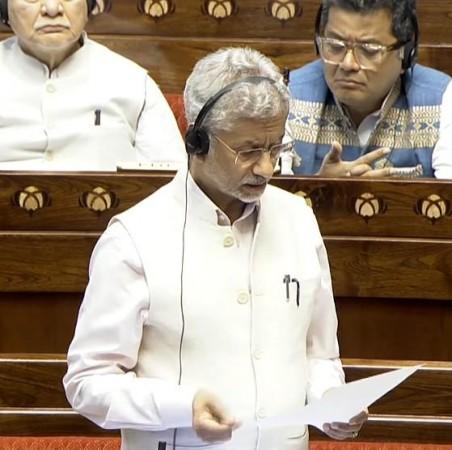
External Affairs Minister (EAM) S. Jaishankar on Monday informed the Rajya Sabha that Iran had expressed gratitude to India for a "humane gesture" after New Delhi allowed the Iranian warship IRIS Lavan to dock at Kochi port amid escalating tensions in West Asia.
Delivering his statement on the evolving situation in the region, EAM Jaishankar said maintaining high-level communication with Iran has been challenging, though diplomatic engagement continues through available channels. "While contacts with Iran at the leadership level are difficult at this time, I spoke to Foreign Minister Araghchi on February 20 and March 5, 2026. We will continue these high-level conversations in the coming days," he said.
The Minister explained that the IRIS Lavan had reported a technical malfunction while operating in the region and requested urgent docking permission. After consideration, the Centre approved the request on March 1, and the vessel docked at Kochi port on March 4. "The crew is currently accommodated in Indian Naval facilities. We believe this was the right course of action, and the Iranian Foreign Minister expressed thanks for this humane gesture," EAM Jaishankar said.
He also addressed concerns about India's energy security amid regional instability, emphasizing that the government has prioritized the interests of Indian consumers. He outlined three guiding principles for India's approach to the crisis: advocating peace, dialogue, and diplomacy; ensuring the safety and security of Indian nationals in the region; and safeguarding national interests, including energy security and trade flows.
Leader of the House J.P. Nadda criticized the Opposition for their conduct during the statement, accusing them of prioritizing "rowdiness" over national issues. He cited past instances, including debates on electoral reforms, Operation Sindoor, and the Union Budget 2026-27, where the Opposition staged walkouts.
EAM Jaishankar informed the House that, as of March 8, 67,000 Indian nationals have safely returned from conflict-affected countries in West Asia. The government facilitated returns during partial openings of regional airspace, including commercial and non-scheduled flights.
The Indian Embassy in Tehran assisted students and business nationals in relocating to safer areas or travelling via Armenia for return to India. Multiple advisories were issued to Indian citizens as security conditions worsened.
The Minister also highlighted that Prime Minister Narendra Modi has been closely monitoring developments, speaking with leaders of the UAE, Qatar, Saudi Arabia, Oman, Jordan, Israel, and Bahrain, urging de-escalation. Positive assurances have been received from these countries regarding the welfare of Indian nationals.

EAM Jaishankar reiterated that the West Asia conflict is of particular concern due to India's large expatriate community in the Gulf, numbering nearly 1 crore, and thousands in Iran for study and work. He noted the region's strategic and economic importance, highlighting its role in India's energy security, trade, and investment.
The conflict has already impacted maritime shipping, claiming two Indian mariners and leaving one missing. The government has been assessing the situation since June 2025, issuing advisories and facilitating safe evacuation of citizens in Iran.
Delivering his statement amid Opposition protests, EAM Jaishankar stressed India's position: the government prioritizes civilian safety, dialogue, diplomacy, and protection of national interests while maintaining engagement with all regional and international partners.
(With inputs from IANS)