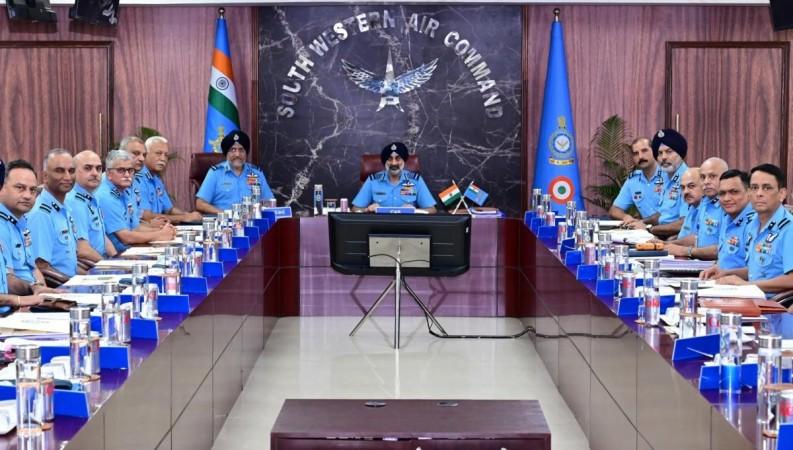
Every once in a while, a military leader coins a phrase that outlives the occasion. Air Chief Marshal A. P. Singh may have done precisely that.
Standing at Karwar during the commissioning of INS Malvan, he observed, "Technology delayed is technology denied." It was ostensibly a comment on indigenous defence production. In reality, it was a diagnosis of India's greatest military vulnerability.
The statement deserves to be viewed as doctrine, not rhetoric.
Modern warfare is no longer decided solely by superior technology. It is decided by who fields superior technology first. A fighter delivered five years late, a radar inducted after the threat has evolved, or an unmanned system entering service when autonomous warfare has already advanced, represents not merely a procurement delay but an erosion of deterrence.
As former US Secretary of Defense James Mattis observed: "If you don't innovate, you're going to lose."
The Air Chief's warning therefore extends far beyond aircraft. It challenges India's entire defence innovation ecosystem. He pointed towards the solution himself.
The Indian Navy has quietly built one of the world's most successful indigenous shipbuilding ecosystems. Today, over 95% of naval platforms under construction are being built in Indian shipyards, supported by a seamless partnership among the Navy, shipyards, DRDO, academia and private industry. More importantly, naval officers remain embedded throughout the design, construction and life-cycle management of warships, creating institutional memory rarely seen elsewhere.
Acknowledging this success, the Air Chief candidly admitted that the Air Force has lessons to learn from the Navy's model. Such institutional humility is uncommon. It is also strategically significant.
Former DRDO Chairman Dr G. Satheesh Reddy captured the underlying principle succinctly:
"Self-reliance in defence technologies is essential for India's strategic autonomy."
Yet self-reliance cannot become an excuse for slow delivery.
Technology now evolves in months rather than decades. Artificial intelligence, autonomous systems, quantum technologies and electronic warfare are redefining military power at unprecedented speed. Procurement cycles designed for the industrial age cannot deliver battlefield advantage in the algorithmic age.
As former Chief of Defence Staff General Bipin Rawat repeatedly reminded India's armed forces: "The character of war is changing. We must prepare for future wars, not fight the last one," so is Air Chief Marshal Singh's emphasis on collaboration. His assertion that no future war will be won by an individual service reflects the reality that integration must begin long before the battlefield. It must start in laboratories, design bureaus, production lines and procurement systems.
India's defence exports have surged from ₹686 crore in FY2013–14 to a record ₹38,424 crore in FY2025–26, reflecting the country's growing role as a global defence exporter. It also demonstrate that the country's industrial base is maturing. The next challenge is not merely to build indigenously, but to build faster than technological obsolescence.
Prime Minister Narendra Modi has consistently linked defence manufacturing with national security, stating: "There is no greater guarantee of security than self-reliance."
The Air Chief has now added the missing dimension: Self-reliance without speed risks irrelevance.
INS Malvan will be remembered as another addition to the Navy's growing fleet. But the more enduring legacy of its commissioning may well be a single sentence that captures the defining strategic challenge before India.
In the 21st century, technology delayed is not merely technology denied. It is deterrence diminished, strategic opportunity surrendered and national power deferred.
[Major General Dr. Dilawar Singh, IAV, is a distinguished strategist having held senior positions in technology, defence, and corporate governance. He serves on global boards and advises on leadership, emerging technologies, and strategic affairs, with a focus on aligning India's interests in the evolving global technological order.]