
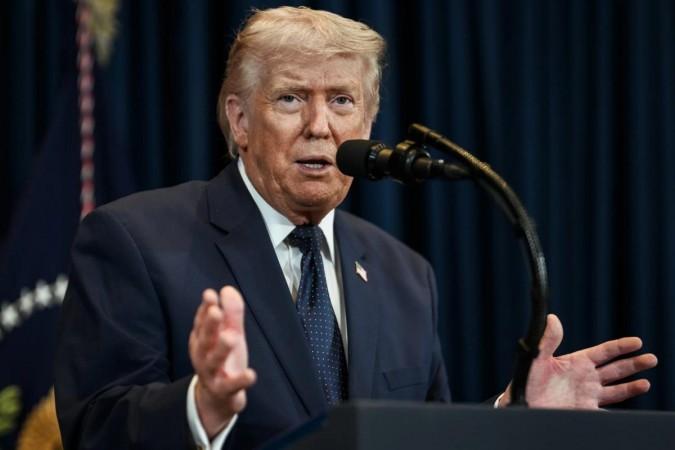
The most revealing signal of the emerging global order reappeared this month when the Trump administration launched new Section 301 investigations into several trading partners, including India. The move came despite months of negotiations and concessions from New Delhi intended to stabilize the bilateral economic relationship.
For many strategic observers, the development confirmed a pattern that Harvard international relations scholar Stephen Walt has described bluntly: modern great powers increasingly behave like "predator hegemons"—pressing hardest against those least willing to resist.
The lesson is not uniquely American. It reflects a deeper truth of international politics: respect is rarely granted to rising powers automatically; it is extracted through capability, consistency, and strategic confidence.
For India, which seeks recognition as a major pole in the twenty-first-century international system, the implications are profound.
India's economy is now approaching $4 trillion. It is projected by many analysts to become the world's third-largest economy by the early 2030s. It possesses one of the world's largest armed forces and a rapidly expanding technological sector.
Yet despite these strengths, India often still conducts foreign policy with the instincts of a cautious middle power rather than an emerging systemic power.
The challenge before New Delhi is therefore not simply diplomatic—it is psychological, strategic, and institutional.
A Harder International System
The global system that India navigates today is fundamentally different from the one that shaped its post-Cold War diplomacy.
Three structural transformations are redefining international politics.
First, economic instruments have become tools of strategic coercion. Tariffs, sanctions, export controls, and supply-chain restrictions are now routinely deployed to advance geopolitical objectives.
Second, military competition is expanding beyond traditional battlefields into cyber, space, artificial intelligence, and data infrastructure.
Third, great-power rivalry is returning as the central organizing principle of international politics.
A report by the International Institute for Strategic Studies warns that the world is entering a period of "competitive multipolarity," in which several major powers simultaneously contest influence across regions and technologies.
In such an environment, diplomatic caution alone does not guarantee stability.
India's Neighbourhood: Influence Under Pressure
The first arena where India's strategic posture is tested is its immediate neighbourhood.
India's relationship with Pakistan remains frozen in a deterrence equilibrium that has endured since the nuclear tests conducted in 1998 by Atal Bihari Vajpayee and Nawaz Sharif.
Crises such as the Kargil War and the Pulwama Attack illustrate how quickly escalation can occur under the nuclear shadow.
Former Chief of Defence Staff Bipin Rawat repeatedly warned that future conflicts in South Asia would increasingly involve hybrid warfare, information operations, and proxy forces rather than conventional invasions.
Yet Pakistan represents only one dimension of India's regional challenge.
China's expanding presence across South Asia has altered the strategic balance in ways that were difficult to imagine two decades ago.
Through the Belt and Road Initiative, Beijing has financed infrastructure projects across Pakistan, Sri Lanka, Nepal, and Bangladesh.
One of the most symbolic examples is the development of the Hambantota Port, which Sri Lanka ultimately leased to China for 99 years after struggling to repay infrastructure loans.
The episode triggered intense debate within India's strategic community about the geopolitical implications of debt-driven infrastructure diplomacy.
The China Challenge
India's most consequential strategic rivalry is unquestionably with China.
The confrontation between Indian and Chinese troops in the Galwan Valley in 2020 shattered decades of assumptions about the stability of the Himalayan frontier.
Since then, both countries have deployed tens of thousands of troops along the Line of Actual Control.
China's military modernization further complicates the balance. According to the Stockholm International Peace Research Institute, China's defence spending exceeds $220 billion annually, compared with roughly $81 billion for India.
Yet the rivalry extends far beyond military budgets.
China dominates global supply chains in electronics, rare earth minerals, and manufacturing. It is the largest trading partner for more than 120 countries.
The RAND Corporation has noted that Beijing's strategy increasingly emphasizes "systemic influence" leveraging infrastructure, technology platforms, and financial networks to shape geopolitical outcomes.
India and the United States: Partnership and Pressure
The India-U.S. relationship represents one of the most significant geopolitical realignments of the past two decades.
The 2008 civil nuclear agreement between the two countries transformed strategic cooperation and opened the door to expanding defence and technology partnerships.
Yet the relationship remains shaped by persistent economic friction.
Trump has repeatedly described India as a "tariff king," arguing that high import duties disadvantage American exporters.
Meanwhile India views American export controls and technology restrictions as potential obstacles to its technological ambitions.
A study by the Center for Strategic and International Studies notes that economic coercion is becoming a central instrument of great-power competition, particularly in sectors such as semiconductors and advanced manufacturing.
For India, the challenge is therefore to deepen strategic cooperation with Washington without becoming strategically dependent.
Energy, Iran, and Strategic Vulnerability
India's energy security illustrates another structural vulnerability.
According to the International Energy Agency, India imports more than 85 percent of its crude oil requirements.
Much of this supply flows through the Strait of Hormuz, a maritime chokepoint that has repeatedly been threatened by tensions between Iran, the United States, and Gulf states.
India's investment in the Chabahar Port was designed to strengthen connectivity with Central Asia and Afghanistan while bypassing Pakistan.
Yet American sanctions and geopolitical pressures have complicated the project's progress.
This dilemma illustrates a broader challenge in Indian diplomacy: balancing strategic autonomy with geopolitical realities.
Economic Power and Strategic Influence
Ultimately, the credibility of any major power rests on the strength of its economy.
India's economic trajectory is impressive. It is the fastest-growing large economy in the world and home to one of the most dynamic technology sectors.
However, economic power is not measured only by growth rates.
It also depends on technological leadership, manufacturing capacity, and supply-chain resilience.
The World Economic Forum warns that countries that dominate critical technologies such as artificial intelligence, semiconductors, and advanced materials will shape the geopolitical balance of the twenty-first century.
India has made significant progress in digital infrastructure and space technology but still lags in semiconductor manufacturing and advanced industrial ecosystems.
From Strategic Restraint to Strategic Confidence
India's diplomatic tradition has long emphasized restraint and consensus-building.
These principles served the country well during the Cold War and helped establish its reputation as a responsible global actor.
But the emerging international system increasingly rewards states capable of combining diplomacy with decisive strategic signaling.
India therefore faces a crucial transition.
It must move from a posture defined primarily by strategic restraint to one characterized by strategic confidence.
This does not mean abandoning diplomacy or cooperation. Rather, it means ensuring that diplomacy is backed by visible economic leverage, technological strength, and credible military capability.
The Strategic Moment
India stands today at a historic inflection point.
It possesses the demographic scale of China, the democratic legitimacy of the West, and the civilizational continuity of one of the world's oldest cultures.
Few nations combine these attributes.
But potential alone does not determine the course of history.
Power must be organized, projected, and defended.
If India succeeds in aligning its economic growth, technological innovation, military modernization, and diplomatic strategy, it can emerge as one of the defining powers of the twenty-first century.
If it hesitates, it risks remaining a perpetual "rising power" admired for its potential but limited in its influence.
The world is entering a harder era of geopolitics.
For India, the moment has arrived to act like the power it aspires to become.
[Major General Dr. Dilawar Singh, IAV, is a distinguished strategist having held senior positions in technology, defence, and corporate governance. He serves on global boards and advises on leadership, emerging technologies, and strategic affairs, with a focus on aligning India's interests in the evolving global technological order.]