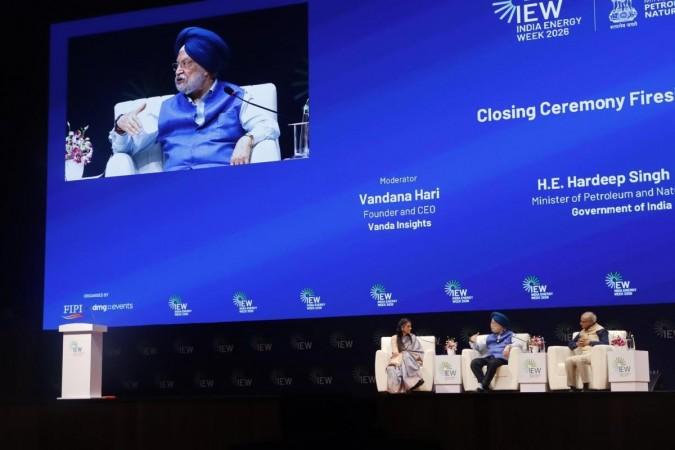
India has successfully insulated its citizens from global price volatility, ensuring that international energy market turmoil has not been passed on to consumers, Union Minister for Petroleum and Natural Gas Hardeep Singh Puri said on Friday.
Addressing the closing ceremony of India Energy Week (IEW) 2026 in Goa, the minister said India has demonstrated strong preparedness to navigate sustained geopolitical volatility in global energy markets and continues to occupy centre stage in international energy discourse.
According to an official statement, Puri noted that India today has among the lowest energy prices in the world and has maintained uninterrupted fuel supply even during global crises. He credited timely interventions by oil marketing companies for keeping fuel prices, including LPG, affordable for consumers.
Highlighting the government's energy transition efforts, the minister said India is rapidly scaling up clean and alternative energy solutions alongside conventional fuels. "Traditional energy will remain essential, but the strides we are making—from ethanol blending to compressed biogas (CBG), hydrogen and biofuels—give us confidence that greener fuels will play an expanding role," he said.
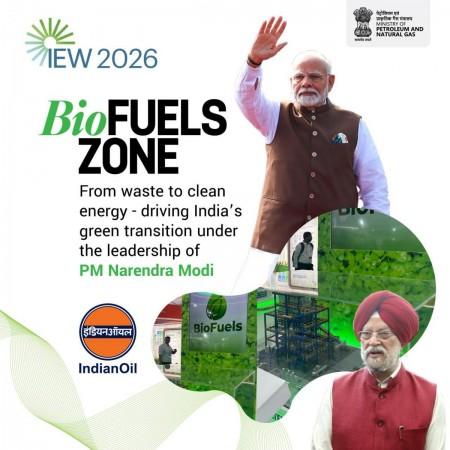
Puri also underlined India's progress in waste-to-energy initiatives, stating that the Biofuels Zone at IEW 2026 showcased how organic waste is being converted into clean energy at scale. "With 133 CBG plants commissioned, having a capacity of 926 tonnes per day and availability at 410 retail outlets, India's CBG ecosystem is expanding rapidly, strengthening energy security and sustainability," he said.
An additional 83 CBG plants are currently under construction, expected to add around 700 tonnes per day of capacity. These plants process agricultural residue, cattle dung, municipal solid waste and sugarcane press mud to generate compressed biogas and organic manure. Promoted under the SATAT (Sustainable Alternative Towards Affordable Transportation) scheme, CBG serves as a green alternative to CNG, reduces import dependency, lowers carbon emissions and boosts rural incomes.
Secretary, Ministry of Petroleum and Natural Gas, Dr Neeraj Mittal, said that with India's projected economic growth exceeding 7 per cent, energy demand is set to rise sharply. "Our focus rests on two pillars—strengthening domestic exploration and production, and positioning India as a reliable supplier of refined products to the world," he said.
Mittal also stressed the importance of integrating refining and petrochemicals to maximise value addition and reduce imports. On energy transition, he highlighted the growing role of technology and digitalisation. "From logistics optimisation to AI-driven efficiencies, technology is becoming central to lowering costs and improving operational resilience," he added.
India Energy Week 2026, held in Goa from January 27 to 30, brought together over 75,000 energy professionals, more than 700 global exhibitors from 120 countries, along with global ministers, policymakers, industry leaders, innovators and investors. The event highlighted India's efforts to balance energy access with decarbonisation goals while ensuring secure, sustainable and affordable energy through strategic investments, new technologies and global partnerships.