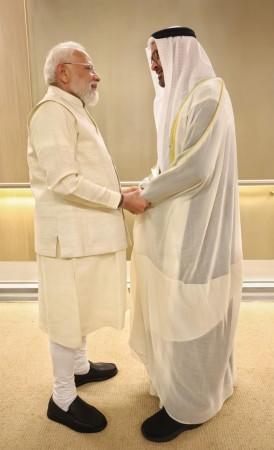
Prime Minister Narendra Modi on Friday said the friendship between India and the UAE remains "very strong" and both countries will continue working together to build a better future for the world, after holding wide-ranging talks with Sheikh Mohamed bin Zayed Al Nahyan in Abu Dhabi during the first leg of his five-nation visit.
"The friendship between India and UAE is very strong! Our nations will keep working together with the aim of building a better future for our planet," PM Modi said after the meeting.
According to the Ministry of External Affairs (MEA), the two leaders discussed strengthening cooperation in energy, trade, investment, defence, blue economy, fintech, advanced technology and people-to-people ties. They also exchanged views on regional and global developments, particularly the ongoing tensions in West Asia.
PM Modi strongly condemned the recent attacks on the UAE and attempts to violate its sovereignty and territorial integrity. He praised the UAE leadership for maintaining unity and stability during the crisis and thanked the government and royal family for supporting the Indian community in difficult times.
"We strongly condemn the attack that took place in the UAE. The way the UAE was targeted is unacceptable in any form," PM Modi said, adding that India stands "shoulder to shoulder" with the UAE and is ready to provide every possible support for restoring peace and stability.
The Prime Minister also stressed that keeping the Strait of Hormuz "free, open and safe" remains India's highest priority and called for adherence to international laws amid disruptions linked to the US-Iran conflict.
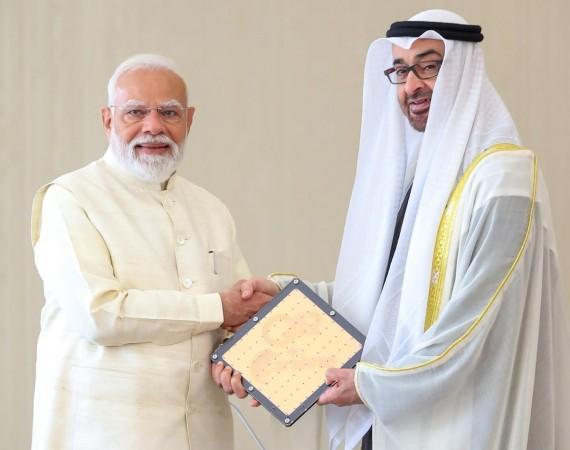
During the visit, India and the UAE signed several key agreements across defence, energy, infrastructure and maritime sectors, giving further momentum to the Comprehensive Strategic Partnership between the two nations.
The two sides signed an Agreement on Framework for the Strategic Defence Partnership to deepen bilateral security cooperation. They also signed a Memorandum of Understanding (MoU) on Strategic Petroleum Reserves and an agreement on Liquefied Petroleum Gas (LPG) supplies to strengthen energy security.
An MoU was also signed to establish a Ship Repair Cluster at Vadinar, aimed at boosting maritime infrastructure and cooperation.
In a major investment announcement, the UAE committed investments worth $5 billion in Indian infrastructure projects as well as in RBL Bank and Samman Capital.
An MoU on Strategic Petroleum Reserves generally provides a framework for cooperation in building and maintaining emergency crude oil reserves to protect countries against supply disruptions and volatile global oil prices.
PM Modi's brief visit to Abu Dhabi also focused on strengthening India's energy supplies and discussing the welfare of the nearly four-million-strong Indian diaspora in the UAE.
The outreach assumes significance amid concerns over disruptions in energy shipments through the Strait of Hormuz due to the ongoing West Asia crisis. The UAE is India's third-largest trading partner and the seventh-largest source of cumulative foreign investment into India over the last 25 years.
PM Modi's visit comes months after Sheikh Mohamed bin Zayed Al Nahyan's short visit to India in January this year.
After concluding the UAE leg of the tour, PM Modi will travel to Netherlands from May 15 to 17 for talks with Dutch Prime Minister Rob Jetten and meetings with King Willem-Alexander and Queen Máxima. Discussions are expected to focus on semiconductors, green hydrogen, innovation, defence and water management.