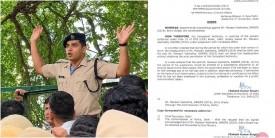
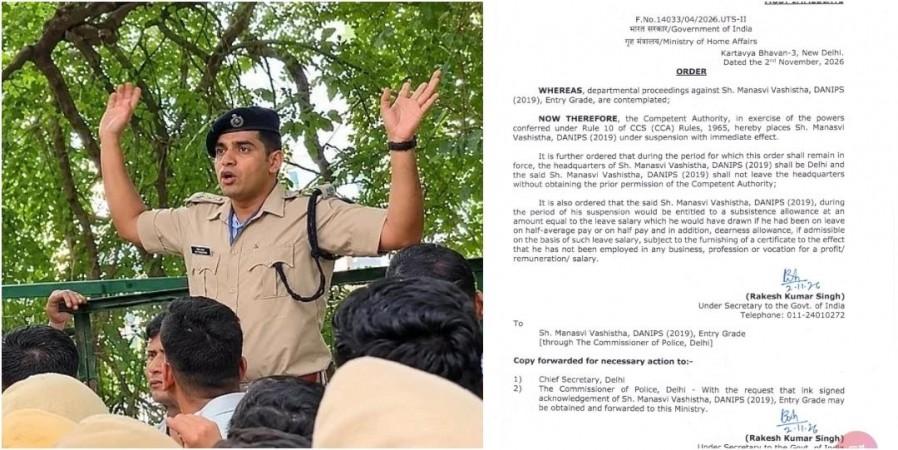
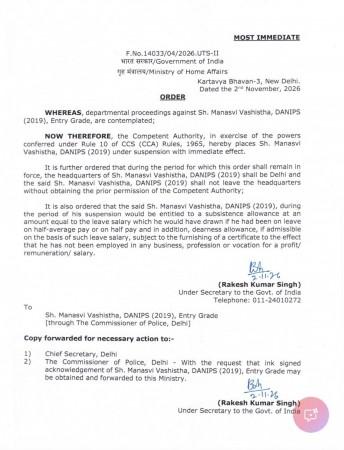
The suspension of ACP Manasvi Vashishtha on 3 November, following a gathering of Delhi Police personnel outside Police Headquarters, has brought an unfortunate confrontation between the police and the legal fraternity into sharp focus.
The controversy followed an incident at Shahdara Police Station on 23 October, in which advocate Lalit Bansal sustained a serious head injury. Allegations and counter-allegations, transfers of police officers, lawyers' abstention from court proceedings and subsequent police protests have brought deeper institutional concerns into the open. The facts and individual responsibilities must be established through impartial investigation. The suspension itself should not be mistaken for a finding of guilt.
Beyond this incident lies a much larger concern. Mounting court pendency, persistent challenges in preventing and investigating crime, complaints of high-handedness and arbitrary exercise of authority, and growing citizen grievances raise uncomfortable questions about the effectiveness and responsiveness of our justice and law-enforcement institutions. These problems have multiple causes and cannot be simplistically attributed to any one profession. Yet they collectively point to a widening gap between what citizens expect and what institutions deliver. This calls for introspection across the police, the legal fraternity and the judiciary, not merely mutual accusations or institutional defensiveness.
All three perform distinct but complementary functions essential to our democracy. Their responsibilities extend beyond maintaining law and order, administering justice and defending citizens' rights. Through their everyday conduct, they also shape public confidence, social civility and respect for the institutions of our nation.
My own interactions with these institutions have, on most occasions, been better than expected. The overwhelming majority of professionals I have encountered have been courteous, competent and genuinely helpful. A very small minority have, regrettably, fallen short. The shortcomings of a few should never diminish respect for an entire profession; equally, institutional loyalty should never become a reason to overlook individual misconduct.
India has been fortunate to have outstanding examples in all three fields. K.F. Rustamji and Julio Ribeiro made distinguished contributions to policing; Justices H.R. Khanna and J.S. Verma exemplified judicial courage and institutional integrity; and Nani Palkhivala, Fali S. Nariman and Soli Sorabjee enriched our constitutional and legal tradition. Their enduring contribution rested not simply on the positions they held, but on the integrity and public trust they earned.
My years in the Armed Forces and public service have reinforced one important conviction: authority and accountability must always go together. A uniform represents the authority of the State and deserves respect, but it also carries the responsibility to protect citizens and exercise power with restraint. Advocates must be free to discharge their professional duties without intimidation, while respecting lawful authority and the rights of others. Judges must administer justice independently, fairly and without undue delay. No public office or professional standing places anyone above the law.
Equally important, no institution can be the judge of its own cause. Allegations involving police personnel or advocates cannot be resolved through collective pressure, public mobilisation or institutional assertions. They require independent, impartial and time-bound examination. The same standard must apply to everyone, irrespective of designation or professional affiliation.
Talk about a self-fulfilling prophecy! ? Just 24 hours after declaring, “Itihaas mein tareekh shaheed kar lo - 2 November,” and calling lawyers “KALE COAT WALE GUNDE,” ACP Manasvi Vashishta has been SUSPENDED by MHA. History was definitely made, just not the way he planned! https://t.co/vrKMtXHOaJ
— D (@Deb_livnletliv) November 3, 2026
Institutional leadership has a particularly important role. Police personnel must have credible avenues to raise genuine concerns about their professional dignity, safety and working conditions. Their grievances deserve to be heard and addressed, while the discipline and chain of command essential to an effective police force must be preserved. Senior police officers, Bar leaders and judicial administration must exercise leadership through dialogue, fairness and established procedures rather than allowing disagreements to escalate.
Above all, the citizen must remain at the centre. Police officers deserve dignity and security; advocates deserve independence and safety; judges must be able to discharge their responsibilities without pressure. Citizens should never feel caught between these institutions or hesitate to seek police protection and legal representation.
Permanent police-Bar coordination mechanisms, clear protocols for interactions at police stations and courts, independent and time-bound grievance inquiries, and greater institutional attention to delays in investigation and adjudication would be practical steps towards restoring confidence. Professional solidarity is important, but it must never become a substitute for accountability.
The real strength of an institution is not how vigorously it defends its own members, but how fairly and courageously it upholds the principles it exists to protect, particularly when doing so is difficult or uncomfortable.
The police, the legal fraternity and the judiciary are not competing centres of power. They are partners in preserving our constitutional order. Their authority derives from the Constitution, their legitimacy from the rule of law, and the respect they command from the character and conduct of those who serve.
Ultimately, institutions must not measure their success by their authority over citizens, but by the trust they inspire, the justice they deliver and the dignity with which they serve society.
[Major General Dr. Dilawar Singh, IAV, is a distinguished strategist having held senior positions in technology, defence, and corporate governance. He serves on global boards and advises on leadership, emerging technologies, and strategic affairs, with a focus on aligning India's interests in the evolving global technological order. Views expressed are his own and do not necessarily reflect those of the IB Times India.]