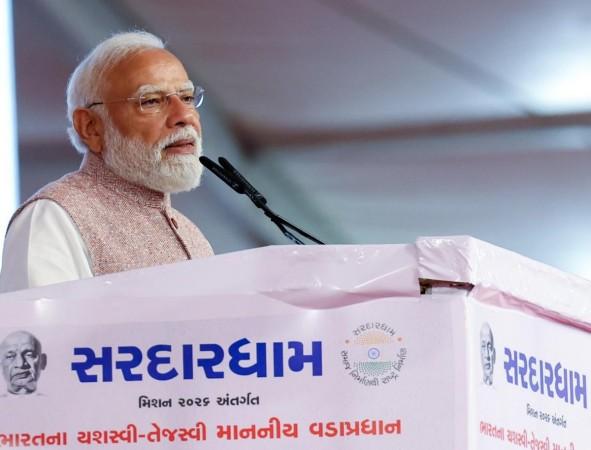
PM Narendra Modi on Monday highlighted political stability as a key driver of development while addressing a gathering at the inauguration of the Sardardham educational complex in Vadodara, Gujarat.
The programme was attended by Gujarat Chief Minister Bhupendra Patel, Deputy Chief Minister Harsh Sanghavi, Union Minister and Sardar Dham founding trustee Mansukh Mandaviya, Sardar Dham President Gagji Sutar, and Dushyant Patel, among others.
Speaking at the event, the Prime Minister referred to recent election results in West Bengal, Assam, and Puducherry, saying they had generated enthusiasm across the country. He also cited Gujarat's local body and panchayat election results, describing them as "very strong and widely discussed across the nation."
He said Gujarat has historically valued political stability and understands its role in development and economic growth. According to him, governance continuity contributes to faster economic progress and improved governance outcomes.
"Gujarat's development trajectory reflects the benefits of continuity in governance. Where stability exists, economic growth accelerates. Gujarat had recognised this relationship early and had benefited from it over time," he said.
The Prime Minister added that sustained voter support reflects public trust in governance and long-term development policies. He also stressed that grassroots democratic participation strengthens institutional frameworks and improves governance delivery mechanisms.
He concluded by saying Gujarat's experience demonstrates how political stability and continuity in governance can influence both development outcomes and electoral patterns over time.
Earlier during the event, the Prime Minister was conferred the 'Sardar Gaurav Ratna' by organisations of the Patidar community. He also inaugurated Sardar Dham Bhavan-3 and announced several initiatives under the Sardar Dham educational and social development framework, including the launch of the Sardar Dham Education Support Yojana with an outlay of Rs 500 crore.
During his address, Modi also appealed for greater self-reliance in consumption habits and financial discipline, urging citizens to reduce dependence on imported goods, gold purchases, and fuel consumption.
He called on people to support domestic products and strengthen local industries, saying, "Today's need is to make Vocal for Local a mass movement."
He noted that increased use of foreign goods places pressure on India's foreign exchange reserves. Referring to gold imports, he said a large amount of national resources is spent on the metal and appealed for restraint in non-essential purchases.
"Gold is not necessary at this time," he said, suggesting people postpone such expenditure until global conditions stabilise.
The Prime Minister also urged moderation in edible oil consumption due to its impact on health and imports, saying reduced consumption would benefit both individuals and the national economy.
On fuel usage, he reiterated the need to reduce dependency on petrol and diesel and encouraged the use of public transport, electric vehicles, shared mobility, and carpooling.
He further spoke against destination weddings and unnecessary overseas travel, saying such practices lead to significant foreign exchange outflow.
"People must consider India for weddings and holidays," he said, adding that India has several culturally significant and scenic destinations suitable for such events. Referring to the Statue of Unity, he remarked, "There can be no better place than India for weddings. I would urge all of you to get married at the Statue of Unity. Sardar Patel will also bless you."
The Prime Minister said the world has been passing through unstable circumstances over the past few years, citing the COVID pandemic, global economic challenges, and rising tensions in West Asia.
"Over the past few years, the world has been continuously passing through unstable circumstances. First, the crisis of COVID, then global economic challenges, and now the rising tensions in West Asia. The impact of all these situations is continuously falling on the entire world, and India is not untouched by it either," he said.
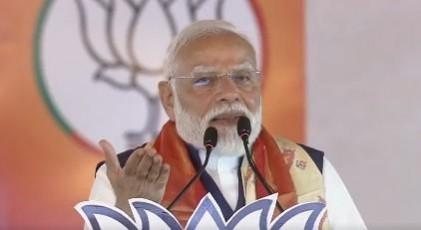
"If the COVID pandemic was the biggest crisis of this century, then the circumstances created by the war in West Asia are one of the major crises of this decade. When we together overcame the challenge of COVID, we will surely get through this crisis as well. The government is also continuously making efforts to ensure that its impact on the people of the country is minimal," he added.
The conflict involving the US, Israel, and Iran has disrupted global energy supply chains, while the US and Iran have been observing a "shaky" ceasefire since March 7.
Modi said that during earlier national crises too, citizens had fulfilled their responsibilities sincerely in response to government appeals.
"Even in the earlier decades, whenever the country has gone through war or any other major crisis, every citizen has fulfilled their responsibility in the same way in response to the government's appeal. Today, too, there is a need for all of us to come together and fulfil our responsibility to reduce the burden on the country's resources," he said.
He added that India spends lakhs of crores of rupees in foreign exchange on imports and noted that prices of imported goods are rising while global supply chains remain disrupted.
#WATCH | Gujarat: Prime Minister Narendra Modi says, "... I appeal to every citizen of my country to reduce the use of petrol-diesel as much as possible. Use the metro, make greater use of electric buses and public transport, and promote carpooling. Those who have a car should… pic.twitter.com/85GGOgBh2W
— ANI (@ANI) May 11, 2026
"Just as every drop fills a pot, every small and big effort matters. We must reduce the use of products that come from abroad and avoid unnecessary dependence on imported goods in our daily lives, and also avoid such personal activities that involve spending foreign exchange," he added.
The Prime Minister also urged farmers to adopt natural farming practices and reduce chemical fertiliser use, stressing that soil protection and sustainability are essential for long-term agricultural health.
He further said the election results from West Bengal, Assam, and Puducherry had created enthusiasm across the country, while Gujarat's local body and panchayat election results were also being discussed nationwide.
PM Modi said the people of Gujarat have always prioritised political stability.
"This reflects the political foresight of the people here. They understand the significance of political stability, and wherever political stability prevails, the pace of economic growth accelerates. Gujarat grasped this fundamental truth a long time ago. Today, the results of that understanding are evident in Gujarat's growth, as well as in the electoral outcomes that have followed, one after another," he said.
"Coming amongst you and participating in your programs is always a deeply gratifying experience for me--it truly feels as though I have returned home," he added.
Speaking at the inauguration of Sardardham Hostel in Vadodara. https://t.co/n6YSMRiWyq
— Narendra Modi (@narendramodi) May 11, 2026
Earlier in the day, PM Modi participated in the Somnath Amrut Mahotsav at Somnath Temple, one of the twelve Jyotirlingas and a symbol of India's enduring faith and civilisational heritage.
Somnath Amrut Mahotsav marks 75 years since the inauguration of the restored Temple.
As part of the celebrations, the Prime Minister participated in a series of auspicious religious and cultural events.
He participated in the Vishesh Maha Puja, followed by the Kumbhabhishek and Dhvajarohan ceremonies, marking the consecration rituals and hoisting of the temple flag.