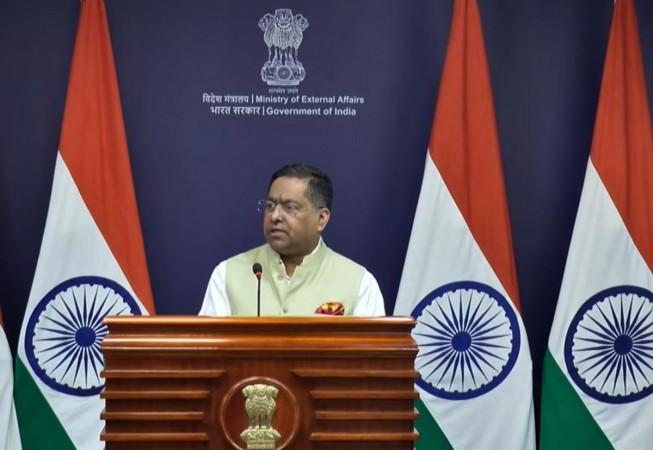
India on Tuesday strongly rejected references to Jammu & Kashmir in the joint statement issued by China and Pakistan, asserting that the Union Territories of Jammu & Kashmir and Ladakh "have been, are and will always remain integral and inalienable parts of India."
Responding to media queries, Ministry of External Affairs spokesperson Randhir Jaiswal said, "India categorically rejects unwarranted references to the Union Territory of Jammu & Kashmir in the Joint Statement between China and Pakistan."
Reiterating New Delhi's long-standing position, the MEA said, "No other country has the locus standi to comment on the same," adding that India's stand on Jammu & Kashmir is "consistent and well known" to both China and Pakistan.
India also objected to references related to the China-Pakistan Economic Corridor (CPEC), parts of which pass through territory claimed by India. The ministry said it "resolutely oppose[s] and reject[s] any moves by other countries to reinforce or legitimise Pakistan's illegal and forcible occupation" of Indian territory.
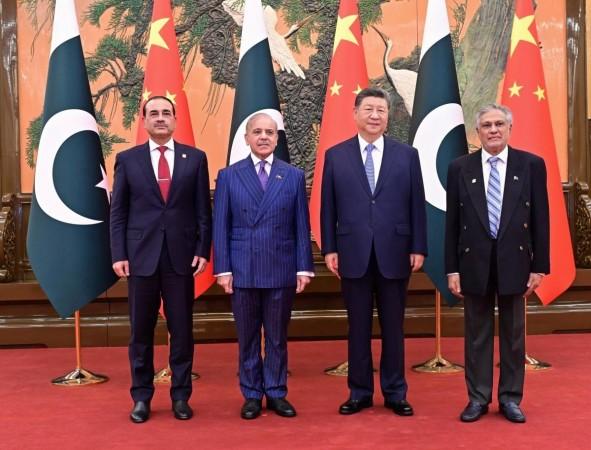
The MEA further criticised references to "trans-boundary water resources cooperation" between China and Pakistan. "As the two countries do not share any boundary, the question of so-called 'trans-boundary water resources cooperation' does not arise," the statement said. India also reiterated that it has "never recognized the so-called 1963 boundary agreement between Pakistan and China."
Just In:
— Sidhant Sibal (@sidhant) May 26, 2026
"No other country has the locus standi to comment", India rejects mention of Kashmir in Pak-China joint statement;
Says, "The Union Territories of Jammu & Kashmir and Ladakh have been, are and will always remain integral and inalienable parts of India." https://t.co/34yk3lhHjI pic.twitter.com/KsON6jnnsp
Earlier in the day, China and Pakistan issued a joint statement after high-level talks, in which Pakistan briefed China on the "latest developments" in Jammu and Kashmir. China reiterated that the Kashmir issue is "left over from history" and should be resolved peacefully in accordance with the UN Charter, UN Security Council resolutions and bilateral agreements.
The joint statement also referred to cooperation between the two countries on counter-terrorism, artificial intelligence, regional stability and trans-boundary water resources.