As India advances toward technological self-reliance under the IndiaAI Mission and the Defence Research and Development Organisation's Evaluating Trustworthy Artificial Intelligence framework, Nvidia's newly unveiled NemoClaw platform arrives at a decisive inflection point. This open-source, chip-agnostic system enables enterprises, and by extension defence organisations, to deploy true AI agents, autonomous digital workers that plan, reason, execute complex multi-step tasks, learn from outcomes, and adapt in real time. For the Indian Armed Forces, NemoClaw offers a pragmatic pathway to operational superiority that preserves complete data sovereignty and aligns seamlessly with indigenous priorities.
The platform operates entirely on Indian infrastructure, integrates natively with models such as BharatGPT, and runs on any approved hardware, from DRDO accelerators to edge devices deployed at extreme altitudes. Built on the Nemotron 3 family, it delivers up to nine times faster inference and 20 per cent higher accuracy on reasoning and multi-step benchmarks, with the smallest variant requiring only approximately 3.6 billion active parameters per token. These gains make large-scale agentic deployment feasible even in bandwidth-constrained forward areas where conventional systems falter.
The Indian Army has already demonstrated the transformative potential of AI. During Operation Sindoor in 2025, AI-enabled tools analysed 26 years of intelligence data in real time to achieve 94 per cent strike accuracy. The ongoing partnership with CoRover to establish a sovereign AI-ML laboratory further signals institutional readiness. NemoClaw can accelerate these efforts by providing an auditable, production-ready foundation for agentic workflows that meet the ETAI framework's rigorous standards for transparency, robustness, and human oversight. With 129 approved AI projects already underway across the services under the Defence AI Project Agency, the infrastructure exists to scale rapidly.
Along the 3,488-kilometre Line of Actual Control, where fog, snow, and vast distances challenge conventional surveillance, NemoClaw-powered Vigilance Claws could orchestrate persistent multi-agent teams. One agent continuously processes satellite, drone, and ground-sensor feeds to detect anomalous movement patterns. A second cross-references weather models, historical incursion data, and terrain analytics to forecast breach points up to 48 hours in advance. A third autonomously tasks loitering munitions or robotic platforms for verification while feeding a unified situational-awareness picture into Trinetra and Project Sanjay. Commanders receive ranked courses of action complete with risk assessments and resource implications, every decision fully traceable and subject to immediate human override.
In the maritime domain, where the Indian Navy protects more than 7,516 kilometres of coastline and vital sea lanes, Ocean Sentinels could revolutionise anti-submarine and counter-swarm operations. Agents would fuse inputs from P-8I aircraft, coastal radars, underwater sensors, and satellite reconnaissance to detect, classify, and shadow hostile vessels or drone swarms. Simultaneously, a logistics agent would optimise fleet replenishment routes in real time, incorporating fuel consumption, weather dynamics, and threat vectors. Early modelling based on analogous enterprise deployments suggests response times could shrink from hours to minutes and sustainment costs fall by 25 to 30 per cent.
Logistics, which underpins the 1.4-million-strong Army across extreme climates from Rajasthan deserts to Ladakh glaciers, stands to gain the most immediate impact. Sustainment Claws could predict equipment failures weeks in advance through continuous analysis of sensor telemetry from tanks, artillery, aircraft, and vehicles. Agents would automatically reroute convoys around landslides or emerging threats and generate adaptive maintenance schedules aligned with mission tempo. Defence experts project that scaled implementation could deliver 40 per cent faster spare-part delivery and 35 per cent reduction in downtime, directly translating into higher combat availability without exposing personnel to unnecessary risk.
Cyber and electronic warfare represent another high-leverage domain. Facing sophisticated state-sponsored threats, NemoClaw agents could function as tireless digital sentinels, continuously scanning networks, simulating adversary tactics, isolating compromised nodes, and generating synthetic decoy traffic. Because the platform is fully open source, DRDO teams could embed India-specific threat signatures derived from indigenous intelligence, ensuring agents evolve with national threat landscapes rather than generic global datasets. All operations can remain air-gapped when required, preserving the highest levels of operational security.
Training and simulation gain exponential depth. NemoClaw agents could serve as infinitely scalable, adaptive adversaries in virtual environments, replicating adversary doctrines with unprecedented fidelity. A single training node could execute thousands of parallel scenarios tailored to individual soldier performance and feed real-time after-action insights directly into doctrine refinement. This capability would compress years of experiential learning into months, preparing forces for the algorithm-driven conflicts that define modern warfare.
The Air Force would benefit equally. Sky Guardians could coordinate swarms of unmanned combat aerial vehicles, dynamically allocating targets, managing fuel and munitions, and maintaining persistent air superiority while minimising pilot workload. Integrated across domains, these agents would enable truly joint operations where Army, Navy, and Air Force digital workforces collaborate seamlessly under human command.
Chief of Defence Staff General Anil Chauhan captured the urgency at the Raisina Dialogue 2026: "Artificial intelligence is going to play a major role in warfare tomorrow, and so would autonomous systems." He added that in combat, victory hinges on "timely decisions and right decisions, and AI and autonomous systems help us do that." DRDO Director General Chandrika Kaushik has been equally emphatic: "In the defence domain, we cannot afford to depend on solutions and AI models which are coming from abroad. We need to be very sure about the trustworthiness of the models and the systems which we are adopting."
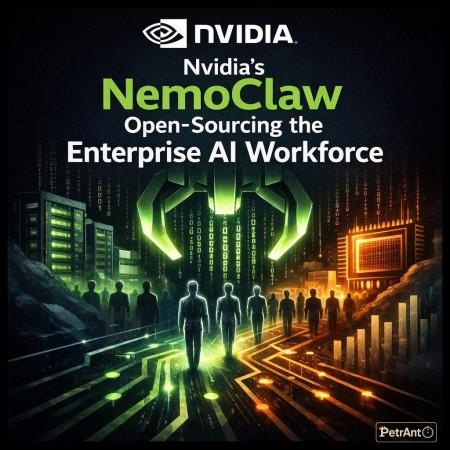
Why Nvidia’s NemoClaw is Open-Sourcing the Enterprise AI Workforce
— PetrAnto (@petranto) March 10, 2026
As of today - March 10, 2026 - the artificial intelligence infrastructure war has (again) fundamentally shifted.
Exactly one week ahead of its highly anticipated GTC developer conference, Nvidia has unveiled… pic.twitter.com/2h2AylNiNA
NemoClaw addresses both imperatives precisely. Implementation can begin immediately in non-kinetic domains such as logistics, predictive maintenance, and training under the Defence AI Project Agency's existing pipeline. Integration with current MoUs between the Army and institutions such as Netaji Subhas University of Technology, combined with IndiaAI Mission compute partnerships, allows all agent logic, data, and decision engines to remain on sovereign soil. Within 18 months, scaled pilots could demonstrate measurable gains in operational tempo and resource efficiency, building confidence for wider deployment.
The strategic payoff extends far beyond efficiency. By mastering agentic AI through an open, auditable platform like NemoClaw, India can emerge as a net exporter of trustworthy defence AI solutions to partners across the Global South, a soft-power multiplier fully aligned with Atmanirbhar Bharat. The Armed Forces would evolve from a manpower-intensive organisation into a hybrid human-digital force where soldiers focus on judgment, leadership, and ethical command while digital claws manage the predictable, repetitive, and time-critical elements of warfare.
The window of opportunity is measured in weeks, not years. With GTC 2026 days away and NemoClaw entering early enterprise pilots worldwide, the Indian defence ecosystem can move now to shape, rather than merely adopt, the next generation of military AI. In doing so, it will not only safeguard national security but redefine what a self-reliant, future-ready armed force looks like in the age of intelligent autonomy. The sentinels of tomorrow stand ready. India now has the platform to deploy them first.
Despite the compelling advantages NemoClaw offers as an open-source, chip-agnostic platform that can accelerate agentic AI adoption within the Indian Armed Forces, its origins as a foreign-developed system from Nvidia introduce unavoidable caveats rooted in national security imperatives. DRDO Director General Chandrika Kaushik has repeatedly emphasized that in the defence domain, India cannot afford to depend on AI models and solutions originating abroad, as reliance on foreign technologies risks compromising trustworthiness, reliability, and sovereign control over critical systems. This concern is amplified by the potential for unintended data flows or backdoor access inherent in any externally originated software stack, even when deployed locally and open-source inspected. While NemoClaw's architecture permits full on-premises execution with air-gapped operations and complete customization, any integration could expose sensitive military workflows, intelligence feeds, or operational telemetry to vulnerabilities tied to upstream code dependencies, model weights, or future updates influenced by Nvidia's global priorities and U.S. regulatory environment. Recent global debates around U.S. export controls, chip diversion risks, and jurisdictional oversight of American tech firms further underscore that true data sovereignty demands minimizing foreign dependencies in mission-critical applications. To align with Atmanirbhar Bharat and the Evaluating Trustworthy Artificial Intelligence (ETAI) framework's emphasis on verifiable resilience and human oversight, any adoption of NemoClaw should therefore proceed only through rigorous, DRDO-led audits, mandatory fork-and-localize strategies that eliminate external telemetry channels, and phased pilots confined to non-sensitive domains until indigenous equivalents mature. These safeguards are essential to prevent scenarios where strategic autonomy is inadvertently eroded, ensuring that digital claws enhance rather than undermine Bharat's independent defence posture.
[Major General Dr. Dilawar Singh, IAV, is a distinguished strategist having held senior positions in technology, defence, and corporate governance. He serves on global boards and advises on leadership, emerging technologies, and strategic affairs, with a focus on aligning India's interests in the evolving global technological order.]