
Senior Indian Police Service (IPS) officer Mukesh Singh has been appointed as the new Director General of Police (DGP) of Ladakh.
The Ministry of Home Affairs (MHA) on Friday ordered the posting of senior Indian Police Service (IPS) officers of the AGMUT cadre with immediate effect, marking a key change in Ladakh.
According to an official order, IPS officer Mukesh Singh (AGMUT: 1996), who was on repatriation from central deputation, has been appointed as the Director General of Police (DGP), Ladakh.
Meanwhile, IPS Shiv Darshan Singh Jamwal (AGMUT: 1995) has been transferred from the post of DGP, Ladakh, and posted as DGP, Arunachal Pradesh. IPS Anand Mohan (AGMUT: 1994), who was serving as DGP, Arunachal Pradesh, has been posted to Delhi.
The transfers have been approved by the competent authority and will remain in force until further orders, the Ministry said.
Mukesh Singh originally belonged to the Jammu and Kashmir cadre before it was merged with the AGMUT cadre following the abrogation of Article 370, which granted special status to the erstwhile state, and its bifurcation into two Union Territories—Ladakh and Jammu and Kashmir—in 2019.
Before moving to the Indo-Tibetan Border Police (ITBP), Singh served as Inspector General and later as Additional Director General of Police for the Jammu range.
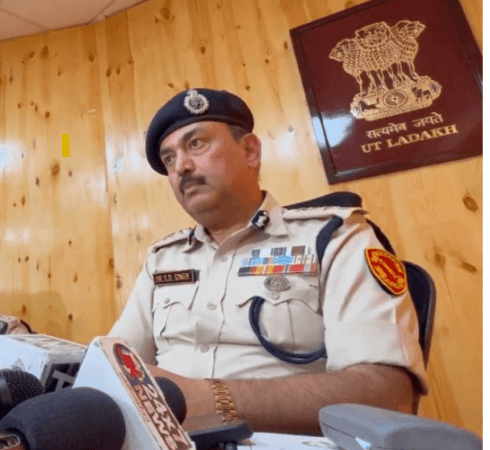
Mukesh Singh takes over from S. D. Singh Jamwal, a 1995-batch IPS officer who has been moved to head the Arunachal Pradesh Police. Singh Jamwal will replace Anand Mohan, a 1994-batch IPS officer, who has been directed to report to Delhi, where he is likely to be accommodated in the Delhi Police.
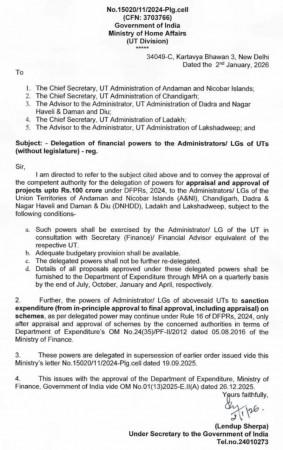
Centre restores ₹100 crore project approval powers to Ladakh LG
In another development, the Union Finance Ministry has restored financial powers to the Lieutenant Governor (LG) of Ladakh. The Ministry has delegated authority for the appraisal and approval of projects worth up to ₹100 crore to the Administrators and LGs of Ladakh, Andaman and Nicobar Islands, Chandigarh, Dadra and Nagar Haveli and Daman and Diu, and Lakshadweep.
According to a communiqué, the powers have been granted under the Delegation of Financial Powers Rules (DFPRs), 2024.
As per the conditions laid down by the Ministry, these powers must be exercised by LGs and Administrators in consultation with the respective Union Territory's Secretary (Finance) or Financial Advisor, and only after ensuring that adequate budgetary provisions are available.
The Finance Ministry directive also states that the delegated powers cannot be further re-delegated.
It further directs that details of all proposals sanctioned under these powers must be submitted quarterly to the Department of Expenditure through the Ministry of Home Affairs by the end of July, October, January, and April.
According to the letter, the powers of Administrators and LGs to sanction expenditure—from in-principle approval to final approval, including appraisal—will continue under Rule 16 of the DFPRs, 2024, but only after schemes are appraised and approved by the competent authorities.
This decision is particularly significant for Ladakh, where political and non-political groups had strongly objected to the Union Government's earlier move to withdraw the LG's powers to approve projects up to ₹100 crore, thereby centralising authority with the Ministry of Home Affairs.
The Centre has also restored financial powers to the Ladakh Lieutenant Governor, allowing approval of development projects worth up to ₹100 crore under the Delegation of Financial Powers Rules, 2024.