
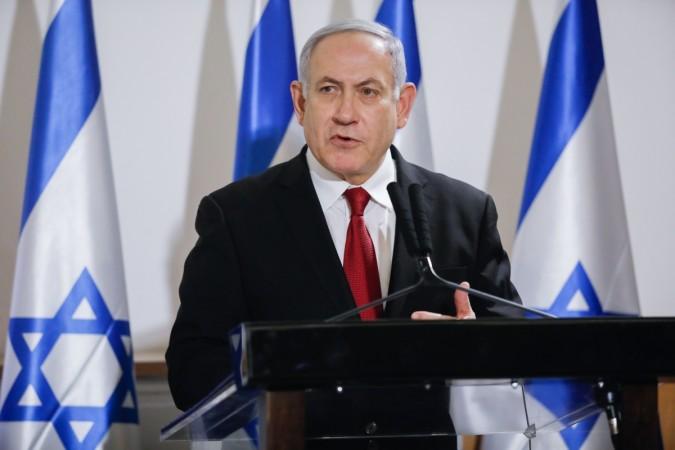
Prime Minister Benjamin Netanyahu signaled a significant escalation in the ongoing regional conflict on Sunday, declaring that Israeli operations against the Iranian regime will "continue to intensify" following a high-level strategic briefing with his top security and intelligence chiefs.
Speaking from the rooftop of the IDF Kirya headquarters in Tel Aviv, Netanyahu confirmed that Israeli forces are currently conducting strikes "in the heart of Tehran" with increasing force.
The prime minister's remarks followed a critical meeting with Defence Minister Israel Katz, IDF Chief of Staff Lt Gen Eyal Zamir, and Mossad Director David Barnea to coordinate the next phase of the campaign.
While maintaining a defiant tone regarding the military's objectives, Netanyahu also addressed the domestic toll of the conflict. He described the current period as "painful days" for the nation, specifically citing recent deadly Iranian missile strikes that hit Tel Aviv and Beit Shemesh. He extended his condolences to the bereaved families and issued a call for the "speedy recovery" of those wounded in the attacks.
According to reports, nine people have died, and many more are severely wounded in Beit Shemesh, marking the highest casualty count in Israel since it began launching strikes on Iran on Saturday. Beit Shemesh lies between western Jerusalem and Jaffa. CNN reported that a missile hit a synagogue, which collapsed onto a bomb shelter beneath, resulting in casualties. People remain trapped in the debris, with rescuers racing against time to save them. Al Jazeera raised questions about why sirens did not go off in Beit Shemesh.
Netanyahu framed the current joint military effort with the United States as a historic opportunity to neutralize a long-standing threat. While stopping short of explicitly promising the total collapse of the Iranian government, he emphasized that the current "combination of forces" has enabled Israel to pursue a decisive blow against the regime—a goal he stated he has sought for four decades. "That is what I promised," Netanyahu concluded, "and that is what we will do."
Iranian Response and Foreign Minister's Remarks
Iranian Foreign Minister Abbas Araghchi on Sunday described the killing of Ayatollah Khamenei as an "absolutely unprecedented" act and a "blatant violation of international law."
In an interview with Doha-based Al Jazeera, he warned that the assassination of a head of state by foreign forces has introduced a "dangerous and complicated" dimension to the existing conflict. Beyond his political role, Araghchi emphasized that Khamenei was a high-ranking religious figure for millions of Muslims globally, noting that the resulting protests in Iraq and Pakistan reflect the scale of the escalation. He specifically condemned the reported killing of demonstrators by US guards in Karachi as a tragic consequence of this "war of aggression."

Military Strategy and Defence of Sovereignty
Regarding ongoing hostilities, Araghchi maintained that Iran is acting strictly in self-defense against American and Israeli aggression. He asserted that while Iran cannot strike the US mainland, it will continue to target US military bases, personnel, and facilities within the region that facilitate operations against Iranian territory.
The Iranian foreign minister accused US forces of attempting to use hotels as "human shields" after evacuating their primary bases. Despite this military friction, Araghchi clarified that Iran has no current intention of closing the Strait of Hormuz or disrupting maritime navigation at this stage.
He addressed concerns from neighboring Persian Gulf nations, insisting that Iran's retaliatory actions are not directed at its "brothers" or neighbors, but exclusively at US targets. He urged regional leaders frustrated by instability to direct their pressure toward Washington and Tel Aviv rather than Tehran, arguing that this war was imposed upon Iran. Furthermore, he criticized the United States for launching attacks while negotiations were still ongoing, stating that while Iran remains open to diplomacy, it recognizes no limits when it comes to defending its national sovereignty.
Constitutional Succession and Transition Council
On the domestic front, Araghchi assured the international community that state institutions remain fully functional and that "everything is in order" according to the legal system. He confirmed that a Transition Council—comprising the President, the Head of the Judiciary, and a member of the Guardian Council—has been established to manage leadership duties temporarily.
He indicated that the Assembly of Experts has already initiated the selection process for a new Supreme Leader, suggesting that a successor could be named within one or two days.
Futility of the War
Reflecting on the broader conflict, Araghchi predicted that the opposition would fail to achieve any of its strategic objectives, much like the "12-day war" of the previous June. He reiterated that Iran will not capitulate or surrender regardless of the duration of the pressure.
"There is no victory in this war," Araghchi said, stating that the "other side" will eventually be forced to realize that their current path cannot yield a favorable result.