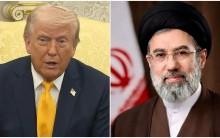
US Defence Secretary Pete Hegseth told senators that the war with Iran has cost an estimated $37.5 billion, as the Trump administration sought nearly $88 billion in emergency funding amid renewed fighting in the Strait of Hormuz.
Hegseth disclosed the figure during a Senate Appropriations Committee hearing on President Donald Trump's supplemental funding request. The administration is seeking $87.6 billion, including around $67 billion for the military.
"The estimate we have as of today is $37.5 billion," Hegseth said in response to questions from Democratic Senator Richard Durbin.
He said the estimate includes costs already incurred as well as anticipated military pay, operations and maintenance expenses through September 30.
The request includes $21 billion for military readiness, covering troop pay, equipment replacement, forward-deployed forces, fuel and National Guard support. Another $46 billion would be used to expand munitions production and accelerate investments in hypersonic weapons, counter-drone systems, satellites and other defence capabilities.
Hegseth warned that military training exercises could be curtailed if Congress failed to approve the additional funding. He argued that the US military was grappling with years of deferred maintenance and depleted weapons stockpiles.
"Without these funds, we face critical shortfalls that threaten our ability to also simply pay our service members, rapidly replenish equipment and munitions, and sustain vital operations without disruption," he said.
Democrats questioned why the Pentagon required additional funding when it still had roughly $75 billion in unobligated funds from an earlier spending package.
Senator Patty Murray criticised the proposal, noting that it includes nearly $1 billion for US Southern Command, about $1 billion for continued National Guard deployments in Washington and more than $1 billion for operations along the southern border.
"The American people want to see a quick and strategic end to this war, not $70 billion of their tax dollars sent to keep it going," Murray said.
The hearing also exposed divisions over the administration's legal authority to continue military operations. Republican Senator Lisa Murkowski noted that the War Powers Resolution generally requires a president to end hostilities within 60 days unless Congress grants authorisation.
Hegseth maintained that the administration believes President Trump has the necessary constitutional authority to continue military operations.
"We certainly, as a department, share the position of the White House that we have all the authorities necessary at this moment," he said.
General Dan Caine, Chairman of the Joint Chiefs of Staff, declined to comment on whether the United States could deploy ground forces, saying military planners routinely prepare multiple operational options and assess their risks.
Meanwhile, US President Donald Trump issued a fresh warning to Iran, threatening to target civilian infrastructure if Iranian forces continue attacking ships in the Strait of Hormuz.
In a post on social media, Trump said that every future Iranian attack on a vessel in the strategic waterway would be met with strikes on key infrastructure.
"From this point forward, any time the Islamic Republic of Iran shoots at a ship in the Strait of Hormuz, whether it be by Missile, Rocket, Drone, or any other device or weapon, the United States will bomb and destroy ONE BRIDGE OR POWER PLANT," Trump wrote.
The warning comes as fighting between the US and Iran has intensified, with strikes escalating on both sides and an interim agreement aimed at ending the conflict collapsing.