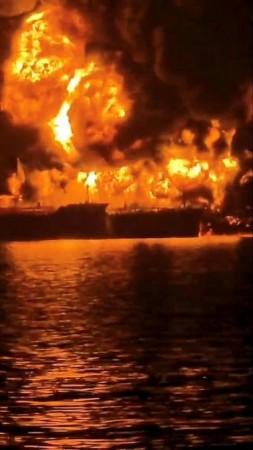
The US-Israeli conflict with Iran entered its 13th day on Thursday, with attacks on vessels in the Strait of Hormuz raising fresh concerns over global oil supplies. The waterway carries around a fifth of the world's oil. Iranian explosive-laden boats allegedly attacked two fuel tankers in Iraqi waters on Wednesday, setting them ablaze and killing one crew member, after projectiles struck three vessels in Gulf waters, according to port authorities, maritime security, and risk firms cited by Reuters.
Amid the disruption, the Trump administration plans to release 172 million barrels from the US emergency oil reserve as part of a coordinated effort by countries around the world to ease surging crude and fuel prices, less than two weeks after the start of the Iran war.
"We'll do that — and then we'll fit it up," Trump said Wednesday in an interview with local television station WKRC during a visit to the Cincinnati area. "I filled it up once, and I'll fill it up again. Right now we'll reduce it a little bit, and that brings the prices down."
The release, announced by Energy Secretary Chris Wright on Wednesday evening, will take about 120 days to fully deliver the oil from the Energy Department's Strategic Petroleum Reserve. It forms part of a broader plan by member nations of the International Energy Agency to release a total of 400 million barrels from global reserves.
"This is to tide the world over while these flows are restricted by Iran, but ultimately the United States military will prevail," Wright said on Fox News. "Hopefully in the next few weeks we will start to see ship traffic returning to the Strait of Hormuz."
this is 2 oil tankers on fire off Iraq https://t.co/aJHjB42qAR pic.twitter.com/PBOS1a7tuf
— Ali (@MerruX) March 11, 2026
Iran warned it could wage a prolonged war with the United States and Israel that would "destroy" the world economy, even as US President Donald Trump said late Wednesday that the Islamic republic was facing imminent defeat.
Tehran's warning came as fighting around the strategic Strait of Hormuz — a waterway that carries about a fifth of the world's oil — sent shockwaves through energy markets, triggering emergency releases from global reserves and a limited drawdown of US stockpiles.

Israel's strikes on Beirut
Israeli strikes pounded Beirut's southern suburbs late on Wednesday, lighting up the skyline with red flashes and setting several buildings ablaze, after the Lebanese armed group Hezbollah fired a volley of rockets into northern Israel.
Saudi Arabia intercepts drone heading to Shaybah oilfield, Reuters reported.
An airstrike destroyed a headquarters of the Iran-backed Popular Mobilisation Forces (PMF) in the western Iraqi city of Al-Qaim near the Syrian border, Iraqi sources said.
More than 20 people were killed or wounded in the strike, according to the sources.
A US-Israeli strike targeted an industrial area in Rabat Karim, about 27 km southwest of Tehran, Iran's Mehr news agency reported.
The city's deputy governor said an abandoned warehouse was among the sites hit in the attack.
Thailand condemned an attack on a Thai-flagged vessel in the Strait of Hormuz and summoned Iran's ambassador as rescue efforts continue for three crew members feared trapped on board.
The bulk carrier Mayuree Naree was struck by Iranian projectiles on Wednesday while transiting the strategic waterway without cargo. Of the 23 crew members, 20 were rescued by the Omani navy after abandoning the ship in a lifeboat.
The three missing sailors are believed to be trapped in the engine room at the stern, where the vessel was hit and a fire broke out, according to its owner, Precious Shipping Pcl.
Rockets fired from Iran towards Israel have been detected heading towards the Golan Heights, Haifa Bay and areas in northern Israel, Israel's Home Front Command has said, Al Jazeera reported.
Sirens were heard as the missiles were detected approaching.
Israeli media reported that they fell in open areas without causing injury.