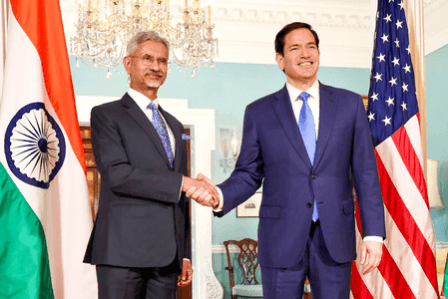
On May 26, 2026, S. Jaishankar and Marco Rubio signed the India–US Critical Minerals Framework in New Delhi, formally titled "Securing of Supply in the Mining and Processing of Critical Minerals and Rare Earths." Publicly, the agreement has been presented through the reassuring language of "resilient supply chains," "trusted partnerships," and "diversification away from single-source dependencies."
Yet beneath the polished diplomatic vocabulary lies a far deeper geopolitical and industrial struggle one that will shape the future balance of economic power, military capability, artificial intelligence dominance, semiconductor ecosystems, clean-energy transitions, and technological sovereignty across the twenty-first century. Rare earths and critical minerals are no longer merely mining commodities; they are rapidly becoming the strategic equivalent of oil in the industrial age and uranium in the nuclear era.
"Whoever controls rare earths controls the technologies of the future." - Deng Xiaoping
India's Hidden Strategic Wealth Beneath Its Soil
India today possesses approximately 6.9 million tonnes of rare earth reserves, making it the world's third-largest reserve holder according to USGS estimates. These reserves, particularly the monazite-rich beach sands spread across Odisha, Kerala, Tamil Nadu, and Andhra Pradesh, contain strategically vital elements such as neodymium, praseodymium, dysprosium, terbium, samarium, yttrium, and lanthanum. These minerals form the invisible foundation of modern strategic power. They are essential for permanent magnets used in electric vehicles and wind turbines, precision-guided munitions, advanced fighter aircraft, missile systems, drones, radars, quantum technologies, satellite systems, semiconductor manufacturing, robotics, and the rapidly expanding global AI infrastructure ecosystem.
Yet despite possessing one of the world's largest geological endowments, India currently contributes less than one percent of global rare earth production, while China dominates nearly 70 percent of mining output and over 85–90 percent of global refining and separation capacity.
"The industrial nation of the future will not merely be energy secure; it will be mineral secure." - Daniel Yergin
The Real Question: Ownership or Dependency?
The fundamental strategic issue, therefore, is not whether India should develop these reserves. It unquestionably must. The real question is whether India will evolve into a fully integrated industrial and technological power controlling mining, refining, metallurgical processing, magnet manufacturing, advanced materials engineering, and downstream strategic industries, or whether it will once again remain trapped at the lowest end of the value chain as a supplier of raw strategic materials to technologically superior economies. History repeatedly demonstrates that nations exporting raw resources without mastering downstream industrial ecosystems rarely achieve durable strategic autonomy.
Africa's cobalt exports, Latin America's lithium extraction models, and decades of hydrocarbon dependence across parts of West Asia reveal a common pattern: resource ownership alone does not create national power unless accompanied by technological depth, industrial processing, manufacturing capability, intellectual property creation, and sovereign control over strategic supply chains.
"There are no rich countries. There are only countries that control high-value industries." - Ha-Joon Chang
The Structural Asymmetry Behind "Partnership"
The India–US framework formally speaks of collaboration across exploration, mining, recycling, technology development, financing, and supply-chain resilience. However, the structural asymmetry within the relationship is difficult to ignore. India brings the actual strategic reserves, geographic access, long-term resource security potential, and a massive future domestic demand market driven by EV expansion, renewable energy, semiconductor ambitions, defense modernization, and AI infrastructure growth. The United States brings capital, strategic alignment, financing networks, selective technological expertise, and access to Western industrial ecosystems. Yet even America itself remains substantially dependent on external refining and processing ecosystems.
The Mountain Pass Mine, America's principal rare earth mining asset, historically relied heavily on Chinese processing infrastructure for refining and separation stages. China today possesses decades of accumulated metallurgical expertise, integrated industrial ecosystems, massive economies of scale, workforce specialization, and cost competitiveness that neither the United States nor Europe has yet fully replicated.
"Supply chains are never merely economic systems; they are instruments of geopolitical leverage." - Henry Kissinger
The Danger of Becoming a Mere Resource Supplier
This creates a serious and legitimate strategic concern for India. There exists a real possibility that India could eventually mine and export increasing volumes of rare earth concentrates while the higher-value industrial layers refining, advanced alloys, permanent magnet manufacturing, electronics integration, and precision engineering — remain concentrated outside the country. In such a scenario, India would assume the environmental, social, land-acquisition, and extraction burdens while the highest-value strategic industrial gains would accrue elsewhere. Such an outcome would replicate historical patterns of asymmetrical economic dependency under a new technological vocabulary. Diplomatic language emphasizing "partnership" and "cooperation" often obscures these structural realities.
"Economic dependence eventually produces strategic dependence." - Zbigniew Brzezinski
India's Coastal Corridors: The Sleeping Strategic Giant
India's rare earth geography itself represents one of the most underappreciated strategic assets in the world today. The coastal monazite-bearing sands of Chhatrapur in Odisha, Chavara and Aluva in Kerala, Manavalakurichi in Tamil Nadu, and Visakhapatnam–Srikakulam belts in Andhra Pradesh collectively constitute enormous long-term strategic potential. In addition, hard-rock deposits in Balotra in Rajasthan and Ambadungar in Gujarat further diversify India's mineral profile. India also possesses substantial reserves of ilmenite, rutile, zirconium, garnet, and thorium-bearing monazite. The thorium dimension is particularly significant because India holds one of the world's largest thorium reserves, potentially critical for future advanced nuclear-energy systems. Recognizing this strategic reality, the Government has now designated these regions under the 2026 Rare Earth Corridors initiative.
"Geography remains the most permanent factor in national power." - Nicholas Spykman
India's Greatest Weakness: Processing, Not Reserves
However, India's principal weakness does not lie beneath the ground. It lies above the ground in the limited scale of its processing, refining, metallurgical, and downstream manufacturing capabilities. At present, India's rare earth ecosystem remains narrow, fragmented, and underdeveloped. IREL (India) Limited continues to serve as the primary institutional anchor for rare earth operations through facilities such as OSCOM in Odisha, which produces mixed rare earth chlorides; Aluva in Kerala, which undertakes refining into separated compounds; and Manavalakurichi in Tamil Nadu, which focuses on monazite separation. Yet India's total refining capability remains only around 5,000 tonnes per annum TREO, a minuscule figure compared to China's processing ecosystem exceeding 200,000 tonnes annually. China additionally controls nearly 90 percent of global permanent magnet manufacturing capacity, while Japan dominates several advanced magnetic-material technologies and South Korea leads critical battery integration ecosystems. Consequently, India continues to import nearly 80–90 percent of its rare earth permanent magnets and several advanced processed materials, primarily from China itself.
"Control over processing matters more than control over extraction." - Dr Dilawar Singh
Rare Earths: The Invisible Backbone of Modern Warfare
The strategic importance of rare earths extends far beyond industrial economics into the core architecture of modern warfare. A single Lockheed Martin F-35 Lightning II reportedly contains more than 400 kilograms of rare earth materials embedded across radar systems, electronic warfare modules, sensors, guidance mechanisms, actuators, avionics, and stealth technologies. Advanced naval systems, hypersonic weapons, satellites, missile-defense systems, drones, AI-enabled battlefield networks, and quantum sensing platforms are all critically dependent upon rare earth ecosystems. India's ambitions under Atmanirbhar Bharat, semiconductor manufacturing initiatives, EV ecosystems, and AI-driven digital infrastructure cannot realistically achieve strategic autonomy without sovereign control over these supply chains. In the coming decades, nations unable to secure critical minerals and downstream technological ecosystems may discover that their military ambitions remain externally dependent regardless of their geopolitical aspirations.
"The next wars may not be fought over oil, but over the minerals powering intelligent systems." - Eric Schmidt
China's Long Game and India's Strategic Dilemma
China's dominance in this sector did not emerge accidentally. Beginning in the 1980s and 1990s, Beijing systematically subsidized mining, processing, separation technologies, metallurgical research, magnet manufacturing, and industrial scaling. It accepted environmental costs in exchange for long-term strategic industrial dominance. Over decades, China built integrated ecosystems that linked extraction directly with downstream manufacturing and export competitiveness. Today, China's rare earth supremacy provides it not merely economic advantage but geopolitical leverage. Beijing has previously demonstrated willingness to impose export controls and strategic restrictions during periods of geopolitical tension, including disputes involving Japan and broader Western defense industries. Given continuing India–China border tensions and long-term strategic rivalry, excessive Indian dependence on Chinese supply chains undoubtedly creates significant vulnerabilities. Yet paradoxically, China still possesses processing depth and industrial sophistication in several segments superior even to the United States. This creates a difficult balancing challenge for India: avoid strategic overdependence on China without simultaneously becoming structurally subordinate to Western extraction-oriented industrial models.
"Strategic autonomy is not neutrality; it is the ability to make sovereign choices." - Shivshankar Menon
America First and the Reality of Transactional Partnerships
The American dimension of the partnership must therefore also be examined with realism rather than sentiment. Washington increasingly views India as both a geopolitical counterweight to China and a strategic node in future supply-chain diversification efforts. However, contemporary American policy is equally shaped by aggressive industrial nationalism. Recent years have witnessed extensive tariff weaponization, technology restrictions, semiconductor export controls, domestic subsidy regimes under the Inflation Reduction Act, and "friend-shoring" policies fundamentally designed to strengthen American industrial resilience first and foremost. Even close US allies across Europe and East Asia have expressed concerns regarding America-centric subsidy structures and supply-chain policies. India must therefore negotiate from a position of strategic clarity rather than diplomatic enthusiasm. Nations ultimately pursue permanent interests, not permanent friendships.
"Nations do not have permanent friends or enemies; they have permanent interests." - Lord Palmerston
India's Correct Strategic Path Forward
India's correct strategic path lies neither in isolationism nor in dependency. The country must pursue a calibrated model combining aggressive domestic refining expansion, indigenous magnet manufacturing, strategic technology acquisition, selective international partnerships, industrial subsidies, university-led metallurgical research ecosystems, AI-assisted mineral exploration, advanced workforce development, and sovereign downstream manufacturing capacity. The Government's recent initiatives including the 2026 Rare Earth Corridors and the ₹7,280 crore permanent magnet manufacturing scheme targeting 6,000 tonnes per annum of sintered rare earth magnets represent important beginnings. Expansions planned through IREL (India) Limited, combined with research contributions from Bhabha Atomic Research Centre and Defence Metallurgical Research Laboratory, could gradually strengthen India's industrial foundation. Yet the scale of global competition demands a far more ambitious national mission.
"Industrial capability is the foundation upon which strategic sovereignty rests." - Lee Kuan Yew
The Non-Negotiable Conditions India Must Enforce
Every future critical minerals agreement entered into by India must therefore include uncompromising safeguards. Processing facilities must be built within India. Technology transfer must involve genuine transfer of process knowledge rather than superficial assembly operations. Strategic assets must remain under majority Indian ownership and control. Local content mandates should ensure downstream manufacturing ecosystems emerge domestically rather than abroad. India must create strategic stockpiles for defense and semiconductor sectors while simultaneously protecting coastal ecosystems and local communities from irresponsible extraction practices. Above all, India must recognize that critical minerals policy is not merely an economic issue but a national-security doctrine for the technological age.
"A country that exports raw materials and imports finished technology mortgages its future." - A. P. J. Abdul Kalam
The Defining Test of India's Industrial Century
India now stands at one of the defining industrial crossroads of the century. The coming decade will witness an unprecedented global struggle for control over rare earths, lithium, cobalt, graphite, nickel, gallium, and semiconductor minerals. The countries that dominate these value chains will shape the future hierarchy of military power, AI leadership, advanced manufacturing, clean-energy systems, space technologies, and geopolitical influence. India possesses the geological foundation necessary to emerge as one of those powers. But mineral wealth alone does not create greatness. Nations become truly powerful only when they convert natural resources into organized national capability through industrial depth, technological mastery, institutional competence, strategic vision, and sovereign control over value chains. The ultimate success or failure of the India-US Critical Minerals Pact will therefore not be determined by ceremonial statements or diplomatic optics in New Delhi. It will be determined by whether India develops sovereign industrial strength or quietly becomes another raw-material appendage within someone else's strategic architecture.
"The future belongs to nations that can convert resources into organized national power." - Samuel P. Huntington.
[Major General Dr. Dilawar Singh, IAV, is a distinguished strategist having held senior positions in technology, defence, and corporate governance. He serves on global boards and advises on leadership, emerging technologies, and strategic affairs, with a focus on aligning India's interests in the evolving global technological order.]