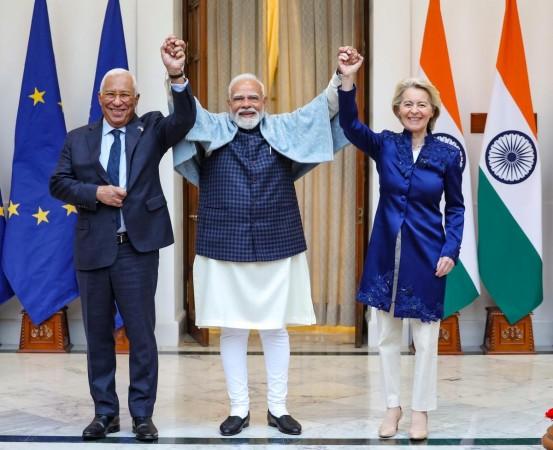
India and the European Union (EU) on Tuesday announced the conclusion and finalisation of negotiations for the proposed Free Trade Agreement (FTA), marking India's 19th trade deal. The agreement is expected to significantly boost Indian exports to the 27-nation bloc and strengthen economic and strategic relations between the two sides.
On the sidelines of the 16th India-EU Summit, PM Modi held delegation-level discussions with European Commission President Ursula von der Leyen and European Council President António Costa. Commerce Secretary Rajesh Agrawal had earlier confirmed that the FTA negotiations had been successfully concluded, with the formal announcement scheduled for January 27.
Hailing the trade pact, Prime Minister Narendra Modi said the agreement will "drive trade, investment and innovation while strengthening our strategic relationship. It reflects our shared resolve to shape a stable, prosperous, and future-ready economic relationship," he said in a post on X. Earlier today, he described the deal as a "perfect example of partnership between two major economies" on the global stage.
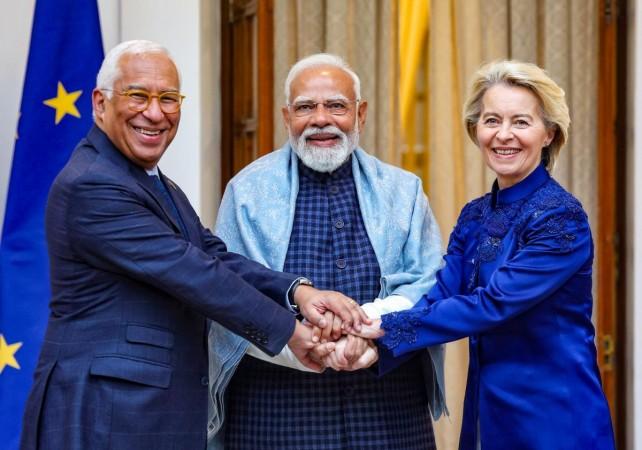
EU Leaders celebrate
European Commission President Ursula von der Leyen called the pact the "mother of all deals," stating, "We have created a free trade zone of two billion people, with both sides set to benefit. This is only the beginning. We will grow our strategic relationship to be even stronger."
The deal comes at a time when both India and Europe face high tariffs imposed by the US. US Treasury Secretary Scott Bessent had recently criticised India's trade with Europe and Russia, calling it "a costly financing of a war against themselves."
What did PM Modi highlight about the economic benefits?
After confirming the agreement, PM Modi said the FTA would provide a major boost to India's manufacturing and services sectors. "This deal represents 25 per cent of global GDP and one-third of global trade," he noted, underlining the significance of the agreement for both economies.
Earlier, on Republic Day, von der Leyen had shared a clip from the Delhi parade, noting: "A successful India makes the world more stable, prosperous, and secure. And we all benefit."
How does it benefit the Indian market?
The India-EU FTA will provide preferential access to 97 per cent of tariff lines for Indian goods in the EU, covering 99.5 per cent of trade value. EU industrial exports to India will also benefit, with tariffs on nearly 97 per cent of goods being reduced or eliminated, saving the EU approximately €4 billion annually.
Key Indian exports expected to benefit include textiles, jewellery, spices, leather, garments, steel, pharmaceuticals, petroleum products, and electrical machinery. Similarly, Indian services such as telecommunications, business services, and transport are expected to see significant growth.
Major EU Industrial Goods Tariff Cuts:
Machinery & electrical equipment: Up to 44% → 0%
Aircraft & spacecraft: Up to 11% → 0%
Optical, medical, surgical equipment: Up to 27.5% → 0% for 90% of products
Motor vehicles: 110% → 10% (quota of 250k)
Pharmaceuticals: 11% → 0%
Major EU agricultural goods Tariff Cuts:
Wine: 150% → 20% (premium range), 30% (medium range)
Spirits: Up to 150% → 40%
Beer: 110% → 50%
Olive oil & vegetable oils: Up to 45% → 0%
Fruit juices & processed foods: Up to 55% → 0%
Import duty on cars cut to 10% from 110%, with riders
For the unversed, India, at present, imposesan import duty of 70-110% on cars
India and the European Union (EU) have signed a free trade agreement that will gradually reduce the import duty on cars to 10% with an annual quota of 2.5 lakh vehicles.
The likes of Volkswagen, Renault, and BMW hold less than 3% share of India's car market, according to industry data. The South Asian country's car market is dominated by Maruti Suzuki India Ltd. and homegrown brands Mahindra and Mahindra Ltd. and Tata Motors PV Ltd., which together hold two-thirds.
India has the world's third-largest car industry after the US and China, but its 4.4 million cars/year market has been one of the most protected, with current levies of 70% and 110% on imported cars.
Trump aide reacts to trade deal
India and the EU finalised the trade deal despite negotiations on trade between India and the US still underway. US treasury secretary Scott Bessent fumed over the development in a news interview on Sunday. He said that European countries are financing a war against themselves by purchasing refined Russian oil products from India.
How will it help global significance?
The FTA will reduce tariffs and administrative burdens, making trade between India and the EU faster, easier, and cheaper. The agreement comes at a time of rising geopolitical tensions and global economic challenges, offering Indian exporters a chance to diversify shipments and reduce dependence on China.
Investment and FDI ties
The EU is also a major investor in India. Cumulative FDI inflows from the EU stood at USD 117.4 billion between April 2000 and September 2024. Around 6,000 EU firms operate in India, mainly from the Netherlands, Germany, and France.
A deal nearly two decades in the making
Negotiations began in 2007 but stalled in 2013 due to disagreements over automobiles, wines, data rules, and public procurement. Talks were relaunched in 2022, finally leading to the agreement.
When will it get implemented?
While the FTA has been signed, it will take effect next year. According to Commerce Secretary Agrawal, the text of the agreement will undergo legal scrubbing for five to six months before formal signing and ratification.