
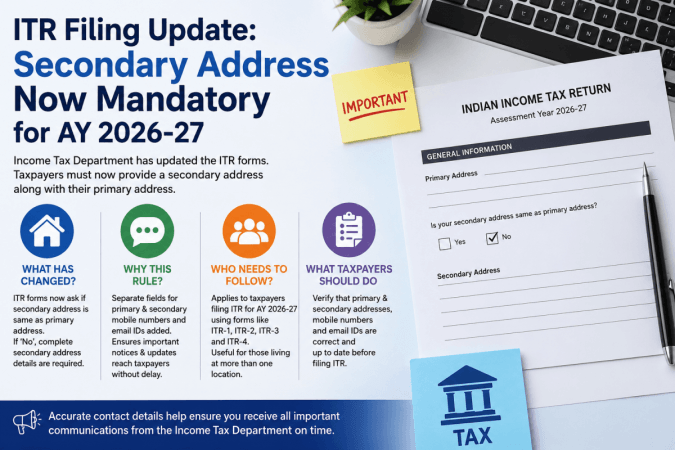
Taxpayers filing their Income Tax Returns (ITRs) for Assessment Year (AY) 2026-27 will now be required to provide a secondary address along with their primary address. The Income Tax Department has introduced this requirement in the revised ITR forms to improve communication and ensure taxpayers' contact details remain updated.
What Has Changed?
The revised ITR forms now ask taxpayers whether their secondary address is the same as their primary address.
- If the answer is "Yes," no additional information is required.
- If the answer is "No," taxpayers must provide complete details of their secondary address.
This new field has been added to the General Informationsection of the ITR forms.
Why Has This Rule Been Introduced?
Along with the secondary address requirement, the Income Tax Department has also introduced separate fields for primary and secondary mobile numbers and email IDs.
The objective is to improve communication with taxpayers. If the department is unable to reach a taxpayer through the primary address or contact details, it can use the alternate address, phone number or email ID to send important notices, updates and other official communications.
Who Needs to Follow This Rule?
The new requirement applies to taxpayers filing returns for AY 2026-27 using the revised ITR forms.
It covers commonly used forms, including ITR-1, ITR-2, ITR-3 and ITR-4, which are filed by individuals based on their income and sources of earnings.
The rule is particularly useful for people who live at more than one location, such as those staying in rented accommodation while maintaining a permanent residence elsewhere.

What Taxpayers Should Do
Before filing their ITR, taxpayers should ensure that their primary and secondary addresses, mobile numbers and email IDs are accurate and up to date.
Keeping these details current will help ensure that any notices or communications from the Income Tax Department are received on time, reducing the risk of missing important updates.