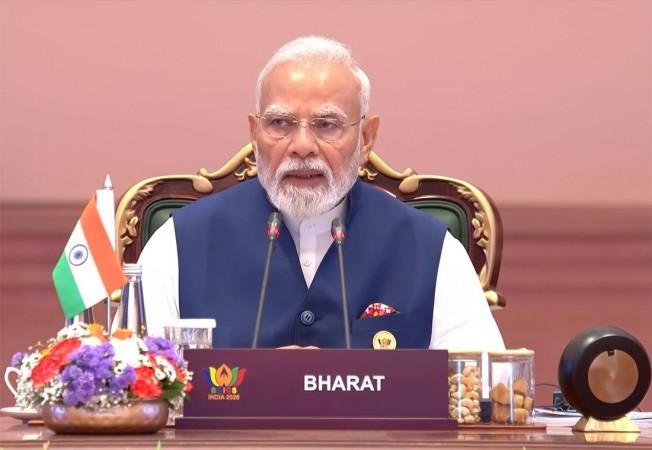
The most revealing economic story surrounding India today is unfolding not in a factory inauguration or a trade agreement, but in the uncomfortable arithmetic of dependence. At the September 12–13 BRICS Summit in New Delhi, Prime Minister Narendra Modi and Chinese President Xi Jinping agreed to deepen economic engagement even as India continues to confront a profound structural trade imbalance. Bilateral trade reached a record $155.6 billion in 2025, but India's imports from China were about $132 billion, leaving India heavily dependent on Chinese machinery, electronics, components and industrial inputs. At precisely the same time, Beijing is demonstrating the extraordinary power that comes from controlling industrial ecosystems: China remains dominant in critical minerals and rare-earth processing, while its manufacturing export machine continues to expand globally. The United States itself is being forced to factor China's rare-earth dominance into its strategic calculations. The message for India is not that China is an adversary from whom everything must be decoupled. It is more consequential than that. A country becomes strategically powerful when other countries need its capabilities. India must now build capabilities that the world needs.
This is where Arun Maira's argument, "India must build industry, not just trade", acquires renewed relevance. Maira's historical diagnosis is uncomfortable but important. India liberalised trade in 1991 and subsequently integrated rapidly into the global economy, while China pursued a very different trajectory, combining openness with an extraordinarily deliberate accumulation of industrial capabilities. India's success in services became a major national asset, but it did not automatically generate the deep ecosystem of machinery, components, industrial R&D, production technology and manufacturing enterprises that China accumulated. Maira's latest intervention, published on September 17, makes the point through the Tata experience: "What India needs now are Indian industry builders, who build India, by building for India, and building in India." He also reminds us of something industrial economies understand instinctively: manufacturing technology is not simply contained in the product. It is embedded in the machines, dies, tools, processes and industrial R&D that make the product possible.
The contemporary evidence is stark. In July, the Indian government identified approximately $51 billion of critical imports for priority domestic manufacturing action, within a much larger pool of about $398 billion of imports that an internal assessment judged potentially replaceable by domestic production. The priority list spans textiles, footwear, electric vehicles, solar equipment and other industrial sectors. This is not merely an import-substitution exercise. Done properly, it should become a capability-substitution strategy: not simply replacing a Chinese component with an Indian component, but building the Indian engineering, materials, tooling, design, skills, finance and intellectual property that make the component globally competitive.
That distinction matters because India's manufacturing story can otherwise become misleading. India can assemble more smartphones, solar modules, vehicles or electronics while remaining dependent on imported components, machinery and specialised knowledge. Carnegie India notes that approximately 56 percent of India's electronic-component imports came from China and Hong Kong in the first half of FY2025, while China supplied about 93 percent of India's rare-earth magnets in FY2024-25. These are not ordinary consumer imports. They are the industrial nervous system. A factory that depends on another country for its critical machines, components, materials and technological know-how is a manufacturing facility, but it is not yet a complete industrial capability.
This is precisely where Arvind Subramanian's "China Squeeze" thesis adds a vital dimension. Subramanian and Shoumitro Chatterjee argue that China's enormous manufacturing export strength is compressing the industrialisation space available to lower- and middle-income countries. Their most striking formulation is that the cost is measured not merely in factories that close, but in "factories never built, export markets never entered, capabilities never accumulated, and development paths never opened." For India, however, the lesson should not be to blame China for India's unfinished industrialisation. The deeper lesson is that the world has become more competitive and the window for conventional industrialisation has narrowed. India must therefore become substantially better at building capabilities than countries had to be in the past.
Dani Rodrik takes the argument further and challenges a comforting assumption: that India can simply reproduce the East Asian manufacturing journey. In May, he argued that the old manufacturing-led development model has become harder because automation and technological change have altered the relationship between factory employment and industrial productivity. In his recent formulation, "manufacturing is no longer an employment-creating sector" in the way it once was. This is not an argument for abandoning manufacturing. It is an argument for redefining it. India cannot afford to pursue yesterday's manufacturing model when today's frontier lies in robotics, AI, advanced materials, semiconductor technology, digital engineering, precision manufacturing and highly skilled services embedded inside physical products.
Raghuram Rajan provides the complementary warning. He argues that India should not mistake factory employment for value creation. Explaining the "smile curve", he points to the enormous difference between designing, financing, marketing and owning a product and merely assembling it. His example is revealing: Foxconn occupies a relatively low-value manufacturing position in the iPhone chain, while Apple captures extraordinary value through design, intellectual property, software, finance, branding and ecosystem ownership. Rajan's prescription is therefore not "manufacturing or services", but services embedded in manufacturing and high-value capabilities around manufacturing. As he puts it, "You want to pick up the end points, the design, the advertising, the marketing, the finance, essentially the services that are embedded in manufacturing."
This is where the apparent disagreement among Maira, Subramanian, Rodrik and Rajan becomes intellectually productive rather than contradictory. Maira tells India to build industrial capability. Subramanian warns that China's scale is compressing the traditional industrialisation pathway. Rodrik warns that manufacturing can no longer be treated as an automatic employment escalator. Rajan reminds us that the greatest value increasingly lies around manufacturing rather than simply inside the factory. Taken together, their arguments point towards a new Indian model: capability-led development rather than manufacturing-led development alone.
India therefore needs to stop asking the narrow question, "How much of what we consume can we manufacture?" The more strategic question is, "Which capabilities must India own if it wants to remain economically secure, technologically competitive and globally relevant?" The answer will include semiconductor fabrication and equipment, advanced materials, machine tools, industrial robotics, batteries, critical minerals processing, defence technologies, biotechnology, pharmaceuticals, AI infrastructure, energy systems, aerospace, telecommunications, financial technology and the digital platforms that connect them. It will also include less glamorous capabilities that determine industrial sovereignty: testing laboratories, standards, industrial software, maintenance ecosystems, precision tooling, technical education, supply-chain finance and applied research.
The semiconductor story shows that such a transformation is possible. At Semicon India 2026, the government reported investment proposals of approximately $11–12 billion under the second phase of the semiconductor programme, spanning equipment, materials, gases, chemicals and substrates. Tata Electronics' partnership with ASML is another indication that India's ambition is beginning to move beyond final assembly towards deeper participation in the semiconductor ecosystem. The objective, however, must be to ensure that today's imported expertise becomes tomorrow's Indian expertise, today's foreign partnership becomes tomorrow's Indian capability, and today's assembly plant becomes the nucleus of a broader domestic ecosystem.
This is also where Sanjeev Sanyal's emphasis on compounding becomes important. Industrial capability is not created by one budget, one PLI scheme or one spectacular investment announcement. It is accumulated through decades of infrastructure, skills, institutions, capital, entrepreneurship, research, managerial learning and repeated improvement. The Chinese experience demonstrates the power of persistence. India's advantage can be that it now has something China did not possess at the beginning of its industrial transformation: a huge digital public infrastructure, globally competitive IT and engineering talent, sophisticated capital markets, a large domestic market, an entrepreneurial private sector and the ability to combine physical industry with software and AI.
The future therefore demands a new definition of Atmanirbharta. Self-sufficiency is neither possible nor desirable in an interconnected world. India should continue importing what others produce more efficiently, attract foreign capital and technology, participate in global supply chains and sign trade agreements. But openness must serve capability creation. Foreign investment should be judged not merely by capital brought into India, but by technology transferred, Indian suppliers developed, R&D established, skills created, intellectual property generated and exports enabled. Trade policy should not merely maximise imports and exports. It should strengthen the industrial capabilities that determine what India can design, produce and sell competitively tomorrow.
This is why India's new trade agreements should be viewed not merely as market-access instruments but as capability-building platforms. The India-New Zealand FTA, for example, is scheduled to enter into force on October 20 and includes a commitment by New Zealand to invest $20 billion in India over 15 years. The strategic opportunity is to ensure that such capital does not simply finance consumption or distribution, but creates productive ecosystems, technology partnerships, skills and export capacity.
The ultimate goal must therefore transcend the old binary of protection versus free trade, manufacturing versus services, domestic versus foreign capital, or India versus China. The real choice is between dependency and capability. India should be open to the world, but never passive before it. It should welcome global technology, but learn from it. It should attract multinational companies, but simultaneously create Indian suppliers, engineers, researchers and entrepreneurs capable of eventually competing with them. It should import components where economically rational, but deliberately build the capabilities whose absence could compromise India's economic or strategic freedom.
The world itself is moving in this direction. Geopolitics, AI, energy transition, critical minerals and supply-chain disruptions are forcing governments to reconsider the assumption that efficiency alone should determine economic architecture. The September 2026 BRICS summit placed AI, technology, finance and trade at the centre of the emerging Global South agenda, while the continuing US-China confrontation demonstrates how technology and industrial capability have become instruments of national power. India therefore has an unusual opportunity: it need not choose between globalisation and self-reliance. It can build a third model, globally integrated capability sovereignty.
By 2047, India's ambition should consequently be much larger than becoming the world's largest market, a faster-growing major economy or merely an alternative manufacturing base to China. India should aspire to become one of the world's great capability creators: designing technologies, building industries, owning intellectual property, developing globally competitive enterprises and exporting solutions to the world. Manufacturing, services, AI, R&D, finance, skills and entrepreneurship should no longer be treated as separate policy silos. They must become components of one national economic architecture in which each reinforces the other.
The decisive measure of India's economic rise will ultimately not be how much the country imports, exports, assembles or consumes. It will be how much of the world's future India helps create and how much of that value India owns. A nation becomes truly powerful not when it closes its borders, but when its capabilities become indispensable beyond them. India's journey from 2026 to 2047 should therefore be a journey from being a large market for other people's capabilities to becoming a global source of capabilities that others want, need and trust.
And that is the economic thesis India now needs:
"India must move from importing capability and exporting opportunity to creating capability, owning technology, and exporting value to the world."
"India must stop importing the future and start building it, owning it and exporting it to the world."
"India's next economic leap must be from importing capability to creating it, from consuming technology to owning it, and from exporting opportunity to exporting value to the world."
"The objective of Atmanirbharta should not be self-sufficiency. It should be capability sovereignty: the ability to design, develop, manufacture and continuously improve what the world needs, and compete globally on its own technological and industrial strength."
"By 2047, India should not aspire merely to be the world's largest market, fastest-growing major economy or an alternative manufacturing base. It should aspire to become one of the world's great capability creators: designing technologies, building industries, owning intellectual property, developing global enterprises and exporting solutions to the world."
[Major General Dr. Dilawar Singh, IAV, is a distinguished strategist having held senior positions in technology, defence, and corporate governance. He serves on global boards and advises on leadership, emerging technologies, and strategic affairs, with a focus on aligning India's interests in the evolving global technological order.]