Every year around this time, homes across South India start filling up with the scent of turmeric, fresh mango leaves and jasmine as families prepare for Varalakshmi Vratam. But this year, there is an extra step before the rituals even begin — figuring out which Friday to actually observe.
Some Panchangs point to August 21, while others insist it is August 28. And unlike most festival date debates, which usually clear up once one authoritative source is checked, this one has genuinely split opinion among priests, temples and family elders alike.
Varalakshmi Vratam 2026 Date: So which Friday is it?
Varalakshmi Vratam is observed on a Friday during the Hindu month of Shravana, traditionally on the Friday preceding Shravana Purnima. The difficulty arises because different Panchang traditions can interpret the relevant tithi differently.
Since a tithi does not necessarily begin and end at midnight, it can span portions of two calendar days. This year, that has resulted in different calendar traditions arriving at two Fridays — August 21 and August 28.
Families following a particular temple, regional Panchang or long-standing family tradition may therefore observe the vrat on the date prescribed by that tradition.
What is Varalakshmi Vratam?
Varalakshmi Vratam is a Hindu festival dedicated to Goddess Lakshmi, the goddess of wealth, prosperity, abundance and auspiciousness. It is particularly popular in Karnataka, Andhra Pradesh, Telangana and Tamil Nadu, although devotees in other parts of India also observe the vrat.
Married women traditionally take the lead in performing the puja and pray for the wellbeing, prosperity and longevity of their families. However, the festival is also a family celebration, with members helping prepare the home, offerings and decorations.
The word 'Varalakshmi' refers to Lakshmi as the giver of boons. Devotees believe that worshipping her on this day brings blessings of prosperity, health, happiness and abundance.
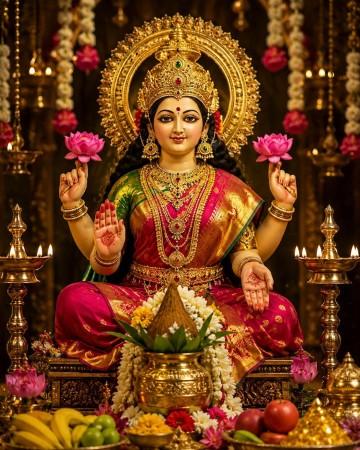
Varalakshmi Vratam story: The legend of Charumati
One of the most widely associated legends of Varalakshmi Vratam is the story of Charumati.
According to the traditional story, Charumati was a devoted and virtuous woman who lived with her husband and family. Pleased with her devotion and righteousness, Goddess Lakshmi appeared to her in a dream.
The goddess instructed Charumati to observe the Varalakshmi Vratam on a Friday during the month of Shravana. She told her that worshipping her with devotion would bring prosperity and wellbeing to her family.
Charumati followed the goddess's instructions and shared the message with other women in her community. On the prescribed Friday, the women gathered together and performed the puja with devotion.
As the ritual progressed, the women were said to receive divine blessings. The traditional story describes their homes becoming prosperous and their families being blessed with wellbeing and abundance.
The story is therefore closely connected with the tradition of women gathering together to observe the vrat and pray for the welfare of their families.
How is Varalakshmi Vratam celebrated?
The day usually begins early, with devotees taking a bath and cleaning the house before beginning the preparations. The puja area is decorated with flowers, mango leaves and rangoli.
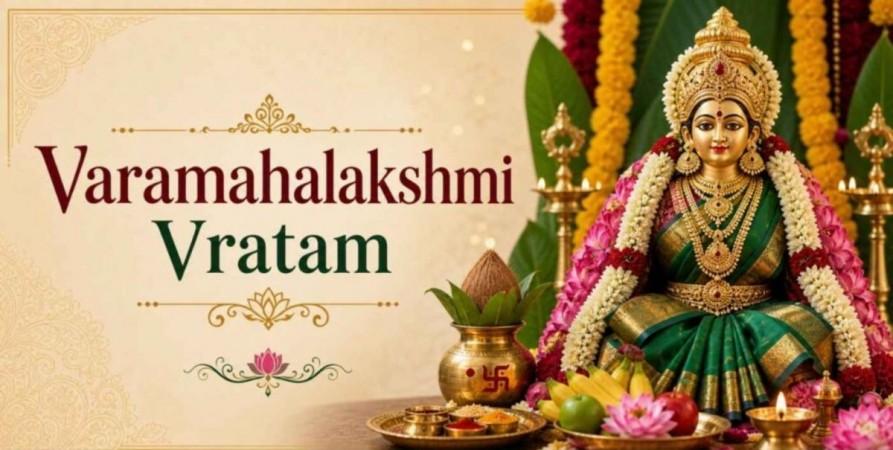
A wooden platform or chowki is generally prepared for the puja. A kalash is placed on it and filled with water or rice. Mango leaves are arranged around its mouth and a coconut is placed on top.
The kalash may then be decorated to represent Goddess Varalakshmi. Depending on family and regional traditions, women may dress it in a sari and adorn it with jewellery, flowers, turmeric, kumkum and other ornaments.
There is no single fixed template for decorating the goddess. Some households go all out with silk drapes, jewellery and elaborate floral decorations, while others keep the arrangement simple with turmeric, kumkum, flowers and a few coins.
Once the sankalp is taken and the goddess is invoked, devotees offer turmeric, kumkum, flowers, fruits, betel leaves, betel nuts and other traditional offerings. Naivedyam is prepared and offered to the goddess, while mantras, stotras and the Varalakshmi Vratam katha are recited according to family tradition.
The puja concludes with aarti, after which prasadam is distributed among family members and guests.
Varalakshmi Vratam significance
Varalakshmi is worshipped as a form of Goddess Lakshmi, and the vrat is centred on prayers for prosperity, wellbeing and a happy household.
The observance also has a strong connection with the concept of Ashtalakshmi, the eight forms of Goddess Lakshmi. These forms represent different aspects of abundance and wellbeing, including wealth, food, courage, knowledge, progeny, victory and prosperity.
During Varalakshmi Puja, devotees may invoke these different aspects of Lakshmi through prayers, although the exact rituals and customs vary between regions and families.
Why is the festival especially important for women?
Varalakshmi Vratam has traditionally been observed by women, particularly married women, who pray for the health, happiness and prosperity of their families.
Women often prepare the entire puja, decorate the kalash or goddess, make the offerings and invite other women to participate. In many communities, turmeric and kumkum are exchanged and prasadam is shared.
The festival therefore becomes more than an individual religious observance. It brings women, families and communities together and allows traditions to be passed from one generation to another.
Varalakshmi Vratam 2026: Brahma Muhurta and puja timing
For devotees in Mumbai and Bengaluru, Brahma Muhurta falls in the pre-dawn hours. However, Brahma Muhurta is not necessarily the main time prescribed for performing the Varalakshmi Puja.
The actual puja muhurta is determined using the local Panchang, including sunrise, tithi and the relevant lagna. Since Mumbai and Bengaluru have different sunrise times, their exact auspicious windows can differ.
Those observing the vrat should therefore follow the local Panchang or the tradition followed by their family or temple when deciding the final puja time.