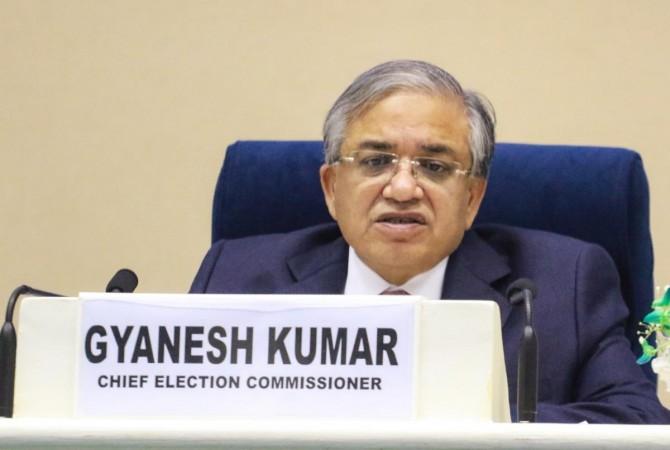
The sudden change in the media's treatment of Chief Election Commissioner Gyanesh Kumar demands careful scrutiny. Until recently, much of the same media that is now questioning him was defending his conduct and attacking those who raised concerns about the Election Commission. Following 'The Indian Express' investigation, the narrative has changed sharply.
That shift may reflect genuine concern. It may also represent a calculated attempt to contain a widening institutional crisis. The distinction is crucial. A campaign against one office-holder can either begin a process of meaningful reform or offer the public a single person to blame while preserving the larger arrangement.
The central question is not whether Gyanesh Kumar should be held accountable. If the allegations against him are established, he must face due process. The more important question is whether the campaign against him is intended to restore the independence and credibility of the Election Commission, or whether it is a carefully managed correction designed to protect a wider political and institutional project.
The constitutional standard is demanding. In its recent consideration of the law governing appointments to the Election Commission, the Supreme Court stressed that the body must not only be independent but must also appear to be independent. That principle is especially relevant when institutional decisions affect electoral rolls, voter data and the conditions under which citizens exercise their franchise.
What the Record Reveals
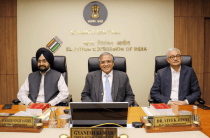
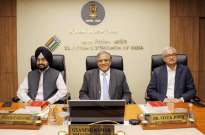
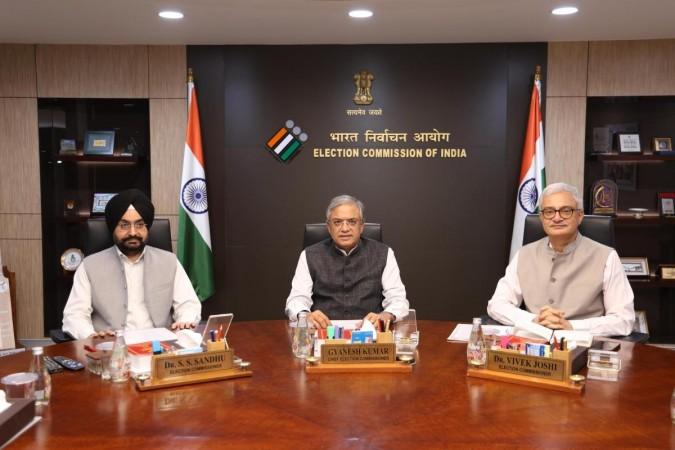
Gyanesh Kumar took charge as the 26th Chief Election Commissioner on February 19, 2025. His tenure has come under scrutiny after reports that Election Commissioners Sukhbir Singh Sandhu and Vivek Joshi recorded at least 14 objections over ten months concerning electoral-roll management, voter registration, deletion and restoration of names, Form 6 applications, appeals and access to the Commission's digital systems.
The reported objections also concerned ECINet, the Commission's centralised digital platform, and the alleged concentration of control over electoral data in New Delhi. Questions were raised about whether state-level Electoral Registration Officers had been denied proper access to the systems through which they perform their statutory functions, and whether decisions were issued in the Commission's name without the prior knowledge or approval of the two Election Commissioners.
The Commission has not denied the existence of the written notes. It has described them as part of normal deliberation and maintained that its decisions were ultimately unanimous. That response may explain the Commission's formal position, but it does not resolve the substantive questions: who initiated the disputed decisions, who authorised them, how were the objections addressed and whether the full Commission functioned collectively on matters affecting citizens' voting rights?
The Missing Centre: Seema Khanna
The most important aspect of the controversy is also the one receiving the least attention: the role of Seema Khanna, the Election Commission's Director General of Information Technology.
If Gyanesh Kumar is the visible political face of the dispute, Khanna appears to be a far more consequential operational actor because the controversy ultimately concerns control over electoral data, software permissions and the digital systems through which voter records are created, modified, deleted and restored.
Khanna joined the Commission in 2025 on deputation from the National Informatics Centre. As head of the IT department, she oversees the digital infrastructure supporting electoral services, including ECINet and systems connected with electoral-roll management. ECINet, launched on January 22, 2026, reportedly integrates more than 40 applications and portals serving nearly a billion voters.
This makes the DG (IT) more than a technical administrator. In a digitised electoral system, the officer controlling access, permissions, workflows, data fields, software updates and audit trails may exercise enormous practical influence, even without appearing to make the final policy decision.
The Supreme Court has underlined why this matters, observing that free and fair elections do not rest merely upon the mechanics of polling. They fundamentally depend upon "the integrity, accuracy and credibility of the electoral rolls, which form the foundation of the democratic process." The integrity of the digital systems controlling those rolls is therefore not a peripheral technical issue. It is part of the constitutional foundation of the election itself.
That is why the public focus on Gyanesh Kumar alone is inadequate. The CEC may be the institution's most visible authority, but the IT architecture is the mechanism through which decisions affecting voters are translated into action.
Access, authority and Form 6
The reported correspondence between Sandhu, Joshi and the IT division places Khanna at the centre of the institutional dispute. Sandhu reportedly questioned whether the DG (IT) had the legal authority to restrict the access and operational freedom available to Electoral Registration Officers and other statutory authorities.
This is the decisive issue. Electoral Registration Officers are not merely users of a government application. They exercise statutory responsibilities under election law. If access to the software required for performing those responsibilities can be restricted by an IT officer without the approval of the full Commission, the digital platform has effectively acquired authority over the legal process.
The reported changes to Form 6 make the issue even more serious. Form 6 is used by citizens seeking inclusion in the electoral roll and, in the context of SIR, by persons seeking restoration of names removed from the rolls.
According to the reported documents, the digital form was modified to ask applicants whether their own name, or the name of a parent or grandparent, appeared in an earlier electoral-roll revision. Although the relevant field was reportedly not formally designated as mandatory, applicants could not proceed without answering it. Sandhu described the change as unauthorised and illegal, while Joshi reportedly questioned whether a statutory form could be altered without a corresponding amendment to the Registration of Electors Rules, 1960.
The Supreme Court has also clarified that where Parliament or a State Legislature has enacted a valid election law, the Election Commission must act "in conformity with, and not in violation of, such provisions." A software modification cannot therefore become an independent source of electoral law. If a digital form imposes a condition that the statute does not impose, the legality of that modification must be demonstrated, not presumed.
This is not a minor interface dispute. A field that is optional in law can become compulsory in practice through software design. A technical modification can therefore create a new administrative requirement without any publicly approved legislative or Commission decision.
The investigation must establish:
- Who ordered the change to Form 6.
- Whether it was approved by the full Commission.
- Whether the legal division was consulted.
- Whether the DG (IT) had delegated authority to implement it.
- Who verified the alteration before it went live.
- How many applications were affected.
- Whether applications were rejected, delayed or abandoned because of the change.
- When the alteration was withdrawn and who authorised its withdrawal.
Until these questions are answered, the public cannot know whether the disputed process arose from a lawful policy decision, an administrative instruction, a technical intervention or a combination of all three.
The Commission Is Larger Than the CEC
The Election Commission is not Gyanesh Kumar alone. It includes the two other Election Commissioners, the DG (IT), Deputy Election Commissioners, senior administrative officers, technical personnel and the field-level machinery that implements decisions.
The Supreme Court has described the Election Commission as a high-powered and independent constitutional body intended to remain free from the pulls and pressures of political influence. That principle applies not only to the CEC but to the institution as a whole, including its Commissioners, senior officials and technical divisions.
If the institution has failed, responsibility cannot be confined automatically to the CEC. Nor can the other officials be exonerated merely because two Commissioners recorded objections.
Sandhu and Joshi's notes are important documentary evidence and should be examined seriously. They may show that they resisted decisions they considered unauthorised or improper. But they were also members of the Commission during the period under review. Their knowledge, participation and response must therefore be assessed on the evidence, not on the basis of a newly constructed public narrative.
The same scrutiny must apply to Senior Deputy Election Commissioner Maneesh Garg and other senior officials involved in translating policy into administrative and technical action. A petition filed before the Supreme Court has reportedly named Gyanesh Kumar, Garg, Khanna and other officials and sought action over alleged breaches of statutory duty. These remain allegations requiring judicial examination, not established findings. But they demonstrate that the controversy extends well beyond the CEC.
What is conspicuously absent is any serious discussion of a comprehensive institutional inquiry. There is no evident demand for a full review of the Commission's administrative chain, a forensic audit of its digital systems or an examination of all officials who may have enabled or implemented the disputed decisions.
That selective focus is itself significant.
The Politics of Selective Accountability
The emerging narrative is increasingly neat: Gyanesh Kumar is cast as the principal wrongdoer, while Sandhu and Joshi are presented as internal defenders of institutional propriety. Seema Khanna, despite her apparent importance to the digital architecture at the heart of the dispute, remains largely below the national radar. The other deputies and technical officials receive still less attention.
This may be accidental. It may also be the result of a carefully managed operation. Either way, it produces the same consequence: responsibility is narrowed before it is established.
Sandhu and Joshi's objections may represent genuine resistance. They may also now be serving as the basis for rehabilitating the Commission's credibility. By presenting them as institutional rescuers, the system can distance itself from Gyanesh Kumar without examining the entire administrative and technical structure.
The public must not be asked to choose between a villain and two heroes before the documentary record has been fully examined. The relevant test is not who receives favourable coverage. It is whether every decision-maker, implementer and beneficiary is examined by the same standard.
Data, SIR and the 2029 Stakes
The most consequential issue is control over electoral data. The voter database is not merely a record of citizens. It is the infrastructure through which electoral participation is recognised, verified, challenged and, in some circumstances, denied.
Control over the software that adds or deletes names, the permissions given to field officers and the audit trail of changes therefore carries immense institutional power. Every material alteration to ECINet and related systems should be traceable through an independent audit showing who authorised it, who implemented it, when it was made, which records were affected and whether it was later reversed.
The Supreme Court has upheld the Election Commission's authority to undertake the Special Intensive Revision, observing that SIR bears a direct nexus to the constitutional goal of free and fair elections and operates within the statutory framework governing electoral rolls. That recognition of the Commission's authority also reinforces the limits within which the exercise must be conducted. Constitutional power is not a licence for opaque procedures, undocumented software changes or unreviewable administrative action.
This controversy cannot be separated from the Special Intensive Revision of electoral rolls and the future delimitation of constituencies. SIR can determine who remains eligible to vote and whose name is removed. Delimitation can alter constituency boundaries and redistribute political representation among states and regions. The government has stated that delimitation will not be implemented before 2029, but its political significance is already evident.
The BJP's overriding objective is to win the 2029 general election. Critics therefore view SIR and delimitation as elements of a wider strategy to shape the electoral environment before that contest. Whether those allegations are ultimately proved or rejected, the institutional response must be the same: complete transparency, independent verification and equal scrutiny.
A politically neutral election authority must not merely be independent. It must also be demonstrably independent.
Removal Is Not Reform
The constitutional process for removing a Chief Election Commissioner is demanding. A CEC cannot be removed simply because political parties or citizens demand his resignation. Removal requires parliamentary action on grounds comparable to those applicable to the removal of a Supreme Court judge, namely proved misbehaviour or incapacity.
The Supreme Court has warned that "an Election Commission which does not ensure free and fair poll as per the rules of the game guarantees the breakdown of the foundation of the rule of law." That warning explains why removing one office-holder cannot be treated as a sufficient response. The issue is not only individual misconduct but whether the institutional rules, procedures and safeguards were respected.
A resignation, a removal motion or a leadership change can create the appearance of accountability. None is sufficient on its own.
Genuine reform would require:
- Publication of the relevant objections, replies and decision records.
- An independent audit of voter additions, deletions and restorations.
- A forensic examination of ECINet and ERONet.
- Disclosure of material software changes and access restrictions.
- Examination of the roles of the CEC, both Election Commissioners, the DG (IT), senior deputies and technical officials.
- Protection for field officers who acted within their statutory authority.
- A review of the appointment process and internal distribution of powers.
- Parliamentary and judicial oversight of future SIR and delimitation exercises.
The Commission's announcement of nine measures, including advance circulation of agendas, post-meeting minutes, review of new IT modules and examination of ECINet with possible independent technical participation, is a useful procedural response. However, reports indicate that important questions remain about the IT division, senior officials and the handling of electoral-roll concerns.
Procedural adjustments cannot substitute for an independent investigation into what has already occurred.
The Real Test
The central question is not whether Gyanesh Kumar has become expendable. It is whether the system that enabled, authorised or benefited from the disputed decisions will also be examined.
If the campaign against him is genuine, it must lead to a full institutional inquiry rather than end with his resignation. That inquiry must cover the CEC, the other Election Commissioners, the DG (IT), Deputy Election Commissioners, technical personnel, field-level implementation and the executive framework governing appointments.
If, however, the campaign is intended primarily to contain public anger, Gyanesh Kumar's removal may amount to managed correction rather than institutional accountability. He would become the convenient casualty of a crisis, while the digital architecture, officials, procedures and political objectives remain substantially undisturbed. Once the controversy subsides, he may even be suitably rewarded elsewhere.
The credibility of Indian democracy cannot be restored by changing one face at the top of the Election Commission or by elevating two members of the same institution into public heroes. It can be restored only when every consequential decision, every software modification, every deletion and addition of a voter, and every exercise of administrative authority is open to scrutiny.
Until then, the media campaign against Gyanesh Kumar should be approached with caution. It may represent a genuine demand for accountability. It may also be part of a carefully designed redistribution of blame: one visible figure offered as the casualty, two others recast as institutional rescuers, Seema Khanna and the wider technical machinery kept outside the full glare of scrutiny, and the larger political project left intact.
[Major General Dr. Dilawar Singh, IAV, is a distinguished strategist having held senior positions in technology, defence, and corporate governance. He serves on global boards and advises on leadership, emerging technologies, and strategic affairs, with a focus on aligning India's interests in the evolving global technological order.]